

A monthly food budget for 1 should cover groceries plus any restaurant meals, takeout and food-related fees. For one adult ages 20–50 living alone, USDA’s September 2026 Thrifty Food Plan works out to about $305 a month for females and $383 for males after the single-person adjustment. The corresponding Moderate-Cost amounts are about $404 and $478. Those figures cover food prepared at home; dining out needs its own allowance.
Use those amounts as a starting reference, then price the food you actually need. Your location, appetite, dietary requirements, kitchen access and time to cook can change the result. A national benchmark cannot tell you exactly what your local shopping basket will cost.


This guide separates official cost estimates from reported spending, shows a complete $450 example, and ends with a worksheet you can fill in or print. The example is a planning exercise, not a priced meal plan or a claim that $450 suits everyone.
USDA grocery costs for one person
The table uses September 2026 data, the latest monthly USDA report available as of November 5, 2026. We multiplied each published individual monthly amount by 1.20, following USDA’s suggested 20% adjustment for a one-person household, and rounded to the nearest dollar. The published amounts otherwise assume individuals in four-person households.
| USDA adult group | Thrifty | Low-Cost | Moderate-Cost | Liberal |
|---|---|---|---|---|
| Female 20–50 | $305 | $332 | $404 | $516 |
| Male 20–50 | $383 | $381 | $478 | $584 |
| Female 51–70 | $284 | $323 | $398 | $479 |
| Male 51–70 | $337 | $359 | $450 | $539 |
| Female 71 and older | $313 | $322 | $396 | $473 |
| Male 71 and older | $322 | $356 | $437 | $538 |
Monthly food-at-home estimates only. Sources: USDA Thrifty Food Plan September 2026 and USDA Low-Cost Moderate-Cost and Liberal plans September 2026. For the youngest adult rows, Thrifty covers ages 20–50; the other plans cover 19–50. The table shows their overlapping 20–50 range.
What these numbers include
All four plans assume meals and snacks are prepared at home. They are modeled food costs, not measured average grocery bills, local store quotes or minimum amounts every person can live on. Household supplies, pet food and restaurant meals should not be folded into this comparison.
The male Thrifty figure is slightly higher than Low-Cost here. The plans use different underlying food baskets and methods: Thrifty was reevaluated in 2021, while the other plans retain their 2007 framework. Their names do not guarantee a perfectly ascending price for every group.
Adjust the reference to your circumstances
Start with the age group that applies, then build a local shopping list. Allow for foods you can safely eat, suitable portions, and practical ways to prepare them. Do not reduce a medically necessary food allowance just to match the table.
These are national reference figures rather than city budgets. Alaska and Hawaii have separate USDA Thrifty estimates. If your stores, travel costs or limited kitchen equipment make the reference unrealistic, record the difference in your own plan instead of treating it as a budgeting failure.
Average monthly grocery spending is a different measure
In the BLS 2025 Consumer Expenditure Survey table for household size, one-person consumer units reported the following average annual spending. The monthly column divides the annual amount by 12 and rounds to the nearest dollar.
| 2025 spending category | Annual average | Monthly equivalent |
|---|---|---|
| Food at home | $3,385 | $282 |
| Food away from home | $2,308 | $192 |
| Total food | $5,693 | $474 |
These are means across one-person consumer units of different ages, incomes and circumstances. They describe spending in 2025, rather than the cost of buying a particular diet in September 2026. BLS reports alcoholic beverages separately from food.
A person who eats some meals out may spend less on groceries while spending more on food overall. That is why the $282 grocery average and USDA’s all-at-home estimates answer different questions. Neither is a universal spending limit.
Set a food budget that fits your actual month
Review a full month of receipts or transactions. Separate food from detergent, toiletries and other nonfood items on supermarket receipts. Count grocery delivery charges with groceries and restaurant delivery charges with dining out; include relevant taxes and tips. Use the same categories each month. If you prefer digital tracking, compare free budgeting apps for logging grocery and dining expenses.
Groceries are a necessary variable expense: the amount changes even when you set a firm target. Compare your food plan with take-home pay using our gross vs net income guide, then allow for fixed expenses such as rent and your other commitments. A fixed percentage of income alone will not establish whether you can buy enough food. Use the fillable monthly budget worksheet to see how your food target fits alongside rent, bills, and savings.
Is a 200 dollar monthly grocery budget enough
For adults in the table, $200 is below every adjusted USDA estimate shown. Some people may spend that amount because they have pantry stock, receive meals elsewhere or have food assistance. That does not establish that $200 will buy a sufficient month of groceries for you. Price your actual needs before adopting a tight target.
A worked monthly food budget for one
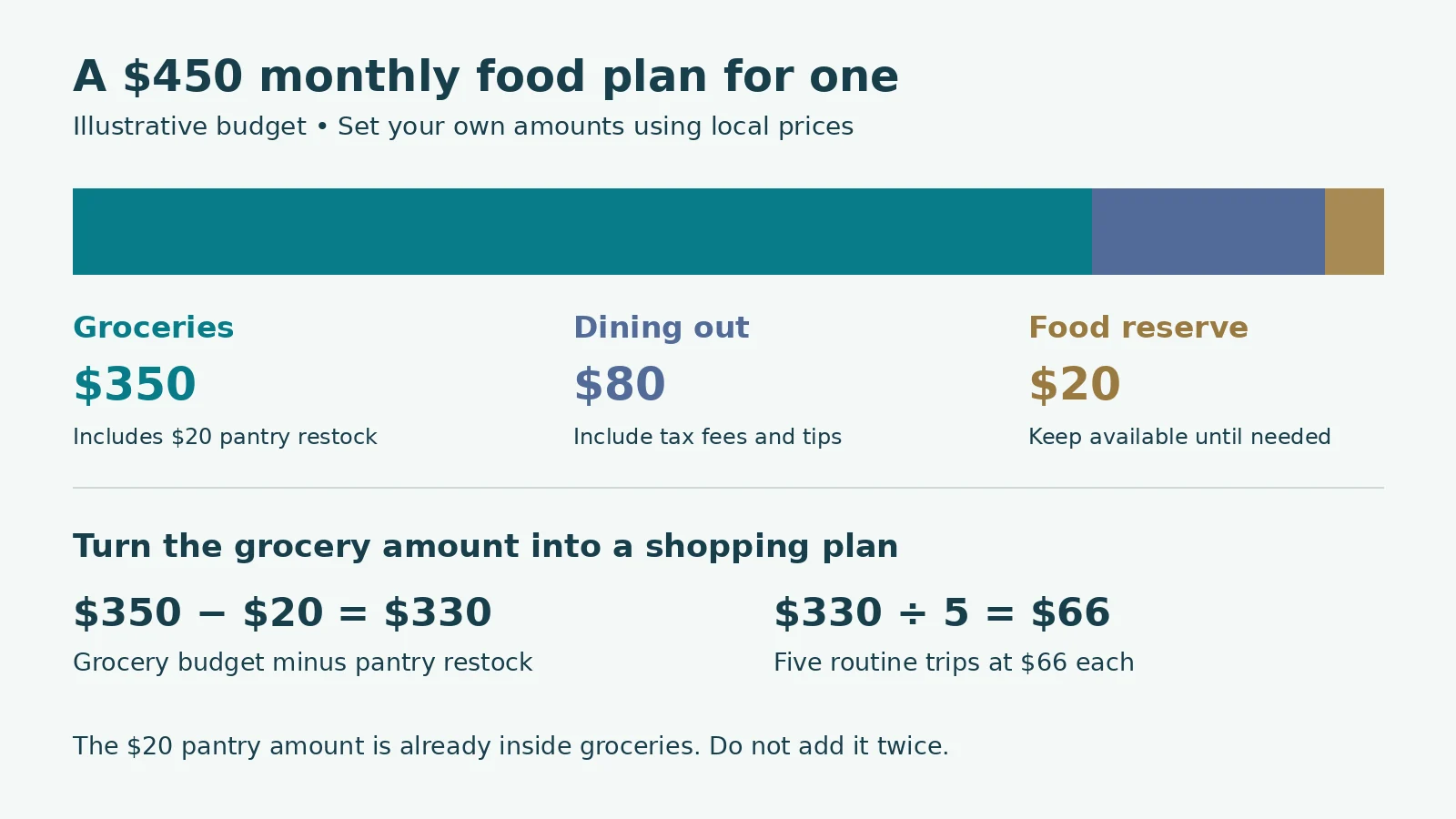
Suppose you choose a $450 total food allowance: $350 for groceries, $80 for dining out including taxes and tips, and $20 held back for food-cost surprises. Inside the $350 grocery amount, reserve $20 for pantry restocking. These are illustrative choices, not national averages or a nutritional prescription. The 50/30/20 budget worksheet can help you fit groceries and dining out into the needs and wants portions of your budget.
Convert monthly and weekly amounts correctly
For an average monthly equivalent, use about 4.333 weeks rather than four. A $100 weekly grocery habit is roughly $433.30 per month, not $400. Conversely, $350 a month averages about $80.78 a week. This conversion helps compare budgets; your actual calendar still determines when you shop.
In the example, subtract the $20 pantry allocation from groceries to leave $330 for routine shopping. That averages about $76.16 weekly. If you plan five routine trips in the calendar month, divide $330 by five instead: each trip has a $66 allowance. With four trips, it would be $82.50. Do not fund five $76.16 trips from a $330 pool.
Check the remaining balance before shopping
If you have spent $190 of the $350 grocery budget, including the full $20 pantry allocation, $160 remains. With two planned trips left, that allows $80 per trip. Use this remaining-balance calculation during the month instead of continuing with the original allowance after overspending. If you are also building a cash reserve for unexpected household costs, the emergency fund worksheet starts with essential expenses such as groceries.
Keep the separate $20 food reserve available until needed. If you use it for groceries or dining, count that purchase in the appropriate actual-spending category. Do not record both the purchase and a reserve transfer as two expenses.
Make a single person grocery budget easier to follow
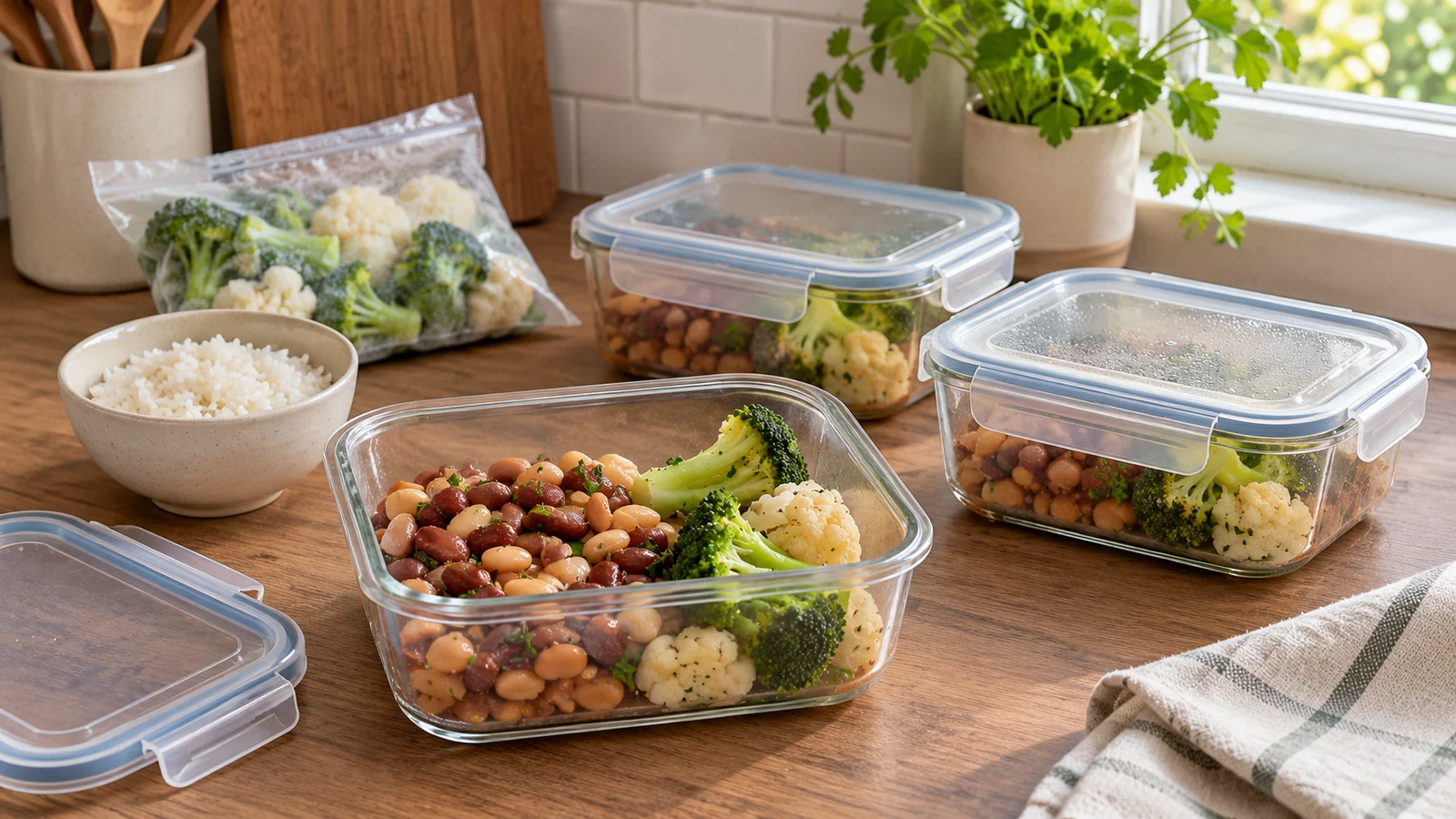
Plan around the food already in your pantry, refrigerator and freezer. Pick meals that share ingredients, and buy quantities you can use. For example, beans and vegetables can become a rice bowl one night and a wrap filling another. These are ingredient-reuse ideas, not a complete dietary plan.
Compare the amount you will actually use
Compare package prices using the same unit, such as price per ounce. Then consider waste. In a hypothetical example, a $4 bag containing 16 ounces costs 25 cents per ounce; a $7 bag containing 32 ounces costs about 22 cents. If you use only half the larger bag before discarding it, the food you ate effectively cost about 44 cents per ounce. Buying more helps only when you can use or store it.
Choose a few perishable ingredients for the next meals, with frozen or shelf-stable options for later. Keep one easy backup meal for a busy evening. A convenience item that fits the budget may be more practical than ingredients you cannot prepare before they spoil.
Store portions safely and review what was wasted
USDA’s leftover-handling guidance says to refrigerate leftovers within two hours, or one hour above 90°F, in shallow containers. Keep the refrigerator at 40°F or below. Use refrigerated leftovers within three to four days, or freeze them for longer storage. Plan portions around those limits.
At month-end, note what you discarded, which meals you skipped, and any unplanned takeout. Adjust one cause in the next budget: smaller produce purchases, fewer separate recipes, or a more realistic allowance for meals you cannot cook. Repeatedly exceeding a target may mean the target needs revising.
If your available money cannot cover enough food, USAGov’s food assistance guide explains SNAP and emergency food-help options. Check eligibility and local resources rather than making the worksheet balance by leaving meals unfunded.
Monthly food budget worksheet for one
Fill in Word or print this page. Month __________ Planned routine shopping dates ____________________
Keep nonfood purchases and alcohol outside this food comparison. Include food-related fees, taxes and tips.
A Plan the monthly amounts
| Planning item | Your amount |
|---|---|
| G Grocery food budget including pantry restocking | $ ______________ |
| P Pantry restocking already included in G | $ ______________ |
| D Dining out takeout and bought drinks | $ ______________ |
| F Separate food reserve if affordable | $ ______________ |
| T Total food allowance G + D + F | $ ______________ |
| N Number of routine shopping trips this month | ________________ |
| Routine allowance per trip (G − P) ÷ N | $ ______________ |
P is part of G and should not exceed it. Count pantry purchases once in grocery spending. Set N to the trips you actually plan; do not divide by zero. Before starting, confirm that the total fits your household budget and the food you need.
B Record spending and revise the plan
| Spending check | Your entry |
|---|---|
| A Actual grocery spending including pantry purchases | $ ______________ |
| B Actual dining out spending | $ ______________ |
| Actual total food spending A + B | $ ______________ |
| Unused allowance or overspending T − (A + B) | $ ______________ |
| Next trip (G − spent − pantry reserve left) ÷ trips left | $ ______________ |
For the next-trip calculation, use grocery spending so far and keep any unspent pantry allocation reserved. A negative balance means overspending. If no trips remain, compare the final grocery total with G instead. Count actual purchases paid from the reserve in A or B; the reserve itself is not another purchase. If you track food in envelopes, our Actual Budget grocery example shows how to cover a shortfall and see what is left for your next trip.
Foods to use first ______________________________________________________________
One change for next month _______________________________________________________
Next review date __________________ Revised monthly allowance $ __________________









Comments 2