


Social Security retirement age involves three milestones: you can usually start your own retirement benefit at 62, receive your full benefit at your full retirement age, or delay until 70 to increase your monthly payment. If you were born in 1960 or later, your full retirement age is 67, with a special rule for January 1 birthdays.
The right claiming date depends on how you will pay your bills before benefits begin, whether you are still working, your health, and your household’s other benefits. A larger monthly payment can be valuable over a long retirement, but waiting requires income or savings to cover the intervening years.


Start by finding your full retirement age below. Then compare benefit estimates using the same earnings assumptions and complete the claiming worksheet. Your last day of work and your first month of Social Security do not have to match.
Find your full retirement age by birth year
Full retirement age, or FRA, is when you qualify for your unreduced retirement benefit based on your earnings record. It is a reference point for calculating your payment, rather than a deadline to leave your job.
| Year of birth | Full retirement age |
|---|---|
| 1943–1954 | 66 |
| 1955 | 66 years, 2 months |
| 1956 | 66 years, 4 months |
| 1957 | 66 years, 6 months |
| 1958 | 66 years, 8 months |
| 1959 | 66 years, 10 months |
| 1960 or later | 67 |
Use the previous birth year if you were born on January 1. For earlier birth years and the associated early-claiming reductions, see SSA’s retirement age chart.
For example, someone born on July 15, 1959 reaches FRA in May 2026. Someone born on July 15, 1960 reaches it in July 2027. Looking only at a calendar year can miss the month that changes your eligibility for an unreduced payment.
Why do people still talk about retiring at 65?
Age 65 was once the standard full retirement age. Congress’s 1983 changes gradually increased it to 67 for people born in 1960 or later. Medicare eligibility still generally begins at 65, so the two programs now have different age milestones.
Does an early benefit become a full benefit at FRA?
No. Claiming your own retirement benefit early generally leaves you with a lasting reduction relative to waiting until FRA. Reaching 67 does not automatically erase that reduction. Cost-of-living adjustments can still raise the dollar payment.
There is a separate adjustment if benefits were withheld because you worked and earned above the applicable limit: SSA recalculates your payment at FRA to account for affected months. That is different from simply undoing every early-claiming reduction.
Compare Social Security at 62, 67, and 70
For someone whose FRA is 67, starting at 62 provides 70% of the full retirement benefit. Starting at 67 provides 100%; waiting until 70 provides 124%. Benefits change by month, so these are useful comparison points rather than your only choices.
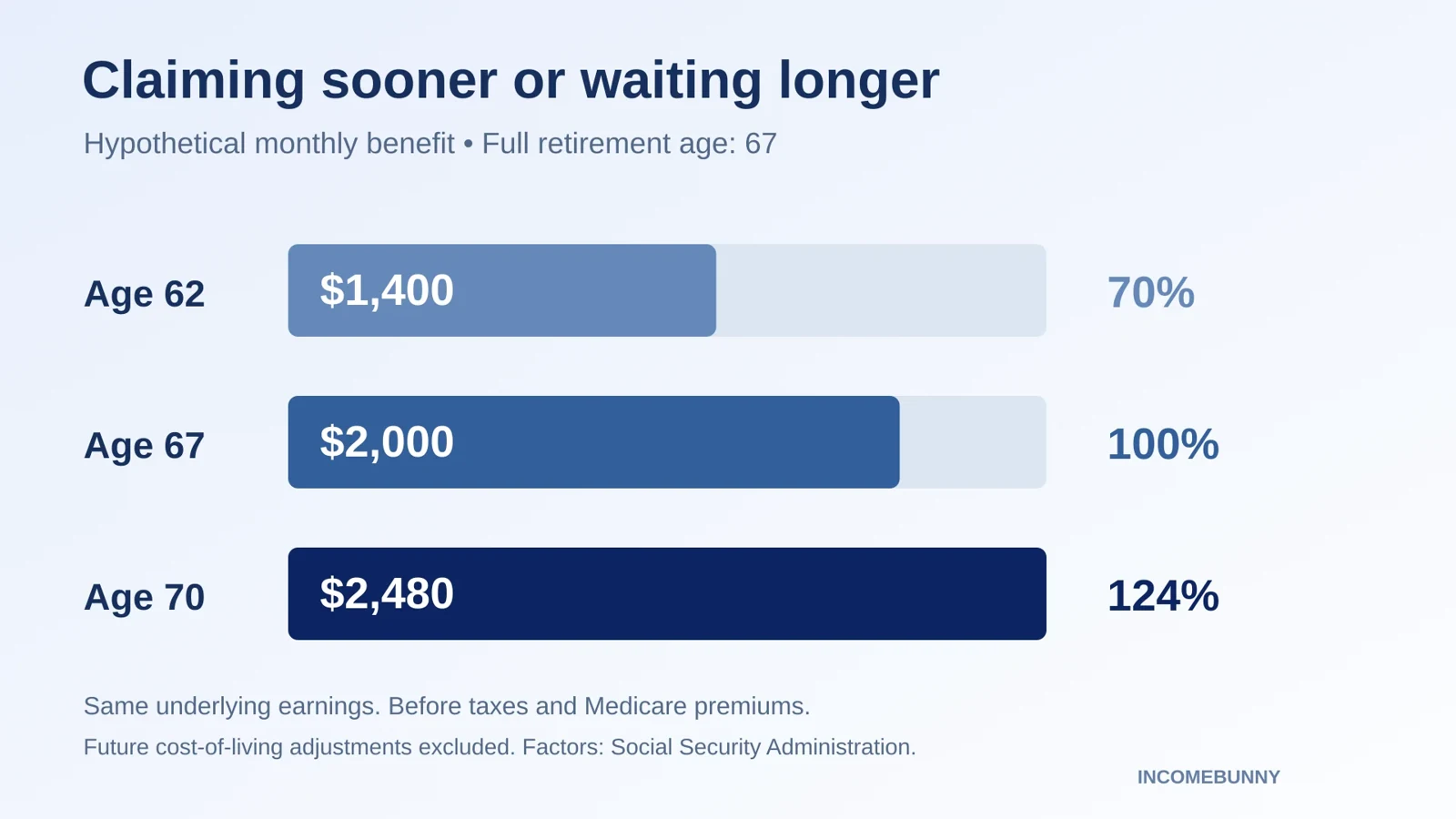
The illustration uses a hypothetical $2,000 full retirement benefit and SSA’s early and delayed retirement factors. It holds the underlying earnings record constant and excludes future cost-of-living adjustments, taxes, and Medicare premiums. It is not an estimate of your benefit.
After FRA, delayed retirement credits add 8% of the full retirement benefit per year for people born in 1943 or later, credited monthly. For FRA 67, three years adds 24%; it is not three years of compounded 8% growth. Waiting beyond 70 earns no additional delayed retirement credits.
A simple break-even calculation
In this example, claiming at 67 pays $72,000 over the 36 months before age 70: $2,000 × 36. Waiting until 70 then pays $480 more per month. Dividing $72,000 by $480 gives 150 months, or 12½ years. Cumulative payments become equal around age 82½.
This simplified comparison ignores inflation adjustments, taxes, investment returns, payment-calendar details, and survivor benefits. It helps explain the tradeoff; it does not predict your lifespan or establish the best claiming age. Also consider how much guaranteed monthly income you would want if you live well into your 90s.
How to choose when to claim Social Security

1. Get estimates that match your work plans
Sign in to your personal my Social Security account and review your earnings record. Record estimates for your earliest realistic claiming month, FRA, and age 70. Use the same dollar basis across all three: today’s dollars or future dollars.
Check projected future earnings as carefully as the claiming age. An estimate assuming several more years of work may overstate the benefit you expect if you stop now. SSA calculates retirement benefits using your highest 35 years of earnings; missing years can enter the calculation as zeros. Additional high-earning years may replace lower ones.
Adjust expected future income to reflect your plan, including part-time work. This separates the effect of waiting to claim from the effect of earning more before retirement. If your record has missing or incorrect earnings, investigate those entries before relying on the comparison.
2. Calculate what you need before benefits start
Use your expected retirement expenses, including health insurance, rather than your current salary. Our monthly budget guide helps you list recurring bills and convert annual costs into monthly amounts.
Subtract income that will actually arrive during the waiting period. If a pension starts later, it cannot cover today’s gap. Keep a separate emergency fund for unexpected expenses so one repair does not derail a carefully funded claiming plan.
3. Test the cost of waiting with a claiming worksheet
Copy this table and complete it for each possible claiming date. Start with gross Social Security estimates, then allow for any expected tax and Medicare deductions when building your spending budget.
| Planning input | Your amount or date |
|---|---|
| Birth date and full retirement age | ____________________ |
| Last month of work / first benefit month | ____________________ |
| Estimated benefit: early / FRA / 70 | $______ / $______ / $______ |
| Monthly retirement spending | $___________________ |
| Monthly income before Social Security | $___________________ |
| Monthly gap before claiming | Spending − available income |
| Months to fund before benefits begin | ____________________ |
| Initial bridge estimate | Monthly gap × waiting months |
| Separate reserve and major planned costs | $___________________ |
Suppose you stop working at 67, spend $3,800 a month, and receive a $1,000 monthly pension. If you claim a $2,000 Social Security benefit immediately, the initial gap is $800 a month. If you wait until 70, the initial gap is $2,800 a month for three years.
With flat amounts and no investment growth or tax, waiting requires $100,800 for that period: $2,800 × 36. Claiming at 67 requires $28,800 of savings over the same period. The additional bridge cost is $72,000—the benefits forgone while waiting.
At 70, a $2,480 benefit reduces the ongoing gap to $320, compared with $800 under the earlier claim. That is the practical exchange: larger withdrawals now for less reliance on savings later. Actual withdrawals may need to be higher if they create income tax, and spending may increase over time.
Run both cases through the IncomeBunny retirement withdrawal calculator, entering the correct start date for each income source. Compare a long retirement and a weaker-return scenario, rather than judging only the first year. Our guide to how long retirement savings may last explains how to interpret those assumptions.
The account funding the bridge can change the tax cost. Our traditional IRA vs Roth IRA comparison explains why an equal withdrawal amount does not always provide equal spending money.
4. Weigh health and financial flexibility
Earlier claiming may be reasonable when you need income for essentials, have serious health concerns, or would otherwise take on expensive debt. Waiting may be more attractive when you can fund the gap comfortably and want a larger payment later in life.
Make the decision using money you can access on a workable schedule. A house, an optimistic investment forecast, and cash available for next month’s bills serve different roles. Include the cost of health coverage if you leave work before Medicare eligibility.
Check the earnings test if you will keep working
You can work while collecting retirement benefits. Before FRA, however, earnings above the applicable limit can cause SSA to withhold benefits. These limits are separate from income-tax rules.
| When you earn the income | 2026 limit | 2027 limit | Benefits withheld above the limit |
|---|---|---|---|
| Under FRA throughout the year | $24,480 | $25,560 | $1 for each $2 of excess earnings |
| Year you reach FRA, before your FRA month | $65,160 | $67,920 | $1 for each $3 of excess earnings |
| Beginning with your FRA month | No limit | No limit | No withholding under this earnings test |
SSA publishes these amounts in its annual earnings-test limits. In the year you reach FRA, only earnings before the FRA month count toward the higher limit. Use the limit for the year the work occurs.
For example, someone below FRA for all of 2027 who earns $31,560 is $6,000 above that year’s lower limit. The earnings test would withhold $3,000 in benefits, before considering any applicable special rule. SSA may withhold whole monthly checks to recover that amount; it is not necessarily an even reduction from every check.
The test generally counts wages and net self-employment earnings, rather than pensions or investment income. A special monthly rule can help some people who retire partway through a year after earning a large salary. Ask SSA to evaluate your expected earnings and retirement month instead of assuming you cannot receive benefits at all.
Keep Medicare enrollment on its own timeline
Waiting until 67 or 70 for Social Security does not automatically mean you should wait for Medicare. For most people, the initial Medicare enrollment period lasts seven months: the three months before turning 65, the birthday month, and the three months afterward.
Qualifying coverage through your or your spouse’s current employment may allow a later Part B enrollment without a penalty. COBRA and retiree coverage do not work the same way. Check your situation using Medicare’s enrollment guidance, especially if you contribute to a health savings account.
Budget with the amount you expect to receive after deductions. Social Security benefits may be taxable, and Medicare Part B premiums are usually deducted from your payment when you receive both. Your gross benefit estimate and your available spending money can differ.
Coordinate your decision with your household
For couples, compare both earnings records and what income would remain after either person dies. A higher earner’s delayed retirement credits can increase the survivor benefit available to an eligible spouse. That can make waiting more valuable to the household than an individual break-even calculation suggests.
Spousal and survivor benefits have their own eligibility, reduction, and timing rules. Do not apply the 70%–100%–124% worker-benefit comparison to every benefit type. A spouse’s maximum spousal benefit is generally based on half the worker’s full retirement benefit, without the worker’s delayed retirement credits. Delaying your own spousal or survivor claim beyond its applicable FRA does not earn delayed retirement credits.
If you are widowed or divorced, have a dependent child, or qualify for benefits on more than one record, ask SSA to compare your options before filing. Include both partners’ proposed claiming months in your plan rather than assuming they must claim together.
Choose a benefit month and apply in time
Once you have compared the numbers, choose the month you want benefits to begin. SSA allows you to apply up to four months before that month. Your first payment generally arrives the following month: a July benefit is paid in August. Use SSA’s first-payment timing tool to work backward from the arrival date you need.
Before submitting the application, confirm these five details:
- Your exact FRA and desired benefit-start month, including any birthday-related eligibility rules.
- An earnings estimate consistent with the work you actually plan to do.
- Cash to cover the period before the first payment arrives.
- Medicare enrollment and employer coverage dates.
- The effect on your spouse, survivor income, and other benefits.
Save the application confirmation and review SSA’s award notice when it arrives. Check the benefit month, monthly amount, and any withholding against your plan. If something differs, resolve it with SSA before treating the expected payment as money available to spend.
Frequently asked questions
Can I get my own retirement benefit before age 62?
Generally, no. Disability and survivor benefits can be available earlier under separate rules. If a health condition prevents you from working, investigate disability eligibility rather than assuming a reduced retirement benefit at 62 is your only option.
Can I stop working at 60 and claim Social Security at 67?
Yes, if you meet the eligibility requirements when you claim and can fund the intervening years. Adjust your benefit estimate for the years without work. The absence of additional earnings and the age-based adjustment for claiming are separate parts of the calculation.










Comments 2