


A 50/30/20 budget divides monthly take-home pay into three reference categories: 50% for needs, 30% for wants, and 20% for savings and financial goals. It is a simple way to see whether essential costs, discretionary spending, and future goals are competing for too much of the same paycheck.
The percentages are guidelines, not requirements. The Consumer Financial Protection Bureau (CFPB) describes this approach as a common rule of thumb and notes that people can create a spending rule that better fits their circumstances.


This guide shows how to calculate the split, classify real expenses, avoid double-counting retirement savings, handle debt consistently, and complete a worksheet that reconciles to 100% of take-home pay.
How the 50/30/20 Budget Rule Works
The standard framework starts with take-home pay rather than gross salary.
| Category | Reference share | Typical expenses |
|---|---|---|
| Needs | 50% | Housing, utilities, groceries, essential transportation, required insurance, minimum debt payments in this worksheet |
| Wants | 30% | Dining out, entertainment, nonessential subscriptions, discretionary shopping |
| Savings/financial goals | 20% | Emergency savings, retirement savings not already deducted from pay, other savings goals, extra debt repayment |
CFPB materials describe a common 50/20/30 rule as applying 50% of take-home pay to needs, 20% to savings and debt payments, and no more than 30% to wants. This article uses the familiar “50/30/20” order while keeping the same percentages.
What counts as a need?
Needs support basic housing, health, work, caregiving, transportation, or another obligation you cannot reasonably skip without a meaningful consequence. Examples include rent or mortgage payments, basic utilities, groceries, necessary transportation, required insurance, essential healthcare, and necessary childcare.
For this worksheet, required minimum debt payments are also placed under Needs so every mandatory payment is captured before optional spending or extra debt reduction. Other explanations may place debt payments in the 20% category. Choose one method and use it consistently so the same payment is never counted twice.
What counts as a want?
Wants are expenses you can reduce, delay, downgrade, or remove without losing a basic necessity. Examples include restaurant meals, entertainment, vacations, nonessential subscriptions, premium upgrades, and discretionary shopping.
Some expenses are mixed. Basic internet service may be necessary for work, while paying extra for a premium package may be discretionary. CFPB financial-education materials similarly emphasize using the needs-versus-wants distinction to make spending decisions.
What belongs in savings and financial goals?
This category can include emergency savings, retirement savings not already deducted from your paycheck, sinking funds for future goals, and debt payments above the required minimum. Use a sinking fund for predictable bills that fall outside your regular monthly expenses. If you are building a cash reserve, the emergency fund worksheet helps turn your essential bills into a savings target.
Should the 50/30/20 Rule Use Gross or Take-Home Pay?
Use take-home pay—the amount that actually reaches you after payroll deductions—as the working income figure for this worksheet.
The IRS distinguishes gross pay, which is what an employee earns before deductions, from net or take-home pay, which is what remains after deductions.
How to handle 401(k) contributions already deducted from pay
A traditional 401(k) can receive employee salary deferrals through payroll deductions. The IRS explains that employees may defer part of their compensation into a 401(k), and traditional elective deferrals generally are not subject to federal income-tax withholding when contributed, although other payroll-tax rules still apply.
For budgeting, the key issue is avoiding double-counting money already diverted to retirement.
Use one method:
- Simplest method: Use the take-home pay shown on your paycheck and treat the payroll-deducted 401(k) contribution as savings already completed outside the worksheet.
- Full-picture method: Add your employee 401(k) contribution back to the budgeting base, then record that contribution once under Savings/Financial Goals.
Do not use take-home pay after the 401(k) deduction and then enter the same contribution again as an expense. That would count the same retirement savings twice.
The IRS provides an example in which a retirement contribution is withheld before net pay is calculated, illustrating why the deduction is already outside the employee's take-home amount.
Employer matching contributions are not cash available for this monthly spending worksheet, so do not add them to take-home pay.
How to Use the 50/30/20 Rule in 5 Steps
1. Find your monthly take-home income
Start with the amount available after payroll deductions. If income varies substantially, use the irregular-income method later in this guide.
2. Record your actual monthly expenses
Review recent bank and credit-card activity and list what you actually spend. Include less-frequent items such as insurance premiums, medical bills, annual fees, seasonal costs, or school expenses. Track variable expenses like groceries and gas across several months to see how much they fluctuate. If you also need to check which bills come due before your next paycheck, use the monthly budget template and payday calendar.
An expense tracker app can help collect the purchases you need to categorize. Check that transfers and credit-card repayments do not count the same spending twice.
3. Sort every expense into one category
Use Needs, Wants, or Savings/Financial Goals.
For this worksheet:
- Required minimum debt payments go under Needs.
- Extra debt payments go under Savings/Financial Goals.
4. Calculate the reference targets
Multiply monthly take-home pay by 0.50, 0.30, and 0.20.
For $4,000 of monthly take-home pay:
- Needs: $2,000
- Wants: $1,200
- Savings/Financial Goals: $800
Together they equal $4,000, or 100% of take-home pay.
5. Compare the targets with reality
Find the largest gap, identify what causes it, and decide whether that cost is structural, adjustable, or temporary.
The objective is not to make the worksheet look perfect. It is to understand why your actual budget differs from the reference budget.
Needs vs. Wants: Use This 3-Question Test
When an expense is difficult to categorize, ask:
- What happens if I remove this expense?
- Is there a cheaper version that still meets the essential purpose?
- Is part of the cost essential and part discretionary?
| Expense | Likely treatment | Why it can vary |
|---|---|---|
| Rent | Need | Housing is essential, but housing cost varies |
| Groceries | Need | Basic food differs from convenience or premium spending |
| Phone service | Need or mixed | Basic connectivity may be essential; upgrades may not be |
| Car costs | Need or mixed | Transportation may be necessary; premium choices may not be |
| Childcare | Often a need | It may be necessary for work or family responsibilities |
| Streaming | Want | Usually discretionary |
The goal is not to find a perfect label. It is to separate costs that are difficult to change from those that give you flexibility.
50/30/20 Budget Worksheet
This worksheet accounts for every dollar of take-home pay.
Required minimum debt payments are counted once under Needs. Extra debt repayment is counted once under Savings/Financial Goals.
Step 1 — Calculate your reference targets
Monthly take-home pay: $________
| Category | Reference percentage | Reference amount |
|---|---|---|
| Needs | 50% | $_____ |
| Wants | 30% | $_____ |
| Savings/Financial Goals | 20% | $_____ |
| Total | 100% | $_____ |
Multiply take-home pay by each percentage. Confirm that the three reference amounts add back to your full take-home pay.
Step 2 — Record and total your actual spending
| Expense | Category | Monthly amount |
|---|---|---|
| Housing | Need | $_____ |
| Utilities | Need | $_____ |
| Groceries | Need | $_____ |
| Essential transportation | Need | $_____ |
| Insurance/healthcare | Need | $_____ |
| Minimum debt payments | Need | $_____ |
| Dining/entertainment | Want | $_____ |
| Subscriptions | Want | $_____ |
| Discretionary shopping | Want | $_____ |
| Cash savings | Savings/Goal | $_____ |
| Retirement contribution not already deducted from pay | Savings/Goal | $_____ |
| Extra debt repayment | Savings/Goal | $_____ |
| Other | _____ | $_____ |
| Total actual allocations | $_____ |
Add all rows within each category to find the category totals. Then add the three category totals together.
Do not enter a payroll-deducted retirement contribution here if you are already using take-home pay after that contribution was deducted.
Step 3 — Find unallocated money or a shortfall
Use:
Take-home pay − Total actual allocations = Unallocated money or shortfall
A positive result means some income has not been assigned. A negative result means your listed allocations exceed the income available in the worksheet.
| Reconciliation | Amount |
|---|---|
| Take-home pay | $_____ |
| Total actual allocations | $_____ |
| Unallocated money / shortfall | $_____ |
This reconciliation step prevents money from disappearing between categories and makes overspending visible.
Step 4 — Calculate actual percentages and gaps
Use:
Category total ÷ take-home pay × 100 = Actual category percentage
Then compare the actual dollar amount with its reference target.
| Category | Reference amount | Actual amount | Actual % | Dollar gap | Main reason for gap |
|---|---|---|---|---|---|
| Needs | $_____ | $_____ | ___% | $_____ | _____ |
| Wants | $_____ | $_____ | ___% | $_____ | _____ |
| Savings/Goals | $_____ | $_____ | ___% | $_____ | _____ |
| Total | $_____ | $_____ | ___% | $_____ |
If the actual percentages do not total 100%, use the reconciliation line above to identify unallocated money or a shortfall.
Completed worksheet example
Assume monthly take-home pay is $4,000 and actual allocations are:
- Needs: $2,100
- Wants: $1,000
- Savings/Goals: $700
Total actual allocations are:
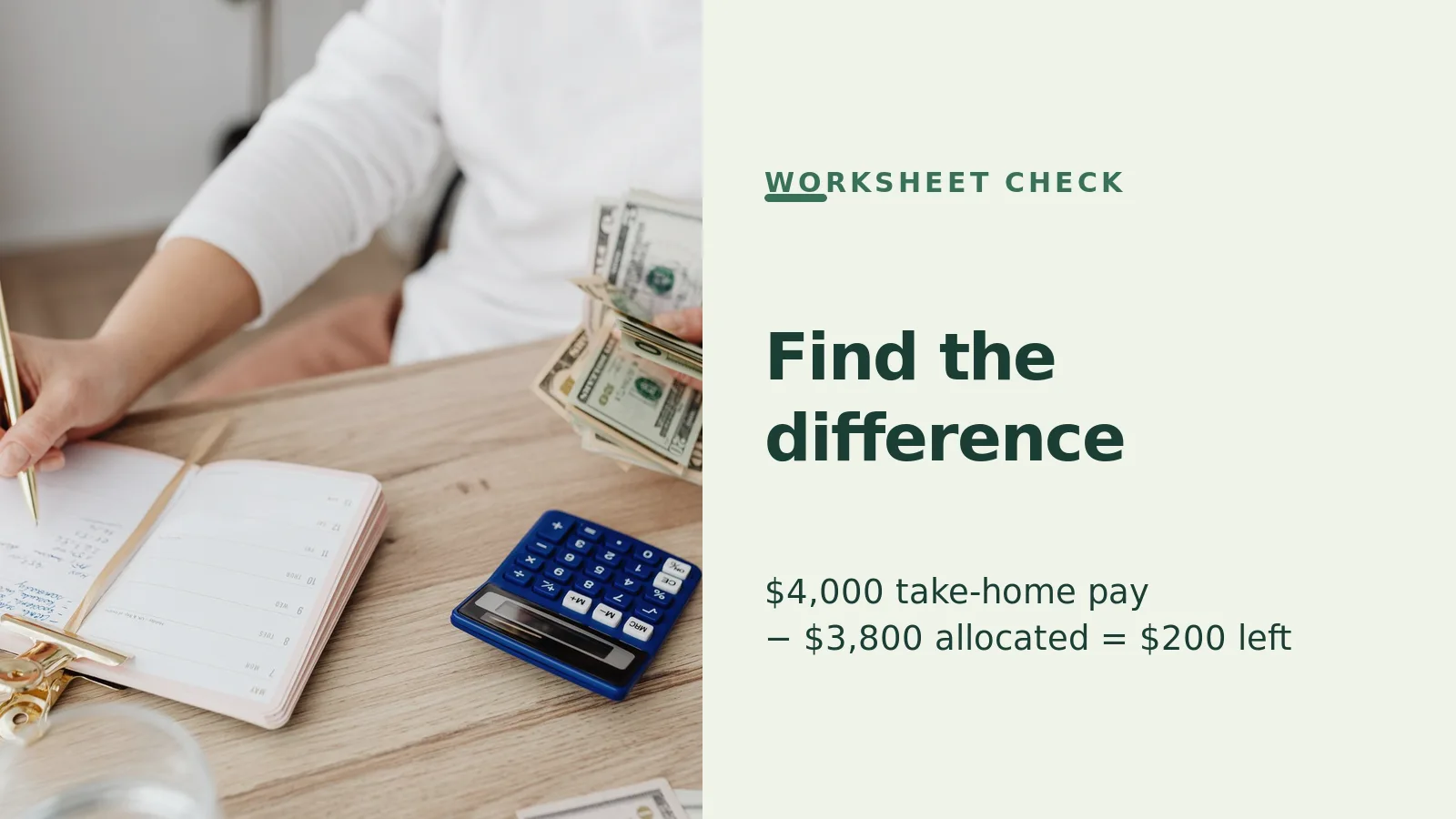
$2,100 + $1,000 + $700 = $3,800
Unallocated money is:
$4,000 − $3,800 = $200
Actual percentages are:
- Needs: $2,100 ÷ $4,000 = 52.5%
- Wants: $1,000 ÷ $4,000 = 25%
- Savings/Goals: $700 ÷ $4,000 = 17.5%
- Unallocated: $200 ÷ $4,000 = 5%
The worksheet now reconciles:
52.5% + 25% + 17.5% + 5% = 100%
The savings/goals reference amount was $800, so the actual $700 allocation is $100 below the reference.
The household can now decide whether the unallocated $200 should remain available for upcoming expenses or be assigned elsewhere. The worksheet identifies the decision without assuming there is one correct choice.
50/30/20 Budget Example When Needs Are 65%
Suppose monthly take-home pay is $3,000 and essential costs total $1,950:
| Need | Amount |
|---|---|
| Rent | $1,150 |
| Utilities | $180 |
| Groceries | $300 |
| Essential transportation | $180 |
| Insurance/other essential costs | $140 |
| Total needs | $1,950 |
Needs consume:
$1,950 ÷ $3,000 = 65%
An illustrative adjusted budget could look like this:
| Category | Amount | Percentage |
|---|---|---|
| Needs | $1,950 | 65% |
| Wants | $600 | 20% |
| Savings/Goals | $450 | 15% |
| Total | $3,000 | 100% |
This is an illustrative example, not a universal financial recommendation.
It shows why a budget can still balance even when it does not match 50/30/20 exactly. Forcing needs down to the standard $1,500 reference would require a $450 reduction.
If most of that difference comes from rent, insurance, or essential transportation, changing it immediately may not be realistic. Adjusting the other categories can be more practical than pretending fixed expenses like rent and insurance are lower than they are.
What If Your Needs Are More Than 50%?
Identify what creates the gap.
Structural costs such as housing, essential childcare, insurance, healthcare, and necessary transportation can be difficult to change quickly. Other expenses may be partly adjustable, such as premium service plans, convenience fees, or optional upgrades.
Use this order:
- Record required expenses accurately.
- Check whether any “needs” include discretionary upgrades.
- Review wants for realistic reductions.
- See what remains for savings and other goals.
- Recalculate when income or major fixed costs change.
If genuine needs remain above 50%, the mismatch itself is useful information. The percentage is a benchmark, not a reason to relabel an unavoidable expense.
How Does Debt Fit Into a 50/30/20 Budget?
Different explanations of the framework handle debt differently. CFPB's own 50/20/30 worksheet places savings and debt payments together in the 20% portion.
For this worksheet, required minimum payments are classified under Needs because they are mandatory monthly obligations, while extra payments above the minimum are classified under Savings/Financial Goals.
This is an editorial worksheet convention designed to keep committed cash flow visible. It is not presented as the only accepted interpretation of the 50/30/20 rule.
Do not count the same payment in both places.
For example, if a credit-card minimum is $100 and you pay $250:
- $100 goes under Needs as the required minimum.
- $150 goes under Savings/Financial Goals as extra debt repayment.
CFPB states that the minimum credit-card payment is the amount that must be paid each month. It also notes that paying more than the minimum can reduce interest costs and help pay the balance off faster.
If you cannot make a credit-card minimum payment, CFPB advises acting promptly and contacting the card issuer.
In that situation, addressing the required payment matters more than making the worksheet match a percentage target.
Does the 50/30/20 Rule Work on a Low Income?
Not always in its standard form.
When housing, food, utilities, healthcare, transportation, childcare, and required payments already use most of take-home income, 50% for needs may not be achievable.
Use the framework diagnostically:
| Question | What it tells you |
|---|---|
| Are essential costs genuinely above 50%? | The standard split may not fit current cash flow |
| Are some “needs” partly discretionary? | Some spending may be adjustable |
| Is the mismatch temporary? | A temporary adjusted budget may be useful |
| Does it persist? | There may be a structural income-versus-cost gap |
CFPB itself describes its spending percentages as a rule of thumb rather than a requirement that every household must meet.
Do not assume every household can save 20% immediately. Record the actual amount available and keep the standard percentage as a comparison point.
How to Adapt the Worksheet for Irregular Income
If income changes significantly from month to month, review several recent months rather than using one unusually high month as the baseline.
Then track two figures:
| Figure | Purpose |
|---|---|
| Planning income | Used to build the working budget |
| Actual income | Used to review the completed month |
Build the budget from the planning figure. After the month ends, replace it with actual income and recalculate the percentages.
This keeps 50/30/20 useful as a comparison tool without pretending every month produces identical dollar targets.
50/30/20 Budget Pros and Cons
| Strength | Practical benefit | Limitation |
|---|---|---|
| Simple | Easy for beginners | Can hide problems inside individual expenses |
| Percentage-based | Scales with income | Essential costs do not always scale with income |
| Savings are visible | Future goals stay in the plan | 20% may not be feasible |
| Low tracking burden | Easier than detailed budgeting | Less precise than category-level methods |
The method works best when broad guardrails are enough to guide decisions. It is less useful when you need close control over individual spending categories.
50/30/20 vs. Zero-Based Budgeting
| Factor | 50/30/20 | Zero-based budgeting |
|---|---|---|
| Structure | Three broad buckets | Each available dollar gets a purpose |
| Setup effort | Lower | Higher |
| Tracking | Broad | Detailed |
| Best for | Simple spending guardrails | Precise cash-flow control |
| Main limitation | Can hide category-level problems | Requires more ongoing management |
Use 50/30/20 when broad boundaries are enough to guide your decisions.
A more detailed method may work better when you repeatedly miss a target but cannot identify which expenses are responsible.
Final Takeaway: Use the Percentages as a Diagnostic Tool
The 50/30/20 budget helps show how much of your take-home pay goes to essentials, discretionary spending, and future goals. It does not require every household to fit the same percentages.
Complete the worksheet with real numbers, reconcile it to your available income, and identify the category with the largest gap. Then focus on the cause of that gap instead of trying to change everything at once.
If your actual budget is 65/20/15 instead of 50/30/20, the worksheet can still be useful. What matters is understanding why the difference exists and choosing a practical next step to review later.
Use your next budget review to update the worksheet with actual income and expenses and see whether the gap has narrowed, widened, or simply changed categories.
Frequently Asked Questions
Is rent a need in the 50/30/20 rule?
Yes. Housing is generally treated as a need. A high rent payment can push total needs above 50% without making housing optional.
How much is 20% of $3,000?
Twenty percent of $3,000 is $600. If $3,000 is take-home pay, $600 is the standard reference amount for the 20% category.
What if my 401(k) contribution already comes out of my paycheck?
Do not count the same contribution twice. If you use take-home pay after the 401(k) deduction, treat that contribution as savings already completed outside the worksheet.
Does debt repayment count toward the 20%?
Some versions of the framework include debt payments in the 20% portion. In this worksheet, minimum required payments are placed under Needs and only extra payments are placed under Savings/Financial Goals. Use one convention consistently so the same payment is never counted twice.
Can I use the 50/30/20 rule if my income changes every month?
Yes, but use a realistic planning income and compare it with actual income after the month is complete. Recalculate the percentages when the income figure changes.
If you want to track this split on your phone, compare free budgeting apps that can help you track needs, wants, and savings separately.
Editorial note: The 50/30/20 budget is a general budgeting framework, not individualized financial advice. Appropriate spending, saving, and debt priorities depend on your income, obligations, goals, and circumstances.












Comments 7