


A backdoor Roth IRA is a two-step strategy: make a nondeductible contribution to a traditional IRA, then convert that money to a Roth IRA. People commonly use it when their income is too high for a direct Roth IRA contribution. It is a funding method, not a separate kind of account.
The important qualification is tax. A conversion can be largely or entirely tax-free when you have no other pre-tax IRA money and little or no growth before converting. Existing pre-tax IRA balances can change that result substantially.


The IRS permits Roth IRA conversions regardless of adjusted gross income. The practical task is checking your eligibility to contribute, calculating the conversion’s taxable portion, and documenting both transactions correctly.
The appeal is access to Roth IRA tax treatment: qualified withdrawals, including investment earnings, are free of federal income tax. The nondeductible contribution provides no upfront deduction. The strategy also leaves the regular annual IRA contribution limit in place.
Who can use a backdoor Roth IRA?
The IRS contribution rules generally require enough taxable compensation, such as wages or qualifying self-employment income, to support the new traditional IRA contribution. A married couple filing jointly may qualify under the spousal IRA rules using their combined compensation. Each spouse uses a separate IRA.
There is no upper income limit for making a nondeductible traditional IRA contribution. Income and workplace-plan coverage can limit a deduction, which is a different question. You can also choose to treat an otherwise deductible contribution as nondeductible.
If you qualify to put your intended amount directly into a Roth IRA, that usually involves fewer transactions. Check your modified adjusted gross income, or MAGI, rather than comparing the limits with salary alone. MAGI starts with adjusted gross income and applies tax-specific adjustments.
For the underlying account differences, see traditional IRA vs Roth IRA. If a direct contribution is available to you, the Roth IRA opening guide covers the simpler setup process.
Contribution and income limits for 2026 and 2027
The IRS has announced the following annual IRA contribution limits:
| Contribution tax year | Under age 50 | Age 50 or older by year-end |
|---|---|---|
| 2026 | $7,500 | $8,600 |
| 2027 | $7,500 | $8,600 |
These are combined limits for regular contributions to your traditional and Roth IRAs, not a separate allowance for each account. Your compensation may impose a lower limit. For example, an eligible person under 50 who already contributed $3,000 for 2026 generally has $4,500 of the $7,500 allowance left.
Direct Roth IRA contributions are reduced through these MAGI phaseout ranges:
| Filing status | 2026 Roth MAGI phaseout | 2027 Roth MAGI phaseout |
|---|---|---|
| Single or head of household | $153,000–$168,000 | $158,000–$173,000 |
| Married filing jointly | $242,000–$252,000 | $250,000–$260,000 |
Below the relevant range, income does not reduce the contribution allowance; at or above its upper endpoint, no direct Roth contribution is allowed. Married people filing separately who lived with their spouse during the year have a special $0–$10,000 phaseout range in both years. Different treatment applies if they lived apart all year.
The figures come from the IRS’s 2026 retirement-limit announcement and 2027 announcement. They limit contributions; a conversion of existing IRA assets is a different transaction and does not use up another annual contribution allowance.
How to do a backdoor Roth IRA
1. Review every relevant IRA before contributing
List your own traditional IRAs, including rollover IRAs and traditional SEP and SIMPLE IRAs. Gather prior Forms 8606 showing any remaining after-tax basis—money already taxed that has not yet been recovered tax-free.
Check for planned employer contributions to a SEP or SIMPLE IRA and any upcoming 401(k)-to-IRA rollover. Those transactions can affect the year-end calculation. A new, empty traditional IRA does not make existing balances elsewhere disappear.
If you have inherited IRAs or an outstanding rollover, get help applying the relevant rules rather than combining balances indiscriminately. A traditional SIMPLE IRA within its first two years also has additional rollover restrictions.
2. Make an eligible nondeductible contribution
Open a traditional IRA if needed, or use an existing one after reviewing its tax consequences. Confirm the contribution year, amount, compensation requirement, and remaining annual allowance.
“Nondeductible” is a tax-reporting treatment. Moving money from your checking account does not establish that treatment by itself. Record the contribution and do not claim an IRA deduction for the amount you intend to treat as after-tax basis. You can repeat the process in later years if eligible, reviewing the limits and balances each time.
3. Request a Roth conversion
Once the funds are available under your provider’s rules, request a conversion into a Roth IRA. The IRS describes same-trustee and trustee-to-trustee conversion methods, allowing the money to move within one institution or directly between institutions.
Check settlement or collection holds, conversion fees, and processing deadlines. Avoid confusing “transfer to another traditional IRA” with “convert to Roth.” Your confirmation should identify the destination as a Roth IRA and the transaction as a conversion.
Before authorizing tax withholding, understand its effect: money withheld is unavailable for conversion and may be an early distribution subject to an additional tax. Paying any conversion tax with outside cash can preserve more retirement money. A sizable taxable conversion may also require estimated-tax planning.
A taxable conversion can also affect income-based tax calculations. Our net investment income tax guide explains why retirement distributions can raise MAGI even when the distribution itself is excluded from net investment income.
4. Confirm the money arrived and choose investments
Check the Roth IRA balance and transaction confirmation. A completed conversion moves assets into the account; it does not necessarily invest cash. Choose investments consistent with your retirement plan, time horizon, and risk tolerance.
When choosing where to hold the account, compare Roth IRA account fees and features and confirm that the custodian supports the conversion and records you need.
Keep the traditional IRA’s transaction history. Interest can arrive after the initial conversion, so check for a small remaining balance before assuming the process is finished.
5. Report the contribution and conversion
Retain contribution confirmations, conversion records, year-end IRA statements, and prior basis records. Report the nondeductible contribution and conversion for their applicable tax years. The calendar distinction below matters even if the two transactions happen only days apart.
The pro-rata rule: why a separate IRA does not solve the tax issue
For this calculation, your own traditional IRAs—including rollover IRAs and traditional SEP and SIMPLE IRAs—are generally treated together. You cannot select only the after-tax dollars for conversion while ignoring pre-tax IRA assets elsewhere.
Balances still inside a 401(k) are outside this IRA calculation. A spouse’s separate IRAs are also calculated separately. However, rolling your pre-tax 401(k) into a traditional IRA during the conversion year can change your result.
The Form 8606 uses year-end IRA values along with conversions and relevant distributions. December 31 of the conversion year matters, even if the conversion happened much earlier.
Example 1: no other pre-tax IRA money
Assume you contribute $7,500 nondeductibly for 2026 and convert the entire $7,500 during 2026. You have no other traditional, rollover, traditional SEP, or traditional SIMPLE IRA assets, no prior basis, no gains, and no other IRA distributions.
The $7,500 basis offsets the $7,500 conversion. The federal taxable conversion amount is $0. You still report the transactions.
Example 2: a $92,500 rollover IRA changes the outcome
Now assume the same $7,500 nondeductible contribution and $7,500 conversion, but you also have $92,500 of pre-tax rollover IRA assets. That $92,500 remains at December 31. Assume no gains, losses, other distributions, outstanding rollovers, or special adjustments.
The calculation is:
- Total for the ratio: $92,500 year-end IRA value + $7,500 converted = $100,000.
- After-tax share: $7,500 basis ÷ $100,000 = 7.5%.
- Nontaxable conversion: $7,500 × 7.5% = $562.50.
- Taxable conversion: $7,500 − $562.50 = $6,937.50.
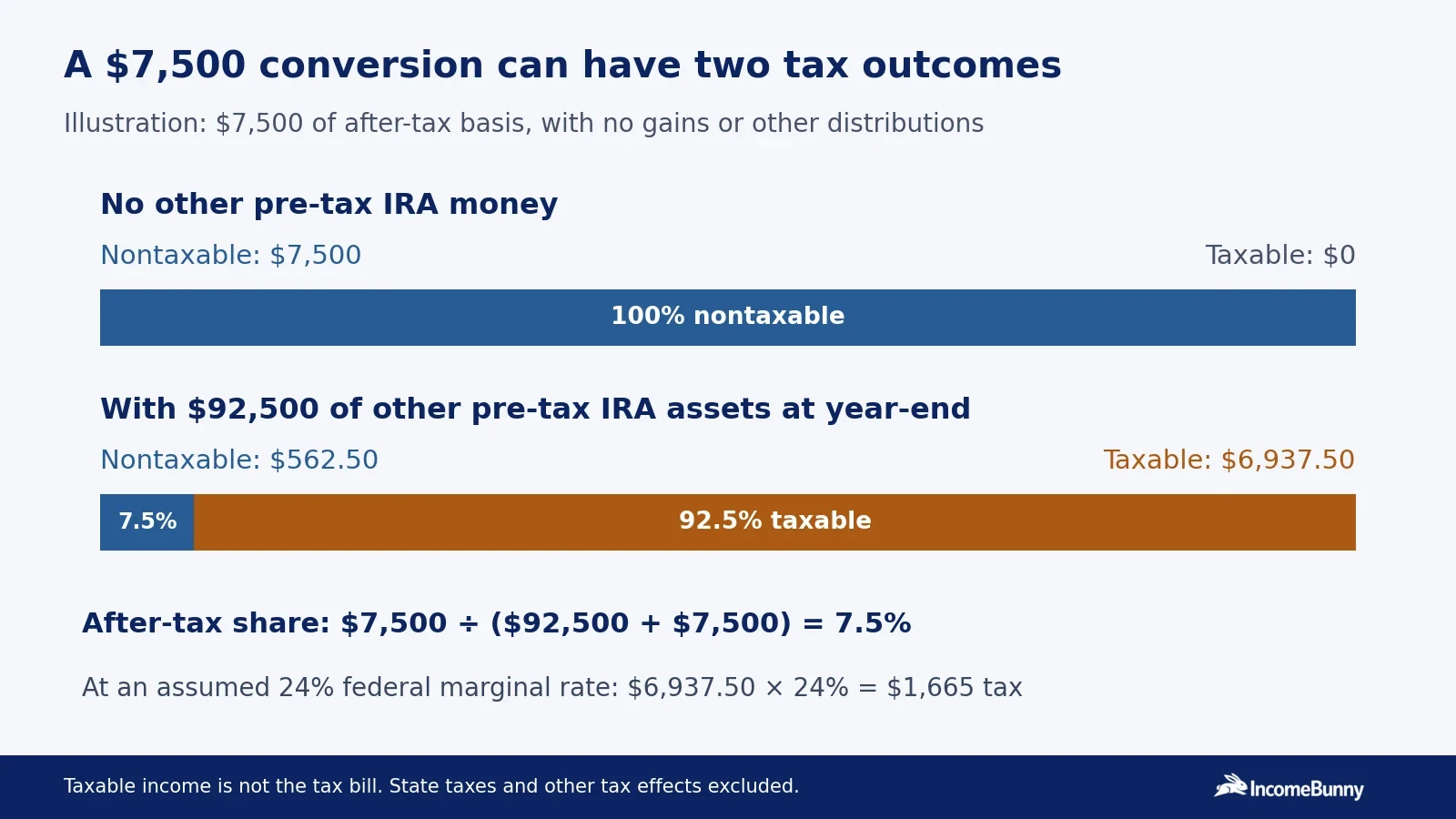
The same conversion amount can produce different tax results. Both scenarios assume no gains, other distributions, or special adjustments.
If that entire taxable amount falls in an assumed 24% federal marginal bracket, the incremental federal income tax is $1,665. That estimate excludes state taxes and other tax effects. The $6,937.50 is taxable income, not the tax bill.
The remaining $6,937.50 of basis stays with your traditional IRAs for future tax calculations. It is not lost, and you should not reset it to zero merely because you converted the new contribution.
This example also explains why a late-year rollover can be consequential: an IRA that was empty on conversion day may have a pre-tax balance on December 31. Use Form 8606’s actual computation when other distributions or adjustments apply.
What if you already have pre-tax IRA assets?
Pause and compare the tax cost before converting. One possible option is moving eligible pre-tax IRA assets into a workplace retirement plan that accepts them. The IRS’s Publication 590-A rollover rules explain that an eligible-plan rollover can include otherwise taxable IRA amounts; after-tax IRA basis cannot simply be rolled into a 401(k).
Ask the plan administrator about acceptance, timing, investment choices, and costs. Coordinate any rollover with the conversion-year calculation. Another choice is accepting the tax cost after analysis, or using a different savings account. Converting an entire large IRA just to simplify a small annual contribution can create a much larger tax event.
Contribution year and conversion year can be different
For most taxpayers, a 2026 IRA contribution can be made through April 15, 2027. A direct conversion completed in 2027 is reported for 2027; you cannot designate it as a 2026 conversion.
Here is an illustrative timeline:
| Transaction | Tax treatment year | Record to keep |
|---|---|---|
| February 12, 2027: contribute $7,500 designated for 2026 | 2026 contribution | Confirmation specifying 2026 |
| February 16, 2027: convert $7,500 to Roth | 2027 conversion | Conversion confirmation and 2027 year-end IRA statements |
In this scenario, the 2026 Form 8606 records the nondeductible contribution and carries the basis forward because there was no 2026 conversion. The 2027 return then uses that basis when calculating the 2027 conversion. Any new 2027 nondeductible contribution must also be accounted for.
If you want a direct conversion completed within a particular calendar year, arrange it before December 31 and allow for the custodian’s earlier processing cutoff. An April contribution deadline does not extend the conversion year.
Form 8606 and the paperwork that prevents double taxation

Keep contribution confirmations and December 31 IRA statements with your tax records.
Three documents have different jobs:
- Form 1099-R: the custodian reports the traditional IRA distribution associated with the conversion.
- Form 5498: the custodian reports IRA contributions and, where applicable, conversion information. It is generally kept with your records rather than attached to your return.
- Form 8606: you report nondeductible traditional IRA contributions, track basis, and calculate conversion tax treatment as applicable.
The IRS’s instructions for Forms 1099-R and 5498 explain the custodian’s reporting obligations. A distribution reported on Form 1099-R does not, by itself, establish how much is taxable after accounting for your basis.
The distinction causes real confusion. In a public r/tax account posted by u/nap2325, the writer described contributing for a prior year, converting the following year, and later discovering the earlier Form 8606 was missing. This is a self-reported paperwork problem, not evidence that a particular correction method is right for everyone.
Use the IRS Form 8606 instructions to check filing and recordkeeping requirements. If a form is missing or a deduction was incorrectly claimed, have the return reviewed before deciding whether a separate form or amended return is appropriate.
Before filing, reconcile the contribution year, conversion year, prior basis, December 31 balances, and taxable amount. Save the completed Form 8606 for future years. Married couples may need a separate form for each spouse, even on a joint return.
Practical answers to common backdoor Roth problems
What if the money earns $25 before conversion?
Suppose your only IRA money is a $7,500 nondeductible contribution that becomes $7,525 before you convert it all. With no other IRA assets or relevant transactions, the $7,500 basis is nontaxable and the $25 of earnings is generally taxable.
That growth does not mean you made a $7,525 annual contribution. The contribution was $7,500; the larger amount is the conversion. If interest arrives afterward, account for it rather than ignoring the remaining dollars.
How long should you wait before converting?
There is no universal brokerage waiting period. Funds must be available under the custodian’s procedures. Vanguard’s backdoor Roth instructions distinguish that settlement step from the conversion itself.
Converting soon after the money becomes available can reduce the opportunity for pre-conversion gains, but it does not remove the pro-rata rule. Do not assume waiting a particular number of days guarantees a tax outcome.
What if you already contributed directly to a Roth but earned too much?
Contact the custodian about a timely correction, which may involve recharacterizing the contribution and its related earnings or loss into a traditional IRA. A later Roth conversion is a separate step. Simply moving cash between accounts without the correct designation can leave the original problem unresolved.
The IRS distinguishes correcting a regular contribution from reversing a conversion: Roth conversions made after 2017 cannot be recharacterized back to traditional IRAs. Check the tax consequences before authorizing a conversion.
Can you withdraw the money whenever you want?
A backdoor Roth conversion does not make every subsequent withdrawal tax- and penalty-free. The IRS’s Publication 590-B describes two different five-year rules.
Qualified Roth IRA withdrawals generally require a five-tax-year holding period, beginning with the first tax year for which you funded a Roth IRA, plus age 59½ or another qualifying condition. Separately, each conversion has a five-tax-year period relevant to a possible 10% additional tax on early withdrawals of amounts that were taxable when converted, unless an exception applies.
Roth withdrawal ordering rules also matter: regular contributions come out first, followed by conversions and rollovers, then earnings. Converted money should not automatically be treated like a regular Roth contribution. Get a withdrawal calculation before relying on it for near-term expenses.
Is a backdoor Roth IRA worth doing?
It can be useful when direct Roth contributions are unavailable, you have money intended for retirement, and the conversion tax and paperwork fit your situation. It is less straightforward when substantial pre-tax IRA assets, missing basis records, or near-term cash needs are involved.
A mega backdoor Roth is different: it generally involves after-tax workplace-plan contributions and a permitted Roth conversion or rollover. It depends on plan features and uses different contribution limits; a regular backdoor Roth IRA does not give you that larger allowance.
Before funding the account, write down three answers: your remaining contribution allowance, the IRA balances expected on December 31 of the conversion year, and the estimated taxable conversion amount. If any answer is unclear, resolve it with the custodian or a qualified tax professional first. This explanation covers general federal rules; state tax treatment and individual circumstances can differ.











Comments 2