


Fidelity is our strongest starting point for a low-cost Roth IRA you manage yourself. Schwab is a strong alternative when phone or branch assistance matters. For automated investing, Fidelity Go is particularly attractive below $25,000, while Wealthfront and Betterment deserve consideration when their portfolio services and pricing fit your balance and deposit habits.
The best Roth IRA account is a place to hold investments, not an investment with its own guaranteed return. Choosing the provider and choosing what to buy inside the account are separate decisions. Fees, available investments, automation, and access to help should drive the comparison.


The account terms below are current as of November 23, 2026. Compare the specific service named: a provider’s self-directed brokerage account can have very different pricing from its managed account.
Best Roth IRA accounts at a glance
Accounts for choosing your own investments
| Account | Standard account charge | Main reason to consider it |
|---|---|---|
| Fidelity self-directed | $0 account fee | Broad investment choice and recurring purchases |
| Charles Schwab self-directed | $0 opening/maintenance fees | Investment choice with phone and branch access |
| Vanguard self-directed | $25 annually; waivers available | Vanguard mutual fund portfolio; check investment minimums |
| Robinhood self-directed | Gold optional: $5/month | Eligible contribution match; retention conditions apply |
Accounts that manage investments for you
| Service | Standard management pricing | Best fit or important condition |
|---|---|---|
| Fidelity Go | $0 below $25,000; 0.35% annually at $25,000+ | Small balances needing management; starts investing at $10 |
| Wealthfront Portfolio IRA | 0.25% annually, plus fund expenses | Automated portfolio management and rebalancing |
| Betterment Digital | $5/month or 0.25% annually | Percentage pricing at $24,000+ eligible household balance OR $200+/month recurring deposits |
These figures describe the account or management charge, not every possible cost. Fund expenses, certain transactions, and transfers can add charges. A $0 account fee does not mean every investment or service is free.
Which Roth IRA fits your needs?
Fidelity: best starting point for low-cost DIY investing
Fidelity’s Roth IRA has no account fee or opening minimum, and offers stocks, ETFs, mutual funds, bonds, and other investments. Its broad selection makes it a practical home for a simple retirement portfolio without requiring a management subscription.
Its recurring investment feature supports stocks, ETFs, and mutual funds in Roth IRAs. That matters if you want regular purchases rather than money simply accumulating in cash.
The tradeoff is responsibility: you choose the investments and decide when to rebalance. Check the specific fund’s expense ratio, minimum, and purchase fee. Fidelity’s self-directed account and Fidelity Go are separate choices; opening the former does not automatically enroll you in portfolio management.
Charles Schwab: best fit for investors who want access to help
Schwab’s Roth IRA combines a $0 opening minimum with a broad investment menu, retirement tools, telephone assistance, and a branch network. Schwab charges no fee to open or maintain an IRA, and online listed stock and ETF trades have $0 commissions.
That is a useful combination if you want to manage your own portfolio but value access to account support. It does not mean every planning service or managed portfolio is included for free.
Check mutual fund transaction charges before buying, especially if you bring a favorite fund from another company. A broker can be inexpensive for one fund or ETF and less economical for another. Also confirm whether your intended investments support the recurring purchase schedule you want.
Vanguard: best fit for a Vanguard mutual fund portfolio
Vanguard is a sensible shortlist choice if you specifically want to build around its mutual funds. Its published investment minimums distinguish between $1,000 for Target Retirement Funds, generally $3,000 for most Vanguard mutual funds, and purchases of Vanguard ETFs starting at $1.
Check the current fee schedule before opening. Vanguard may charge a $25 annual account service fee, which can be waived by electing the specified electronic delivery options or meeting other conditions. A $100 account closure and full-transfer-out processing fee may also apply, with exceptions.
You do not have to hold a Vanguard ETF at Vanguard. If the fund is available at another broker, compare the account features around it. A familiar fund brand is not, by itself, a reason to accept an unsuitable account setup.
Fidelity Go: best fit for a small account needing management
Fidelity Go chooses and manages a portfolio of mutual funds. There is no opening minimum, and investing starts once the account reaches $10. The advisory fee is $0 below $25,000 and 0.35% annually for accounts at or above that threshold.
This makes it a useful option for someone who wants help getting invested with a small balance. Revisit the comparison as the account grows: $25,000 is a pricing threshold, not merely a milestone on a chart.
The tradeoff is giving up the same investment-by-investment control you would have in a self-directed account. At $25,000, Go also adds access to financial coaching, so evaluate the service you will actually use alongside its fee.
Wealthfront: best fit for ongoing automated portfolio management
Wealthfront’s IRA service builds and manages a diversified portfolio, reinvests available cash, and rebalances automatically. It offers portfolio customization rather than requiring you to maintain every holding yourself.
Its Wealthfront Portfolio advisory fee is 0.25% annually, with underlying fund expenses additional. That percentage-based structure is straightforward to translate into dollars at different balances.
Choose it for the managed service, not because you assume a robo-advisor will outperform a portfolio you could build yourself. Confirm the portfolio you will receive, its risk level, and the funding requirements for your particular IRA and transfer method.
Betterment: best fit for automated investing with regular deposits
Betterment’s managed investing service provides portfolios, trading, and rebalancing. Its fee depends on your eligible household balance and recurring deposits, making the deposit setup part of the buying decision.
Under Betterment’s Digital pricing, the charge is $5 per month when the eligible household balance is below $24,000 and qualifying recurring deposits are below $200 per month. It becomes 0.25% annually when either threshold is met.
Betterment has no opening minimum; its minimum disclosure specifies a $10 ACH deposit minimum and separate portfolio requirements for rebalancing. The major caution is the flat fee on a small, infrequently funded account. If you stop qualifying recurring deposits, check whether your pricing changes.
Robinhood: best fit for investors who will keep an eligible match
Robinhood’s self-directed IRA supports stocks and ETFs, including recurring purchases. Its IRA match rules currently offer 1% on eligible annual contributions without Gold, or 3% with the $5-per-month Gold subscription. Managed Robinhood Strategies accounts do not receive that contribution match.
The holding conditions matter. Keeping the full Gold match requires maintaining Gold for one year after the first Gold match. Funds that earned a match generally need to remain for five years to avoid a potential match-removal fee. An outgoing ACATS transfer also costs $100 under the current terms.
Choose it only after checking the investment menu and calculating the net match. Robinhood’s five-year match condition is a company rule; the IRS’s Roth withdrawal rules are a separate consideration.
What the management fees cost in actual dollars
A fee that looks modest on a pricing page can be substantial relative to a small balance. For an illustrative account held at a constant $1,000, $5 per month is $60 per year, or 6% of the balance. A 0.25% annual charge is $2.50 on that same balance.
Here is an annualized comparison using the published pricing above:
| Constant balance | Fidelity Go | Wealthfront | Betterment without qualifying recurring deposits |
|---|---|---|---|
| $1,000 | $0.00 | $2.50 | $60.00 |
| $7,500 | $0.00 | $18.75 | $60.00 |
| $25,000 | $87.50 | $62.50 | $62.50 |
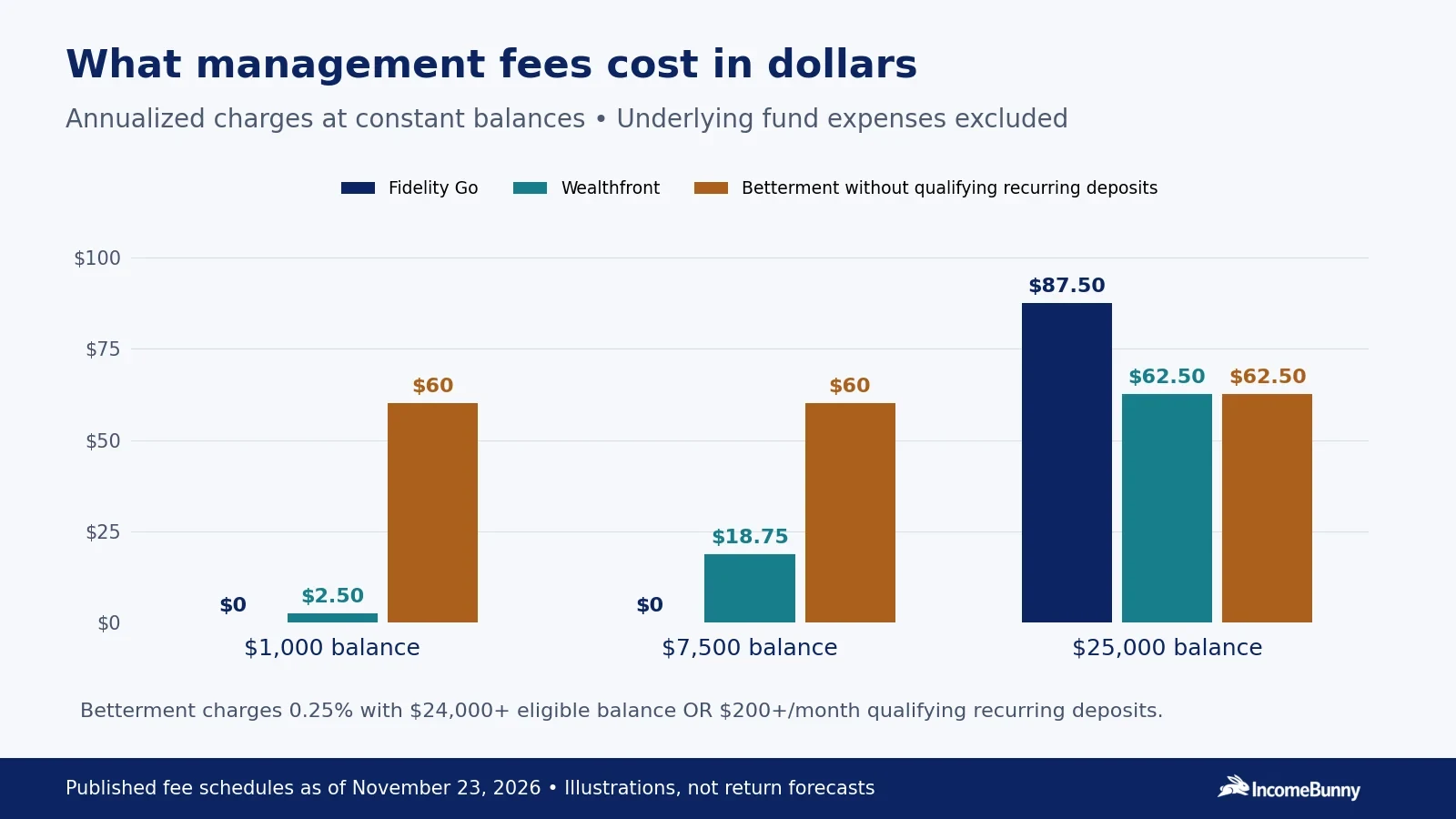
Betterment customers with qualifying recurring deposits receive 0.25% pricing at smaller balances. Actual fees change as balances and eligibility change.
Assume the displayed balance is the account holder’s only eligible balance, with no discounts or promotions. These are fee illustrations at unchanged balances, not forecasts of bills for accounts receiving deposits or earning returns. They exclude underlying fund expenses and differences in services. Betterment qualifies for 0.25% pricing at $24,000 even without recurring deposits.
At $25,000, Fidelity Go’s 0.35% advisory charge is $87.50 annually, while 0.25% is $62.50. Decide whether the included coaching and portfolio service justify the difference for you. A self-directed account without an advisory fee is another option if you can manage the investments yourself.
Also distinguish Roth services from taxable-account features. Fidelity describes Go’s tax-loss harvesting as a feature for qualifying taxable accounts. For a Roth IRA, prioritize allocation, rebalancing, costs, and useful help rather than assuming every advertised tax feature adds value inside the account.
Is Robinhood Gold’s 3% match worth the subscription?
Compare Gold with Robinhood’s free 1% match, not with receiving nothing.
Suppose you make an eligible $7,500 contribution and pay $5 monthly for Gold for 12 months. Under the current rates:
- Gold match: $7,500 × 3% = $225.
- Gold subscription: $5 × 12 = $60.
- Match minus subscription: $165.
- Free 1% match: $75.
- Extra value from Gold in this illustration: $90.
Counting only the extra two percentage points of match, the break-even contribution is $60 ÷ 2% = $3,000. Below that amount, the extra contribution match does not cover a full year of $5 monthly payments. This assumes that monthly plan, unchanged terms, and no value from other Gold benefits.
The calculation does not price the five-year retention condition, investment results, or a future transfer-out fee. A match is useful only if the account, costs, and commitment fit the way you plan to save.
Roth IRA contribution limits are the same across providers
For both 2026 and 2027, the combined regular contribution limit for your traditional and Roth IRAs is $7,500, or $8,600 if you are 50 or older by year-end, subject to having enough eligible compensation. Opening accounts at multiple firms does not multiply that limit.
Direct Roth contributions are also subject to modified adjusted gross income, or MAGI, limits:
| Filing status | 2026 MAGI phaseout | 2027 MAGI phaseout |
|---|---|---|
| Single or head of household | $153,000–$168,000 | $158,000–$173,000 |
| Married filing jointly | $242,000–$252,000 | $250,000–$260,000 |
The allowable contribution is reduced within the applicable range; at or above the upper endpoint, direct contributions are unavailable. Married filing separately taxpayers who lived with their spouse during the year have a special $0–$10,000 phaseout range in both years. Other filing situations have their own rules.
The IRS’s 2026 limits and 2027 announcement govern eligibility regardless of which broker you choose. Roth conversions and transfers follow different rules from regular contributions; do not assume an account-opening approval establishes that you qualify to contribute the full amount.
If income rules prevent a direct contribution, review the backdoor Roth IRA tax examples before treating a conversion as a routine deposit.
If you are still choosing between account types, our traditional IRA vs Roth IRA guide explains the tax differences. Once you have chosen a provider, follow the Roth IRA opening checklist to confirm eligibility, funding, and investment purchases.
A practical checklist before opening or transferring

Write down account fees, investment costs, and the funding routine you want before choosing a provider.
Match the account to a routine. If you will choose a diversified fund and keep contributing, a self-directed account may be sufficient. If choosing, purchasing, and rebalancing investments would stop you from getting started, compare managed services at your actual balance.
Separate deposits from purchases. In a public r/fidelityinvestments question, u/OldTeaching8407 asked how money from a bank could automatically buy an index fund. The distinction is practical: a scheduled bank transfer and a scheduled investment are different instructions. Confirm the holding, dollar amount, funding source, and first purchase date. After it runs, verify an executed purchase rather than assuming the deposit invested itself.
Get the total cost of your intended portfolio. Ask about account fees, advisory charges, fund expense ratios, purchase fees, and exit costs. For scale, a hypothetical 0.05% fund expense ratio costs about $5 annually on a constant $10,000 balance; 0.50% costs about $50. Add the relevant account or advisory fee rather than comparing only one line item.
Check access to help before it becomes urgent. Ask whether support handles contributions, beneficiary changes, transfers, and conversion paperwork. Find out whether any planning conversation is general guidance, a paid consultation, or an ongoing advisory relationship.
Review the transfer details. Ask the receiving firm which investments can move in kind, what must be sold, and whether fractional shares or proprietary holdings require special treatment. Confirm the departing firm’s charges and any match conditions. Coordinate a direct Roth-to-Roth transfer instead of casually withdrawing money to your bank.
Questions worth answering before choosing
Which Roth IRA has the highest return?
There is no single Roth IRA return or interest rate attached to a brokerage account. The investments determine market exposure and performance; fees and trading decisions affect the result. The same fund held at two brokers does not become a different investment because the account logo changes.
Focus on an affordable, diversified portfolio suited to your time horizon and risk tolerance. A provider’s account features cannot guarantee positive returns.
Does brokerage protection prevent Roth IRA investment losses?
No. SIPC explains that its protection concerns missing eligible cash and securities at a financially troubled member brokerage, within applicable limits. It does not reimburse ordinary market declines or losses from poor investment advice.
Treat security and custody protection as one check, alongside portfolio risk. Before committing, be able to name the exact account, the investments it will hold, what the next year’s fees could be, and how your next contribution becomes an investment.










Comments 1