

An emergency fund is money reserved for necessary, unexpected expenses or an interruption in income. Keep it accessible and separate from everyday spending. A common longer-term goal is three to six months of essential expenses, but begin with an amount you can build and a first milestone that fits your household’s likely needs.
The Consumer Financial Protection Bureau emphasizes that even a small reserve can help. You do not need to reach a full several-month target before the money becomes useful.


Use this guide to calculate your essential monthly budget, choose a coverage period, and set a realistic contribution. The worked example shows the arithmetic; the planning worksheet at the end gives you space to enter your own numbers and next action.
How much should you have in an emergency fund
Calculate essential expenses rather than salary
Start with the bills you would still need to pay during a disruption: housing, food, utilities, transportation, insurance, necessary care, and debt minimums. Include essential costs paid annually or quarterly as monthly equivalents. Adjust for costs that could change after losing a job, such as health insurance or commuting.
Our fixed expense guide helps identify recurring commitments. Then review variable expenses to estimate a realistic reduced budget. Groceries remain essential even though the amount varies; entertainment can usually be reduced. Avoid counting the same purchase and its credit card payment twice.
For illustration, suppose this is the essential monthly budget you would need to cover. These amounts describe a hypothetical household, not US averages.
| Essential monthly cost | Example amount |
|---|---|
| Housing | $1,250 |
| Groceries and household basics | $400 |
| Utilities, phone and internet | $220 |
| Transportation | $330 |
| Health insurance and essential care | $250 |
| Minimum debt payments | $200 |
| Other continuing essentials | $150 |
| Essential monthly total | $2,800 |
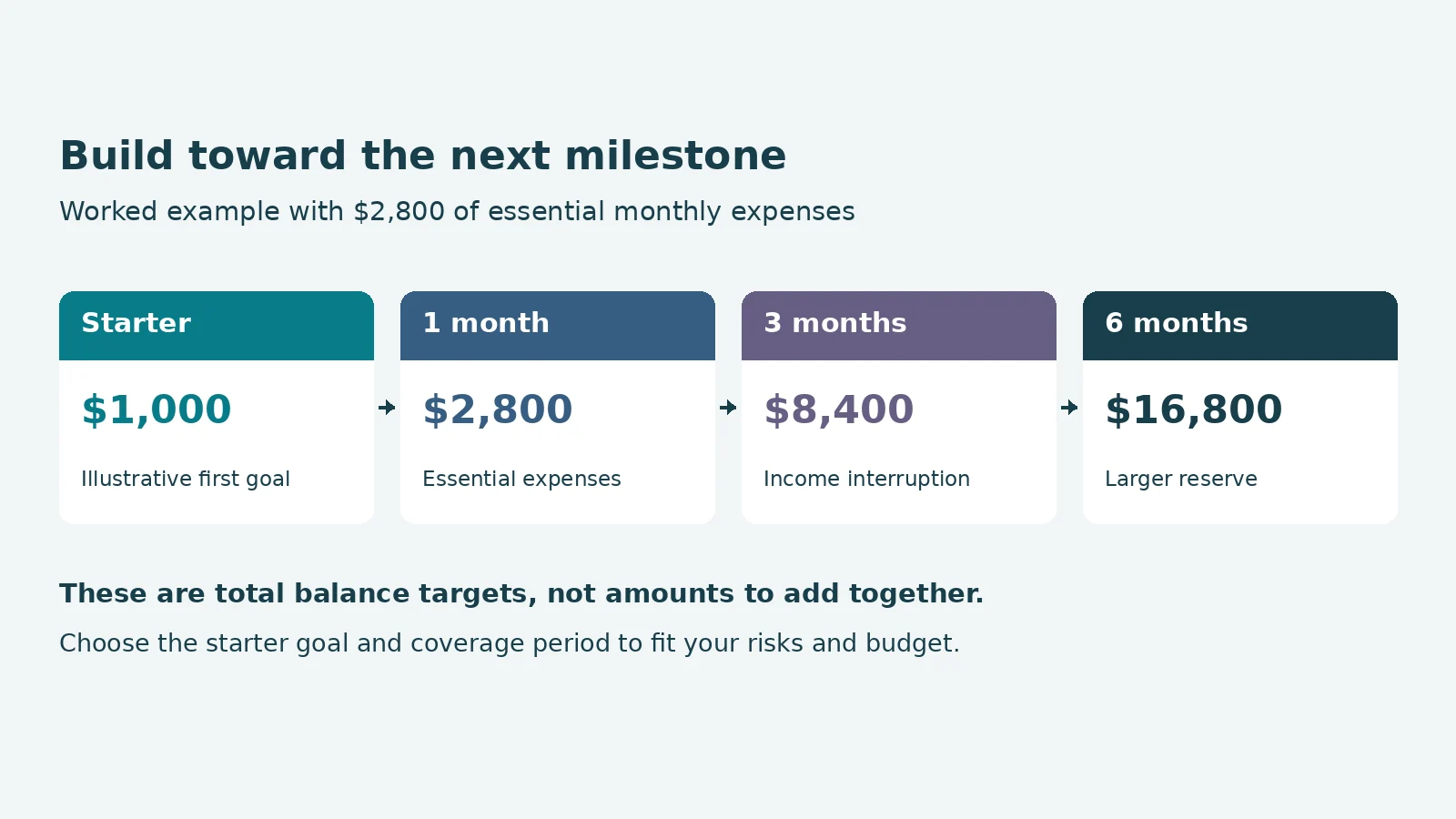
Emergency fund target = essential monthly expenses × months of coverage. At $2,800 per month, three months is $8,400 and six months is $16,800. These are total balance targets. Money already set aside for rent, taxes, a vacation, or another goal is not also available as an emergency reserve.
Agree which household costs the fund must cover and who will update those amounts. Our household budgeting app guide explains how to build and test a shared expense plan.
Choose the coverage period for your household
Vanguard’s guidance on income volatility identifies income variability, dependents, job security, and spending flexibility as relevant factors. Consider a larger reserve when income is irregular, one paycheck supports the household, or replacing work could take longer. Two incomes are less protective if both are exposed to the same employer or industry.
Treat three to six months as a planning range, not a guarantee or a deadline. Someone with more uncertainty may choose more. Record why you chose your coverage period, then revisit it when work, housing, health costs or household responsibilities change.
How to build an emergency fund in stages
Set a smaller next milestone alongside the full reserve target. Fidelity suggests starting with $1,000, then working toward several months of essential expenses. Your starter amount can differ: consider the unexpected essential bills you have faced and what you can realistically save.
Calculate the gap and an achievable timeline
Suppose the example household already has $900 genuinely available for emergencies and can save $250 each month. The gap to its $8,400 target is $7,500. Dividing $7,500 by $250 gives 30 monthly deposits. After eight deposits it has $2,900, enough to pass the one-month milestone along the way.
For your own plan, subtract available emergency cash from the next milestone, never taking the gap below zero. Divide the gap by the monthly contribution and round up to a whole number of deposits. A $100 gap with $250 monthly contributions needs one deposit. A positive gap with no contribution has no projected completion date until the plan changes. If you are saving toward more than one milestone, use a financial goal tracker to compare the planned balance with the amount you have set aside.
These estimates assume a constant contribution and no withdrawals, interest or changes in expenses. Recalculate after a withdrawal or budget change. Keep the starter balance inside the larger target; do not add the milestone amounts together.
Make the transfer fit your cash flow
Choose the contribution from money left after required spending and other commitments. Our gross vs net income guide explains why take-home pay is generally more useful than gross salary for this budget. For self-employment, allow for business expenses and taxes before treating receipts as spendable cash.
A recurring transfer after payday or a split direct deposit can make saving consistent. The CFPB explains both automatic-saving options. Check that the transfer will leave enough in checking for upcoming bills, and adjust it when pay changes. An automatic contribution that causes an overdraft defeats its purpose.
With irregular income, use a modest affordable baseline and add surplus only after it arrives. If there is no room to save, first check bill timing and essential costs. A small sustainable contribution is more useful than a larger promise that repeatedly needs to be reversed.
Where to keep your emergency fund
For a straightforward starting point, consider a separate savings account at an FDIC-insured bank or a savings account at a federally insured credit union. Compare access and fees alongside the annual percentage yield (APY). A high-yield savings account is still a savings account; the label alone does not establish insurance, availability or good terms. If you’re comparing where to hold the reserve, check how high-yield savings accounts handle transfers, fees and insurance.
FDIC deposit insurance generally covers eligible deposits up to $250,000 per depositor, per insured bank, per ownership category. Accounts in the same category at the same bank are combined for coverage; opening a second savings account does not create a fresh limit. At federally insured credit unions, NCUA share insurance provides coverage under its ownership rules, including up to $250,000 for a qualifying single-owner account.
| Before opening the account | What to verify |
|---|---|
| Institution and insurance | The actual bank or credit union and the coverage applicable to your ownership |
| Access | How you withdraw or transfer money and whether holds or transfer limits could delay it |
| Costs | Monthly fees, minimum-balance conditions and withdrawal or transfer charges |
| Rate | The current APY, whether it varies, and any conditions or temporary promotion |
| Practical use | You can sign in, recover access and move a small amount using your intended method |
Distinguish a deposit account from an investment
A money market deposit account at an insured bank can qualify for FDIC coverage. A money market mutual fund is an investment. The SEC’s explanation of money market funds makes clear that they are not FDIC-insured and can lose money. Similar names do not make the products interchangeable.
Stocks, crypto and other investments with fluctuating values are a poor default for money you may need immediately. A certificate of deposit can also be awkward for the first layer of emergency cash if early access brings a penalty or restriction. Read the terms before putting needed reserves behind a lockup. Gold can also lose value when you need the cash: see why gold can fall despite its safe-haven reputation before treating it as an emergency reserve.
Check who holds money behind an app
A nonbank financial app is not itself an FDIC-insured bank. The FDIC’s guidance on third-party apps explains that pass-through coverage depends on conditions and does not insure the nonbank company’s bankruptcy. Identify the underlying bank and understand the withdrawal route before relying on the app for urgent expenses.
Keep some immediately usable cash in an accessible account if your main savings requires transfers. A separate savings label should reduce casual spending while leaving you a workable way to pay an urgent bill. Test access with a small transfer before an emergency, including how the service describes weekend processing or holds.
When to use your emergency fund and rebuild it
Before withdrawing, ask whether the cost is necessary, unplanned, and difficult to delay without a serious consequence. Urgent treatment or an essential repair can qualify even if income continues. A holiday sale or a routine annual bill belongs in a different part of the budget.
| Situation | Planning response |
|---|---|
| Unexpected repair to the car needed for work | Consider the emergency reserve after checking the repair and any coverage |
| Known annual insurance premium | Build a separate planned-expense fund before it is due |
| Loss of income while rent and food still need paying | Use the reserve for essential spending and revise the budget |
| Vacation upgrade or optional purchase | Use discretionary savings or postpone it |
A planned-expense fund, often called a sinking fund, spreads a predictable cost across the months before it is due. A repair can be unexpected; regular maintenance is foreseeable. Keeping those categories separate makes the emergency balance a more honest measure of protection. For known costs, follow our sinking fund setup guide to spread the amount over the paychecks before the bill is due.
Review the plan after using the money
Record what you withdrew, the balance remaining, and the next contribution you can afford. Using the reserve for a qualifying emergency is what it is there for. Resume rebuilding when cash flow permits, and check whether the event revealed a recurring expense that needs its own budget line. If you need to check what you can afford to set aside each month, compare free budgeting apps for tracking expenses.
While building savings, keep required debt payments current. If high-interest debt is also a priority, choose a starter cushion and an affordable split between saving and extra repayment rather than assuming one rule fits every household. If the budget cannot cover essentials or minimums, contact creditors promptly and reassess the plan before scheduling more transfers.
Emergency fund planning worksheet
Fill in Word or print this page. Use monthly amounts and available emergency cash.
Date __________ Household or initials __________
A. Calculate essential monthly expenses
| Cost that must continue | Your monthly amount |
|---|---|
| Housing and required housing costs | $ ______________ |
| Groceries and household basics | $ ______________ |
| Utilities, phone and essential internet | $ ______________ |
| Transportation and required vehicle costs | $ ______________ |
| Health insurance and necessary care | $ ______________ |
| Child care, support and dependent care | $ ______________ |
| Required minimum debt payments | $ ______________ |
| Other essentials (include monthly share of annual bills) | $ ______________ |
| E. Essential monthly total (add the rows above) | $ ______________ |
B. Set your target and next action
| Planning item | Your entry |
|---|---|
| M. Months of coverage and reason | ________________ |
| T. Full reserve target: E × M | $ ______________ |
| P. Next milestone: starter amount or T | $ ______________ |
| C. Available emergency cash (exclude earmarked money) | $ ______________ |
| G. Gap to next milestone: P − C (minimum zero) | $ ______________ |
| D. Affordable monthly contribution | $ ______________ |
| Monthly deposits needed: G ÷ D (round up) | ________________ |
| Account provider and access method (no account number) | ________________ |
| First transfer date and amount | ________________ |
| Next review date | ________________ |
If G is zero, that milestone is funded. If G is positive and D is zero, revise the contribution or timeline. Estimates exclude interest and withdrawals. Review after a withdrawal or a change in essential costs, income or household needs.










Comments 9