


The debt snowball method pays off debts from the smallest balance to the largest. Make every required minimum payment, put your extra money toward the smallest debt, and roll its entire payment into the next debt when it is paid off. Your total monthly debt budget stays steady while the payment aimed at each remaining target grows.
Its main advantage is an early, visible win. Its main drawback is that a larger, higher-interest balance can keep accumulating interest while you tackle smaller debts. The Consumer Financial Protection Bureau describes snowball as a motivational alternative to paying the highest interest rate first, which can save more money.


Snowball is most useful when you can cover essentials and all minimums, have several balances, and need a straightforward order to follow. If the monthly budget does not cover those basics, start by stabilizing payments. Changing the repayment order cannot create money that is missing from the budget. If an unexpected bill could derail the payment plan, use the emergency fund worksheet to estimate a starter reserve you can build alongside it.
How to start the debt snowball method
1 List current debts from smallest balance to largest
Use recent statements to record each creditor, current balance, annual percentage rate (APR), minimum payment, due date, and any promotional deadline. Rank the balances, not the minimum payments or original loan amounts. For equal balances, targeting the higher APR first is a reasonable tie-breaker.
Keep mortgage, car and other required payments in your budget even if your snowball list focuses on credit cards, personal loans and agreed medical payment plans. Review overdue accounts and special repayment terms separately before committing extra money. A balance-only ranking does not account for the consequences of missing a payment.
2 Set an extra payment you can repeat
Start with the cash you can actually spend. Our gross vs net income guide explains why take-home pay is generally the useful starting point for a household budget. For irregular income, build the routine payment around a conservative amount, then add genuinely available surplus after it arrives. Use the 50/30/20 budget worksheet to separate required minimums from the extra payment you can afford.
Subtract essential spending, required debt minimums, and money reserved for upcoming nonmonthly bills. Keep a cash cushion for surprises so a repair does not immediately send spending back onto a card. The CFPB’s emergency fund guide notes that even a small reserve can help; the appropriate amount depends on your circumstances.
Separate fixed expenses, such as rent or a flat subscription, from costs that fluctuate. Then review variable expenses for realistic savings. Cutting takeout by $40 only adds $40 to your snowball if you actually redirect that cash rather than spend it elsewhere.
3 Pay every minimum and concentrate the extra
Pay at least the amount due on every account, on time. Add the extra payment to the smallest balance. Avoid spreading the extra evenly across all debts if your goal is to finish the first balance quickly. Autopay can help with minimums, provided the payment account has enough cash; monitor statements and scheduled withdrawals.
4 Roll the payment forward and keep the budget intact
When the target is paid off, add its full planned payment to the next-smallest debt’s payment. If a $30 minimum plus $100 extra clears one debt, the next target receives an additional $130, not just $30. Do not reduce the overall budget simply because a required minimum disappears or falls.
If the final payment is smaller than the amount you budgeted, direct the unused portion to the next target once you confirm the payoff amount and payment arrangements. The CFPB’s free debt reduction worksheet provides a printable place to record balances, payments and payoff dates.
Debt snowball example with interest included
Suppose you have the following current debts and can pay $400 per month toward them. The medical payment plan is genuinely interest-free under its agreement; it is not a deferred-interest promotion. All accounts remain current, and you make no new purchases or borrowings.
| Snowball order | Starting balance | APR | Monthly minimum |
|---|---|---|---|
| Medical payment plan | $500 | 0% | $50 |
| Card A | $1,500 | 18% | $45 |
| Card B | $3,000 | 27% | $90 |
| Total | $5,000 | — | $185 |
Your extra payment is $400 − $185 = $215. Month one therefore sends $265 to the medical plan, $45 to Card A and $90 to Card B.
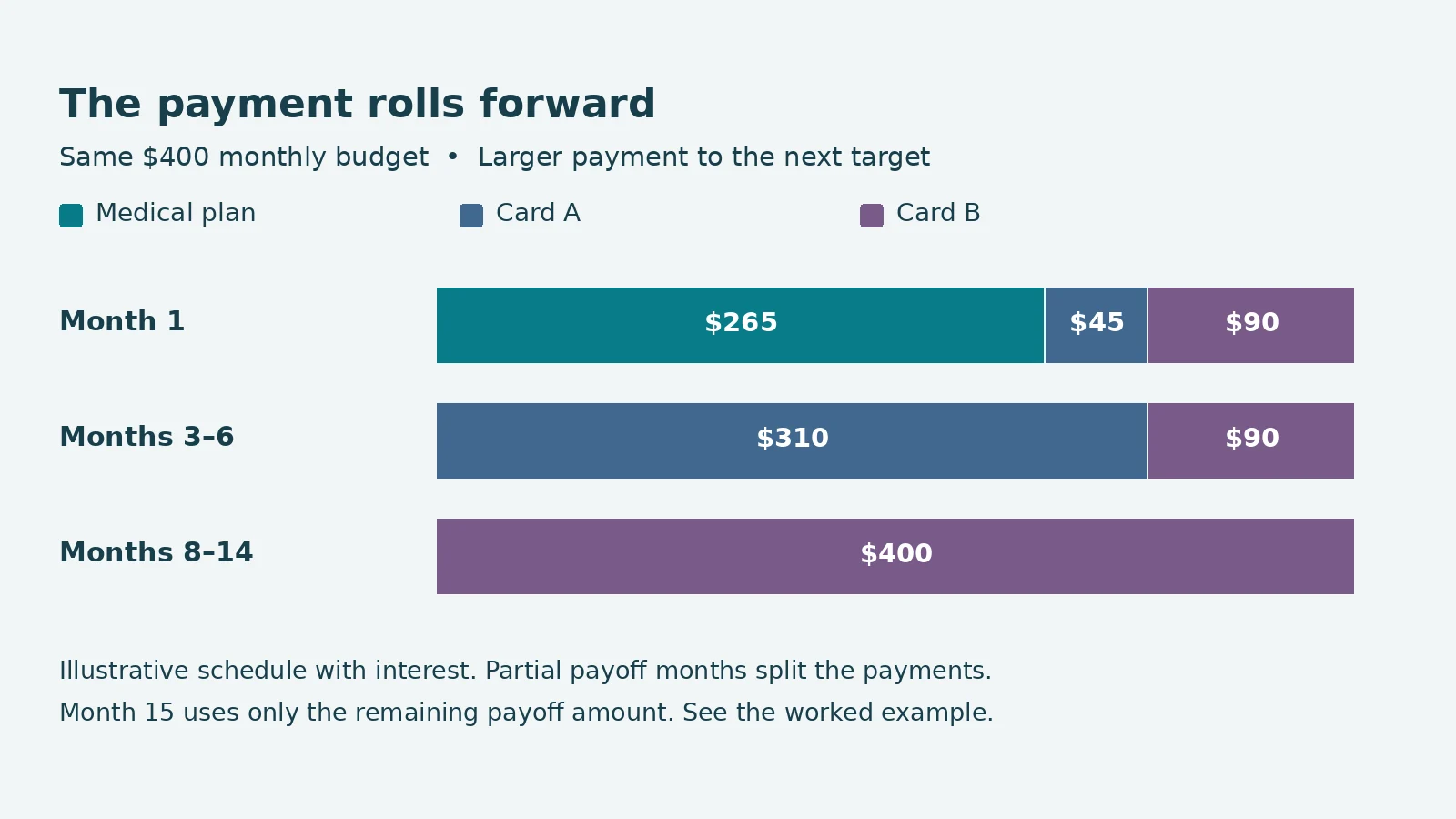
In month two, only $235 remains on the medical plan. Pay that off and send the unused $30 to Card A, which receives $75 including its $45 minimum. Card B still receives $90. The total remains $400.
From month three, Card A receives $310 and Card B receives $90. Card A clears in month seven with a $247.57 payment; the remaining $152.43 goes to Card B. From month eight, the full $400 targets Card B until the last payment of $244.87 in month 15.
Calculation assumptions: interest is added monthly at APR ÷ 12, rounded to the nearest cent with half cents rounded up, before each month-end payment. Minimums stay fixed, rates do not change, there are no fees, and unused payoff money moves to the next debt within the same month. Actual credit cards often calculate interest daily, so statements and real payoff dates will differ.
Debt snowball vs avalanche
The debt avalanche method directs extra money to the highest APR first while maintaining every other minimum. With the same payment budget and otherwise comparable terms, this prioritizes the most expensive borrowing. Snowball instead prioritizes completing smaller balances. Compare both schedules before choosing; neither method guarantees that you will stick with it.
| Result for the same example | Snowball | Avalanche |
|---|---|---|
| First extra-payment target | Medical plan at 0% | Card B at 27% |
| First balance paid in full | Medical plan in month 2 | Medical plan in month 10 |
| All three debts paid off | Month 15 | Month 15 |
| Total interest | $844.87 | $696.78 |
| Total paid | $5,844.87 | $5,696.78 |
Avalanche saves $148.09 in this illustration. Both finish in month 15 because payoff dates are grouped into whole monthly payments, but avalanche’s final payment is smaller. Its medical plan also finishes through regular $50 minimum payments, even though Card B receives the extra money first.
Choose motivation with the interest cost visible
Snowball can suit someone who benefits from fewer outstanding balances and clear milestones. Avalanche is more attractive when the APR gap is large or minimizing interest is the main objective. Wells Fargo’s comparison explains these tradeoffs and emphasizes keeping current on bills before accelerating repayment.
There is evidence behind the small-win idea, but it has limits. A 2012 study by David Gal and Blakeley McShane, using data from a debt settlement firm, found that completing debt accounts predicted debt elimination. That association does not establish that snowball is cheaper, fastest, or best for every borrower.
A hybrid is also possible: clear one small balance, then switch extra payments to the highest APR. Recalculate the schedule so you can see the cost of that choice. If your smallest debt also has the highest APR, both approaches initially point to the same target.
When a deadline or cash shortage changes the order
A deferred-interest purchase needs separate attention. Under these offers, failing to clear the promotional balance by its deadline can trigger interest dating back to the purchase. Minimum payments may not be enough to avoid that charge. Check the statement and ask the issuer how payments are allocated; the CFPB explains the deferred-interest rules. A true 0% APR promotion has different terms.
If you cannot cover essentials or a minimum payment, pause extra snowball payments and contact the creditor promptly. Explain what you can afford, why the payment is difficult, and how long you need help. The CFPB’s guidance for unaffordable card bills also points to credit counseling. Ask about services and fees before enrolling, and be wary of instructions to stop making minimum payments.
Build a debt snowball worksheet you will maintain

A notebook, spreadsheet or budgeting app can all work. If you need help seeing how much room your spending leaves for extra payments, compare free budgeting apps for tracking spending. Start with one row per debt and columns for current balance, APR, current minimum, due date, planned extra payment and actual payment. Add a separate field for promotional deadlines. Use account nicknames rather than full account numbers. For help turning a payoff plan into a routine, see the exercises in our personal finance books for budgeting and debt.
Keep the amount allocated to repayment visible above the list. In the worked example, that is $400. Update balances from statements each month, then check that planned payments fit the cash available before their due dates. Tracking a debt does not automatically send a payment, and a forecast is not confirmation that an account is paid off.
Use these checks before trusting a payoff calculator
Enter the extra payment in the correct field. Some calculators ask for the amount above all minimums; others ask for the entire repayment budget. In this example those numbers are $215 and $400. Confusing them can substantially distort the forecast.
Check whether the calculator includes interest, fixes or recalculates minimums, rolls unused money forward immediately, and keeps payments constant as debts disappear. Compare snowball and avalanche with exactly the same balances, rates and total budget. Use the resulting date as a planning estimate, then reconcile it against actual statements.
A monthly review that keeps the snowball moving
Confirm that every payment posted and each minimum was met. Record interest, fees and any new spending separately from principal reduction so a smaller balance does not conceal fresh borrowing. Check that the next target received the freed payment and that no promotional deadline is approaching.
If a balance grows despite payments, look for new charges, fees, or interest exceeding the payment. If an unexpected expense absorbs the extra money, revise that month’s plan and protect required payments. Resume the extra only when the cash is available. When a debt reaches zero, verify any remaining charges with the creditor before treating its planned payment as fully available for the next target.










Comments 1