


Market update: November 19, 2026. Price observations through November 18.
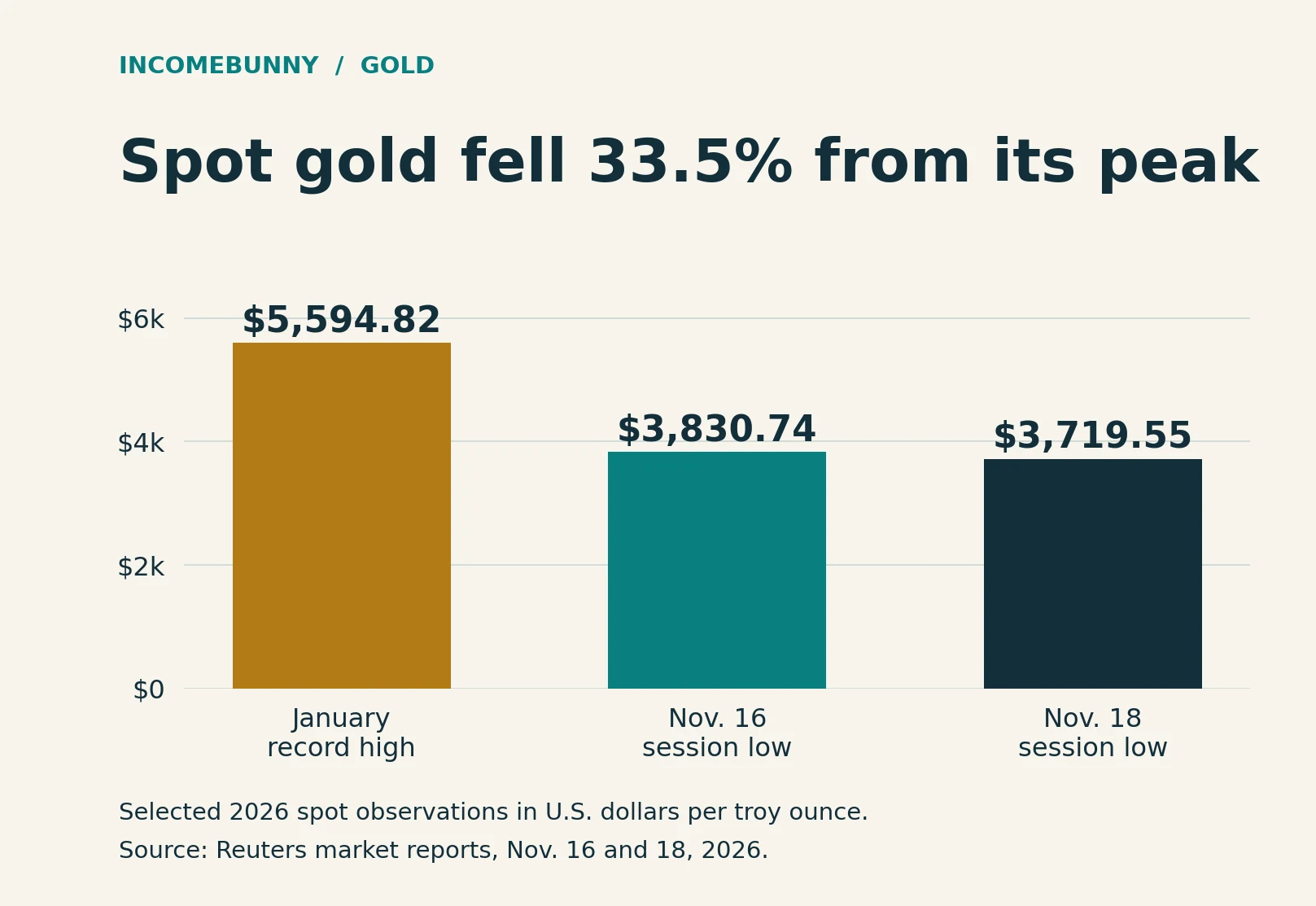
Gold fell in November as the U.S. dollar strengthened, Treasury yields rose, and investors prepared for the possibility of further Federal Reserve rate hikes. Reuters reported that spot gold touched $3,719.55 per troy ounce on November 18, about 33.5% below its January record of $5,594.82. [11] [12]


Imagine Maya checking that price on her phone. She bought a small gold bar after watching grocery bills climb. She wanted to protect some of her savings, and the bills were still high. Yet her gold was worth less. How could both things be true?
What happened to gold in November 2026?
Gold had already hit $3,830.74 on November 16 before setting a lower intraday low two days later. The comparison below uses three spot-price observations: January’s record high and two November session lows. [11] [12]
The Fed released minutes from its October meeting on November 18. Investors had already been weighing the chance of another rate increase, and gold was under pressure before the release. A change in expectations can move gold before the Fed makes a decision. [12] [13]
That brings Maya to a question she missed when she bought the bar: what could the same money earn somewhere else?
1. Gold has competition: money that pays you to wait
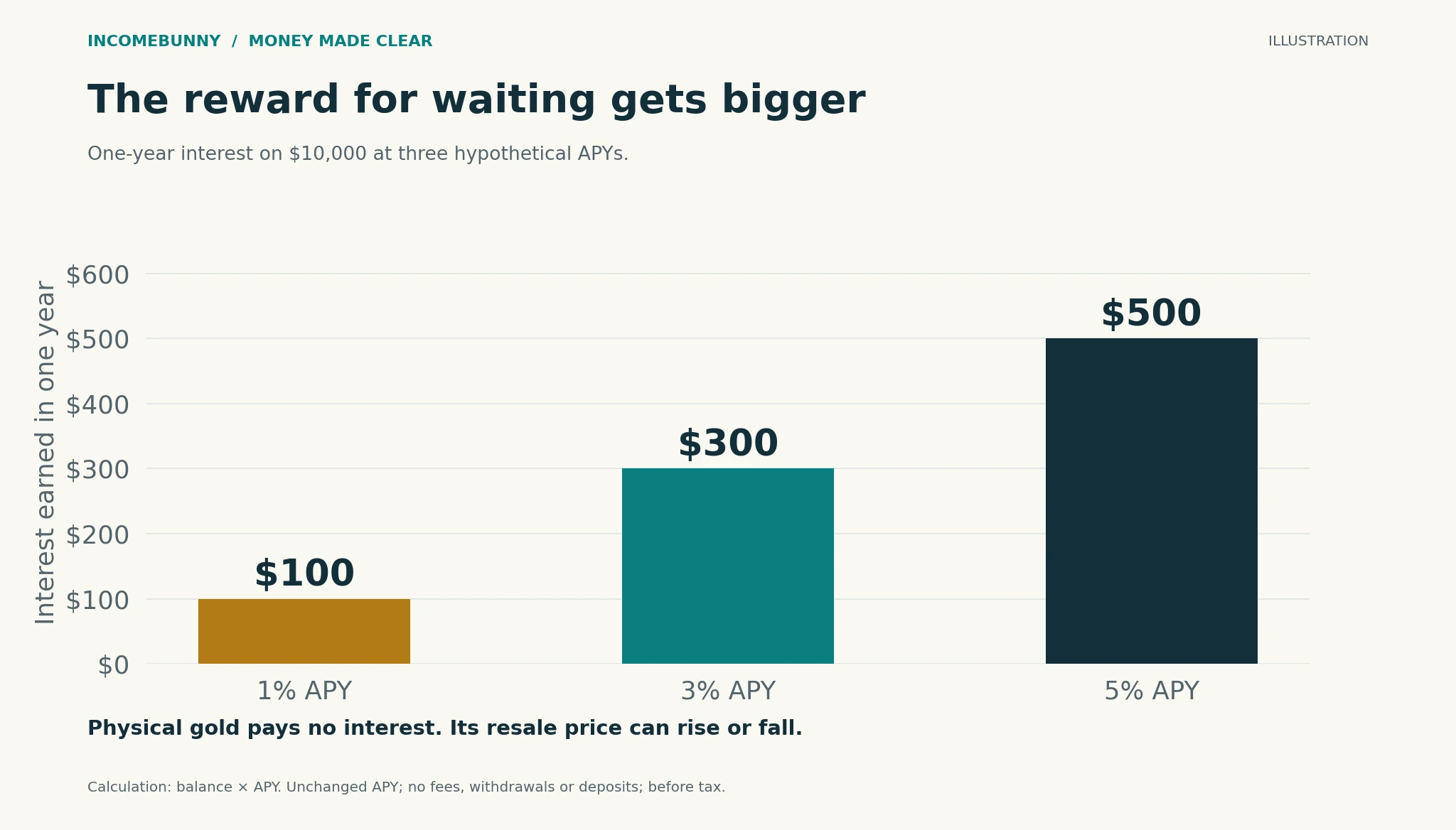
In this example, Maya and her friend Daniel each start with $10,000. Maya buys gold. Daniel puts his money in a hypothetical high-yield savings account paying 5% annual percentage yield (APY).
Assuming the rate stays unchanged and Daniel makes no deposits or withdrawals, he earns $500 before tax. Maya’s gold pays no interest. Her outcome depends on its resale value and ownership costs.
At 1% APY, Daniel would earn only $100. At 5%, the alternative has become much harder to ignore.
| Hypothetical annual APY | Interest on $10,000 after one year |
|---|---|
| 1% | $100 |
| 3% | $300 |
| 5% | $500 |
Illustrations, not current offers. Assumes an unchanged APY, no fees, and no withdrawals; excludes tax.
This is opportunity cost: the benefit you give up by choosing one use of your money over another.
Maya does not receive a $500 bill for holding gold. She forgoes a possible $500 return elsewhere. Gold might still outperform the account if its price rises enough. It simply has a higher hurdle to clear.
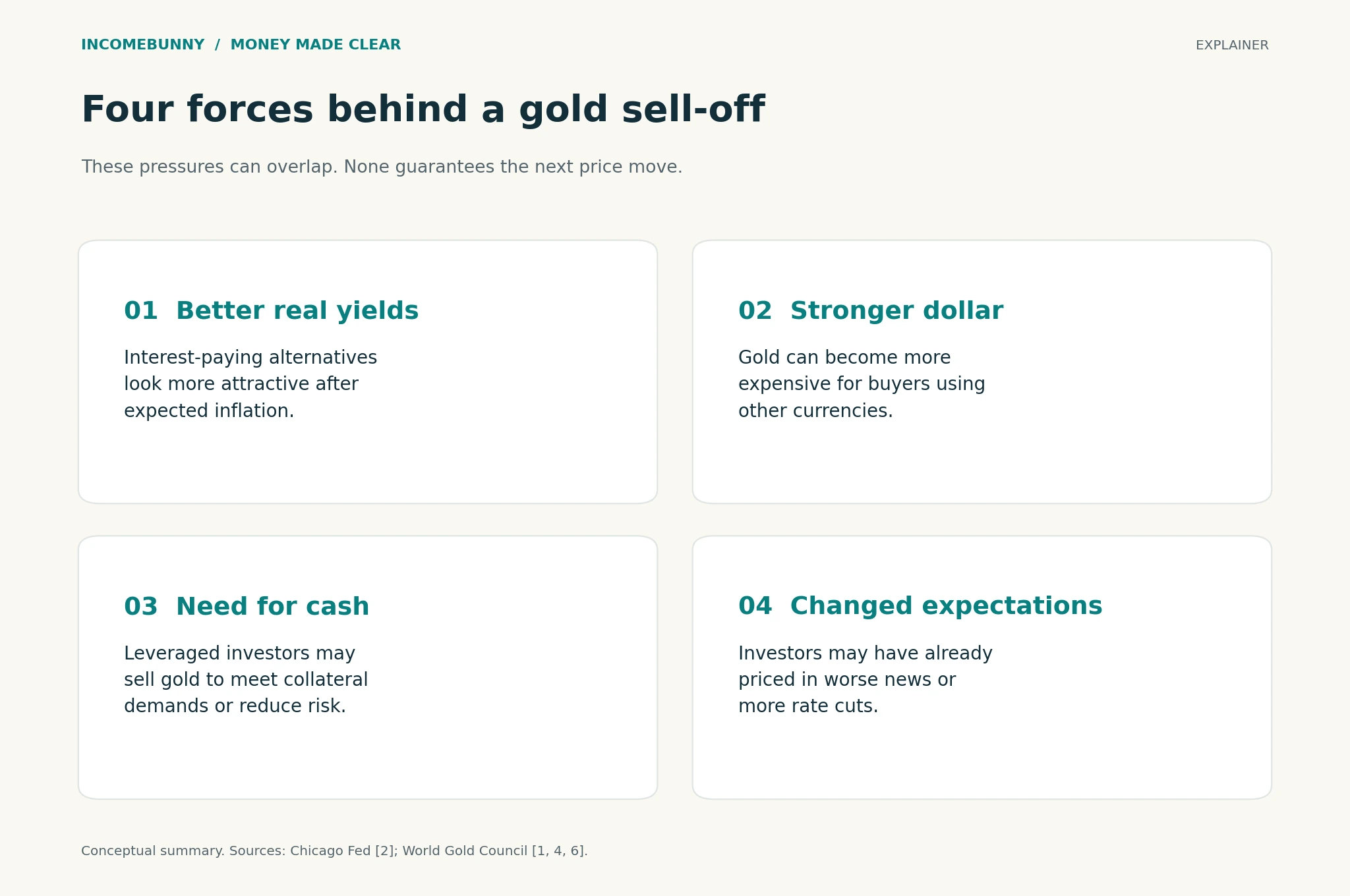
Research from the Federal Reserve Bank of Chicago identifies expected real interest rates, inflation expectations, and pessimism about the economy as important influences on gold. None works as an automatic price switch. [2]
Why the Fed matters before it changes rates
The Federal Reserve influences short-term interest rates. Markets also price in what investors expect it to do next.
On September 16, 2026, the Fed raised its target range by a quarter percentage point to 3.75%–4%, citing elevated inflation. [3]
That policy rate is different from a savings account’s APY or a 10-year Treasury yield. They can move differently.
By November 2, the World Gold Council was linking gold’s recent weakness partly to changes in expectations for the Fed’s future rate path and a shift toward bonds. [4]
That explains why gold can react to an inflation report or a central bank speech before any new rate decision occurs. Investors change their comparisons immediately.
2. Inflation matters—but so does the return after inflation
You may have heard that gold protects against inflation. Why, then, would higher inflation coincide with falling gold prices?
Because the inflation rate is only part of the comparison.
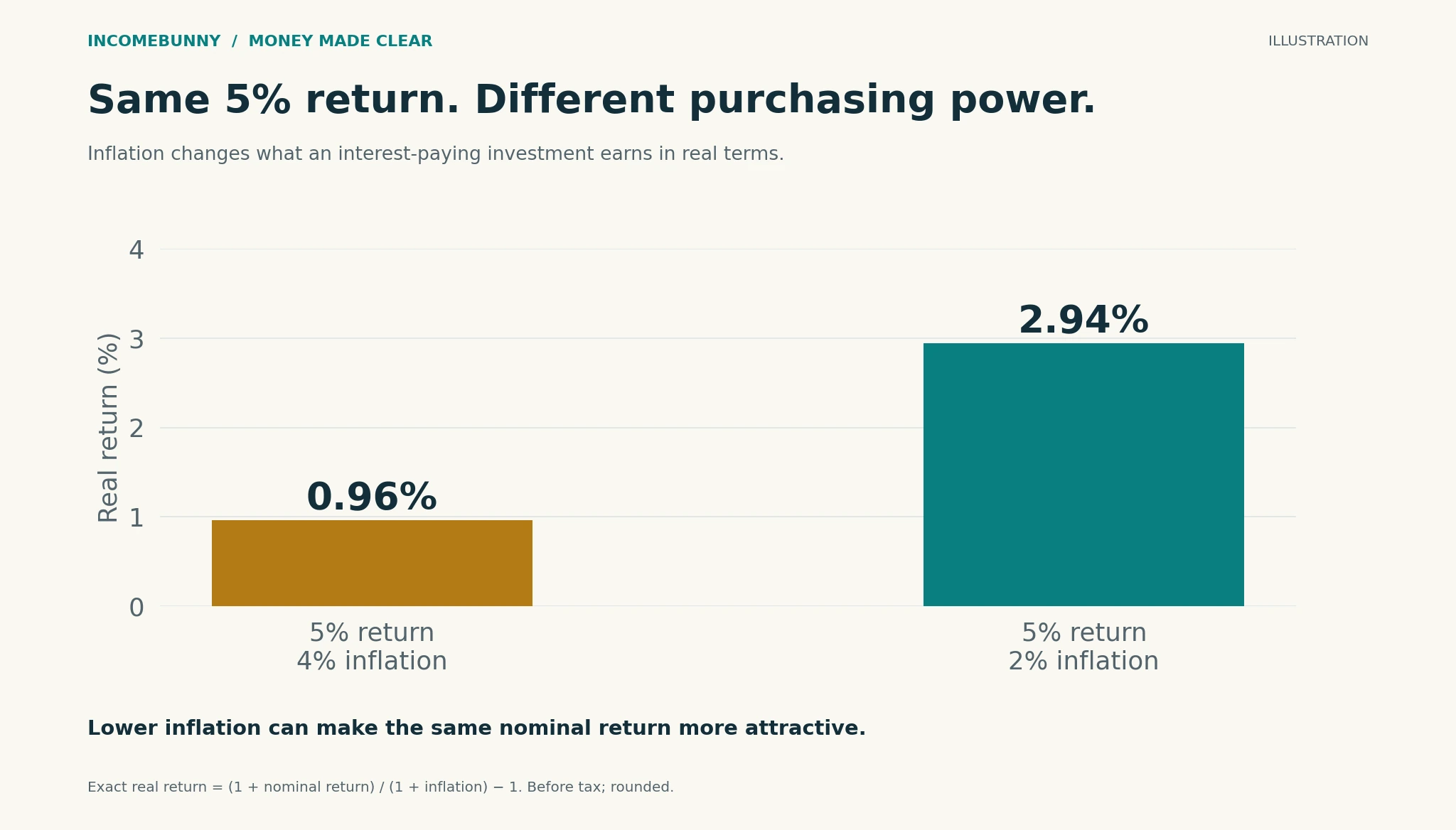
Imagine a hypothetical investment paying 5% while prices rise 4%. Its approximate return after inflation is 1%, before tax.
If it still pays 5% but inflation falls to 2%, that approximate return becomes 3%. The headline interest rate has not changed, but the purchasing-power reward has improved.
This is the idea behind a real return: what remains after accounting for inflation. Subtracting inflation from the stated return is a useful approximation; the exact calculation differs slightly.
When Maya compares Daniel’s 5% with the price of her bar, she needs to ask what that interest will buy. Gold investors make a similar comparison using expected inflation and bond yields. Investors often watch inflation-protected Treasury yields as a market measure of real yields. Chicago Fed research examines that relationship, while cautioning that statistical associations do not establish causation. [2]
Gold’s inflation protection also depends on the period you measure. The World Gold Council’s research distinguishes its long-term record from its less dependable short-term performance. [5]
A higher grocery bill is not a reliable signal that gold must rise next week.
3. A stronger dollar can make gold harder to buy
International gold prices are commonly quoted in US dollars. Buyers using other currencies also face an exchange rate.
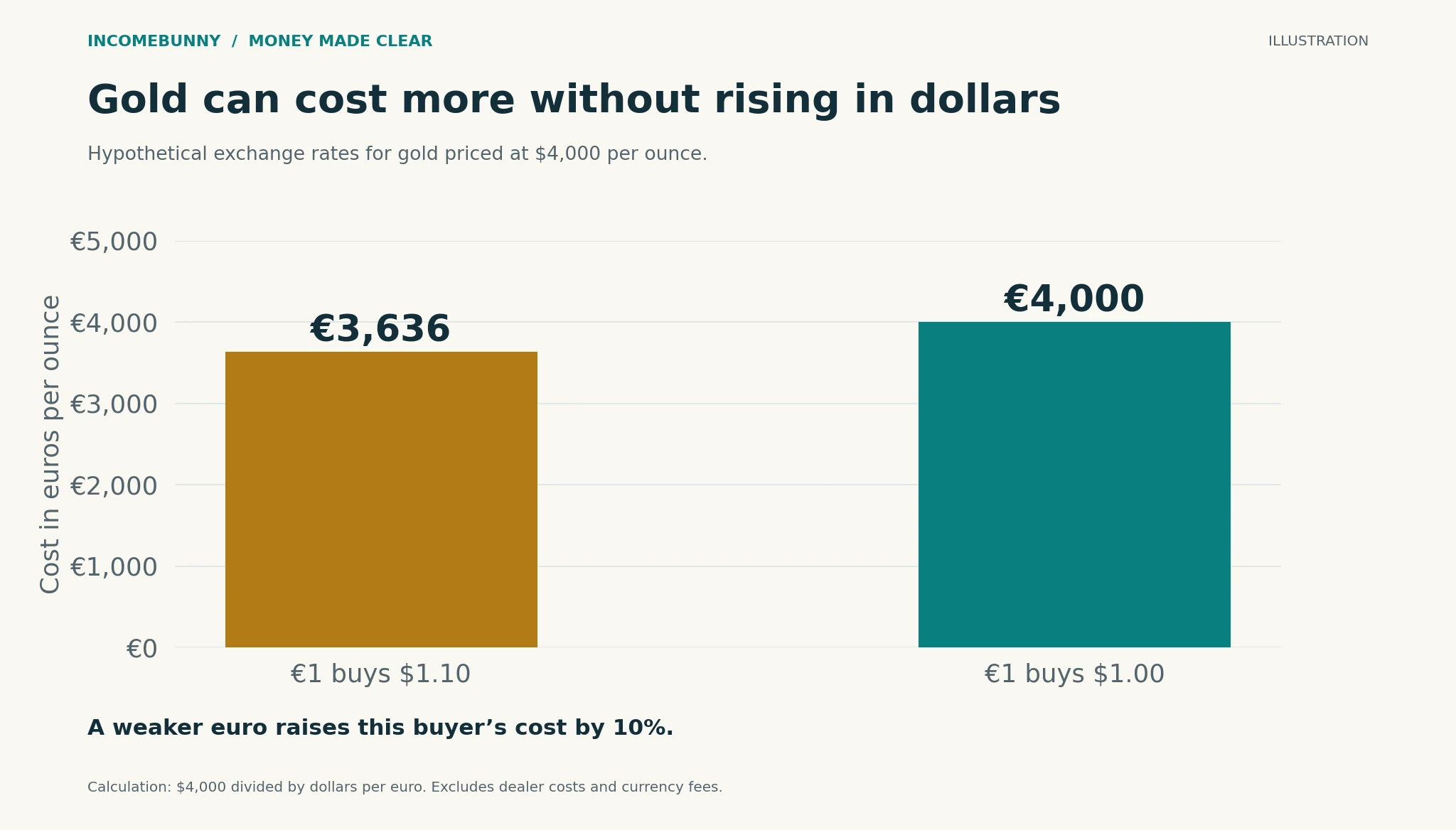
Suppose gold costs $4,000 an ounce. If one euro buys $1.10, that is about €3,636. If the euro weakens until it buys only $1, the same dollar gold price costs €4,000.
Gold has become 10% more expensive for that euro buyer even though its dollar price has not moved.
That can discourage purchases and put pressure on the dollar gold price. It also explains why a US reader and a reader abroad can experience different returns.
In its September 2026 review, the World Gold Council identified rising Treasury yields, a stronger dollar, and shrinking futures positions as contributors to gold’s decline. [6]
But currency and interest rates still do not explain every month. October provides a useful warning against making the story too simple.
4. Investors sometimes sell gold because they need cash
Return to Maya. She bought gold with her own savings and can afford to wait.
Now imagine a trader whose gold exposure involves borrowed money. If losses elsewhere trigger demands for more collateral, waiting may no longer be an option. The trader may sell gold to raise cash or reduce risk.
This helps explain why gold can fall during a stock-market sell-off. Something can be useful to own over time and still be useful to sell in an urgent cash squeeze.
The World Gold Council’s October analysis attributed weakness partly to reduced leveraged exposure, changing Fed expectations, and rotation into bonds. It also noted that gold and yields fell together that month, contrary to the familiar inverse relationship. [1]
Meanwhile, global gold ETFs recorded inflows despite the price decline. Some investors were buying while other parts of the market were selling. [1]
“Gold is falling” does not mean “everyone has stopped wanting gold.” It means the balance of buying and selling is clearing at lower prices.
5. A safe haven can already have safety priced in
Imagine two versions of the same frightening headline.
In the first, it is a complete surprise. Investors rapidly seek protection.
In the second, they have spent months preparing for it and buying gold. The event arrives, but it is less disruptive than expected. Some investors take profits.
The headline is still bad. The change relative to expectations is different.
This is why reading the news alone cannot tell you where gold should trade. You also need to ask what investors expected, what they already owned, and whether they now need cash.
“Safe haven” describes a potential role in a portfolio. It does not promise a stable balance every time you open an app.
Gold vs. savings accounts and Treasury securities
Daniel’s interest looks reassuring. But his choice needs scrutiny too. A savings account and a long-term Treasury are different tools.
| Option | How it produces a return | What to watch for |
|---|---|---|
| Physical gold | An increase in resale value | Price declines, dealer spreads, storage, and insurance costs |
| Savings account | Interest on the deposit | Variable APY, fees, access conditions, and inflation |
| Individual Treasury security | Interest or discount, depending on the security | Price changes if sold before maturity; access and maturity considerations |
| Gold fund | Changes in the fund’s value, less expenses | Market losses and product-specific fees and structure |
At an FDIC-insured bank, eligible deposits generally have coverage up to $250,000 per depositor, per insured bank, per ownership category. Investment products are not covered by deposit insurance simply because a bank sells them. [7]
Treasury notes pay fixed interest every six months. Their coupon does not increase when rates on newly issued notes rise. [8]
Existing fixed-rate bonds generally fall in market value when market interest rates rise. If Daniel needs to sell a long-term Treasury early, he could receive less than he paid. [9]
That changes the question from “Which asset is safest?” to “Which risk can I afford for this particular money?”
Before buying the dip, calculate the price of getting out
When Maya sees gold fall below her original purchase price, she considers buying a second bar. She wants to know how much she could recover if she needed to sell next week, so she asks the dealer two questions:
- What is the total price to buy this exact bar today?
- What would you pay me to buy it back today?
Suppose the answers are $4,200 and $3,950. Her immediate resale gap is $250—about 5.95% of the purchase price.
That is before any storage or insurance costs. The quoted market price could stay flat while her personal investment starts at a loss.
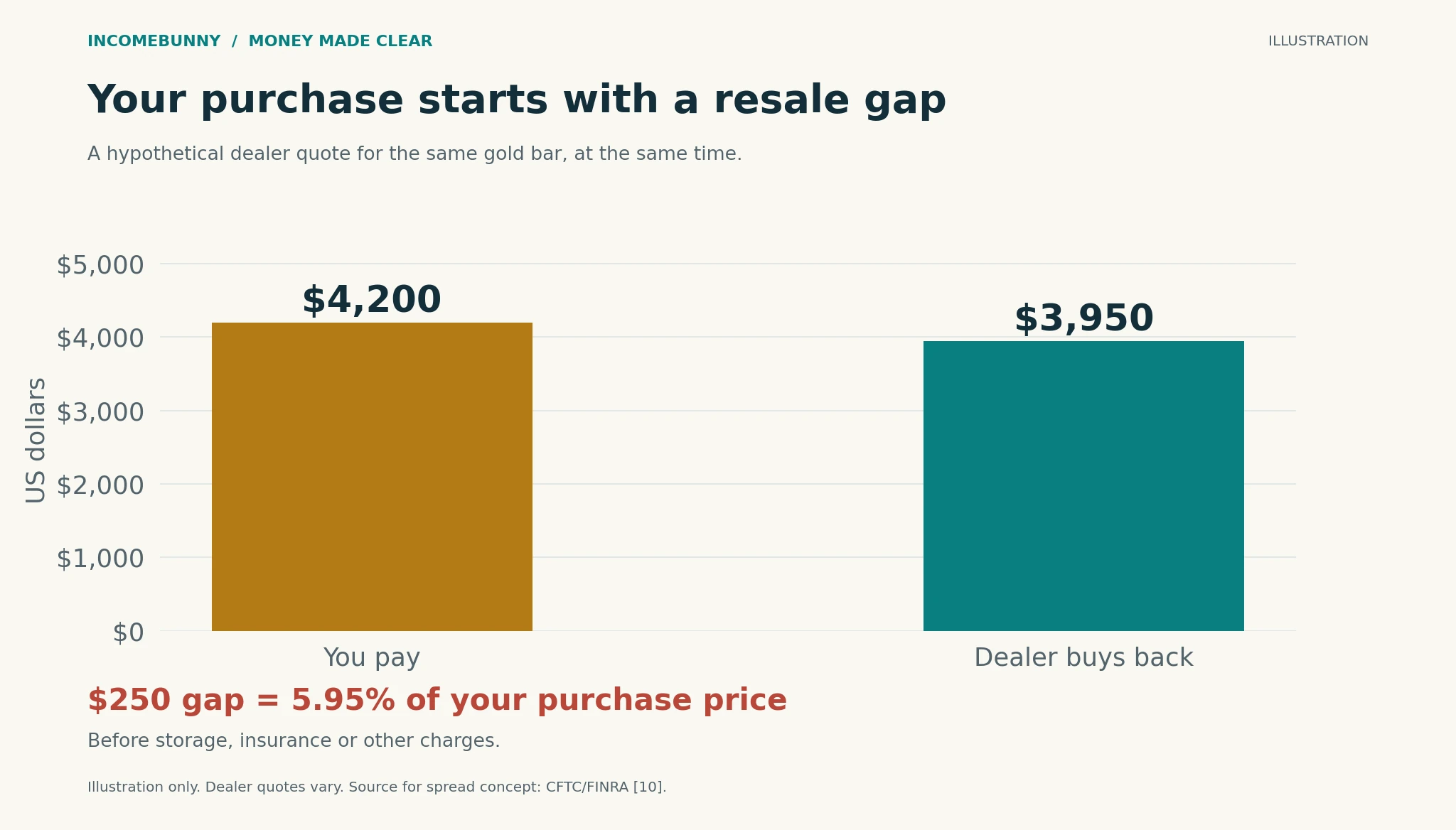
The CFTC and FINRA advise buyers to examine dealer spreads and costs before buying physical precious metals. The spread is the difference between the dealer’s selling and buying prices. [10]
Ask for the all-in purchase price, the buyback quote, and any custody or withdrawal charges in writing. If comparing a fund instead, examine its expense ratio, holdings, and trading costs. Similar gold exposure can come with different ownership terms.
A 30% fall requires more than a 30% recovery
Suppose a gold holding falls from $10,000 to $7,000.
A 30% gain on $7,000 adds $2,100, taking it to $9,100. Getting back to $10,000 requires approximately 42.9%.
| Decline from purchase value | Gain needed to recover |
|---|---|
| 10% | 11.1% |
| 20% | 25% |
| 30% | 42.9% |
| 40% | 66.7% |
Calculated as loss ÷ remaining value; excludes fees and taxes.
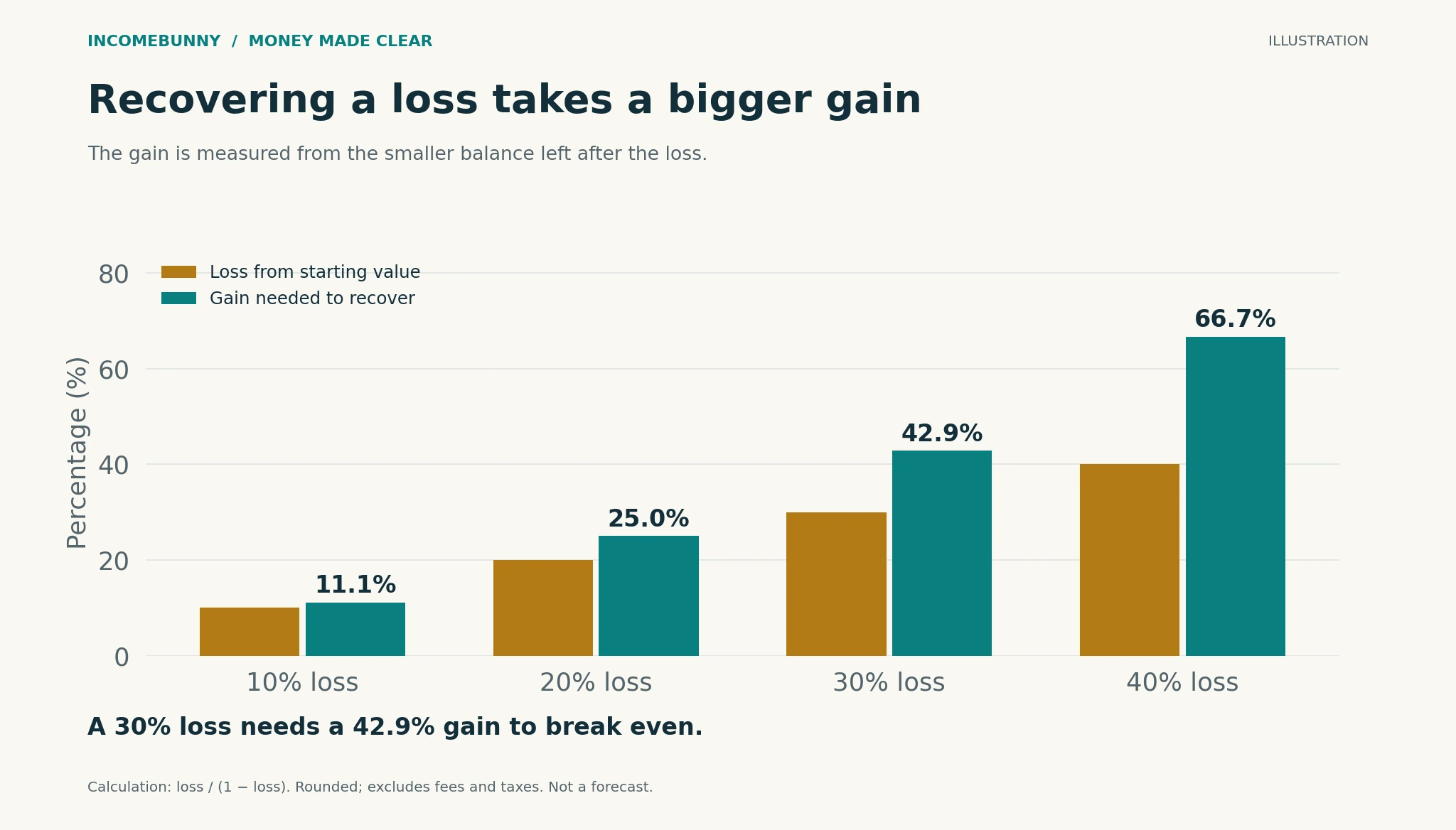
If Maya needs the money soon, the size of the required gain matters more than a prediction about when gold might recover.
What should you do with your own savings?
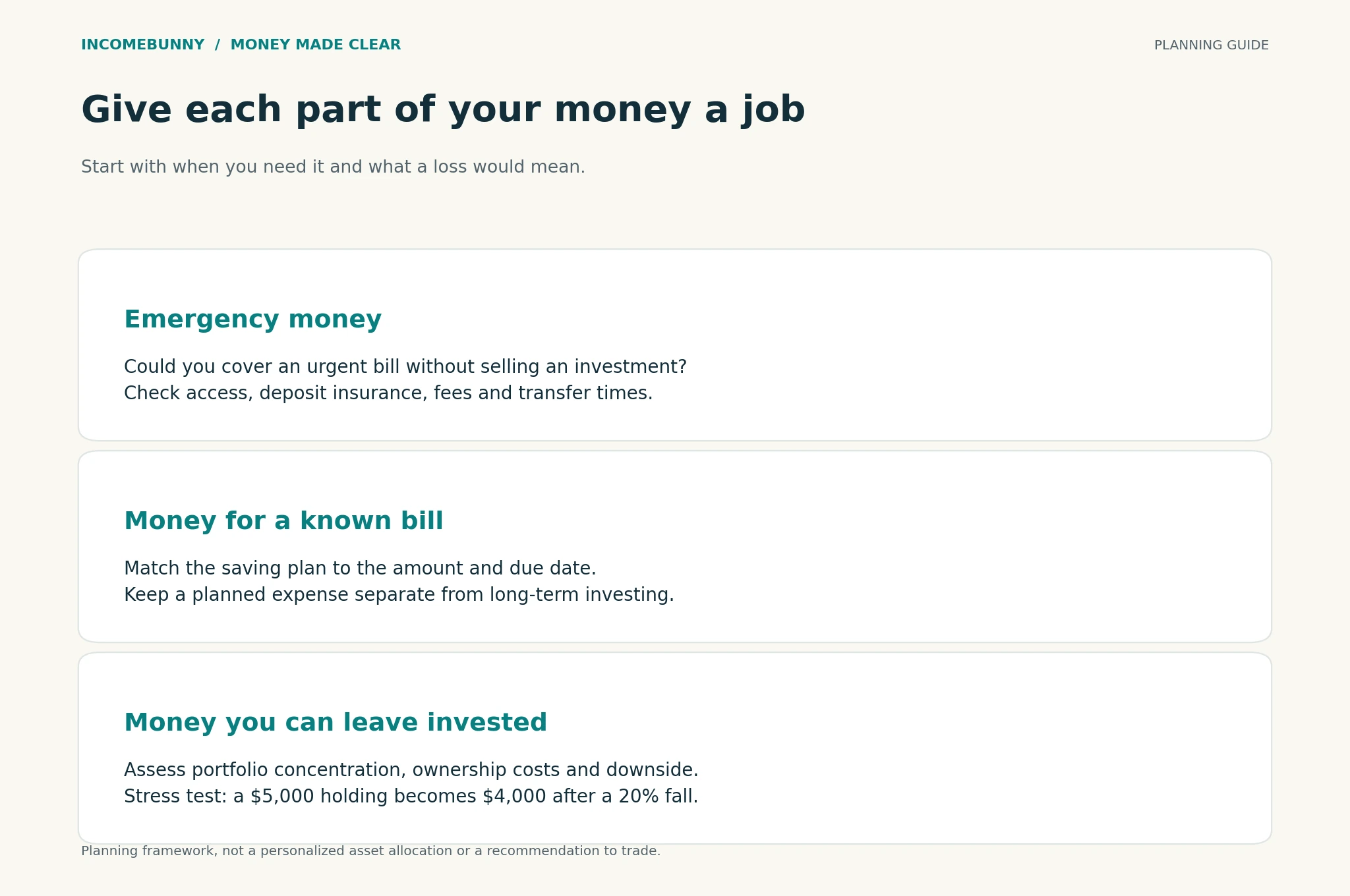
Start by naming the purpose of the money. A medical reserve, next year’s tuition, and a long-term investment portfolio have different requirements.
If this is emergency money
Ask whether you could cover an urgent bill without selling gold during a slump. Our emergency fund guide helps you calculate a reserve and check access to it.
For a known future bill, use a separate plan. Our sinking fund guide explains how to spread that expense across paychecks.
Choose the contribution from money actually available after essential commitments; our gross vs. net income guide explains the difference between headline income and take-home pay.
If you already own gold
Write down your original reason for owning it, its current share of your investments, and when you might need the cash.
A price decline alone cannot establish whether selling is right. The more useful test is whether the holding still fits your purpose and whether its size exposes you to a loss you cannot afford.
If you are thinking of buying
Test a further hypothetical 20% decline. A $5,000 purchase would become $4,000 before costs. Would that interfere with rent, debt payments, or a planned expense?
If the answer is yes, the purchase may be too large or the money may have a more urgent job. Buying in smaller installments can spread entry prices, but it cannot remove investment risk.
What to watch next without staring at the chart
Use these as context, not trading instructions.
| Indicator | The question it helps answer |
|---|---|
| Real Treasury yields | Are interest-paying alternatives becoming more attractive after expected inflation? |
| US dollar | Is currency strength adding pressure to dollar-priced gold? |
| Fed announcements and inflation reports | Has the expected path of interest rates changed? |
| ETF flows and futures positioning | Are different investor groups buying, selling, or reducing leverage? |
Check which explanation the evidence supports. If gold falls while yields also fall, a rate-only explanation is incomplete—as October’s analysis illustrates. [1]
Frequently asked questions
Why is gold going down when inflation is high?
Investors may expect tighter monetary policy, better real returns elsewhere, or a stronger dollar. Selling to raise cash can add pressure. Gold is not a dependable hedge against every short-term inflation increase. [2] [5]
Does gold always fall when interest rates rise?
No. Expected real yields matter alongside currency moves, investment demand, and market stress. Relationships can change, and several forces can work against one another. [2] [6]
Is gold safer than a savings account?
They protect against different risks. Gold’s price fluctuates and physical ownership has costs. An eligible insured bank deposit offers protection against covered bank failure within insurance limits, but its purchasing power can still be eroded by inflation. [7] [10]
Will gold recover?
No one can promise whether or when it will regain a previous high. A recovery would depend on the balance of demand, yields, currencies, and selling pressure. A lower price alone does not establish that the bottom has arrived.
Give your money a job before choosing an asset
At the beginning, Maya thought buying something associated with safety would make her feel safer.
What she needed first was a distinction: money she could leave invested through a decline, and money she needed to be there for a bill.
Gold might have a place in the first category. Its reputation cannot make it suitable for every dollar in the second.
When the next dramatic gold headline arrives, start with the question you can answer: When will I need this money, and what happens if its value falls before then?
Maya can answer that question before the next price alert. She can set aside what she needs for bills and decide how much of the rest she can afford to leave invested.
Educational information, not personalized investment advice. Hypothetical rates and examples are illustrations, not current offers or forecasts.
Sources
- World Gold Council: October 2026 market commentary, published November 5. Market data through October 30; October drivers and flows.
- Federal Reserve Bank of Chicago: What Drives Gold Prices?. Research on real rates, inflation expectations and economic pessimism; associations are not a deterministic forecast.
- Federal Reserve: September 16, 2026 FOMC statement.
- World Gold Council: Weekly Markets Monitor, November 2, 2026.
- World Gold Council: Gold as a strategic inflation hedge.
- World Gold Council: September 2026 market commentary.
- FDIC: Deposit Insurance FAQs.
- TreasuryDirect: Treasury Notes.
- Investor.gov: Interest rates and fixed-rate bond prices.
- CFTC and FINRA: Questions to ask before buying physical precious metals.
- Reuters: November 16 spot gold report and January peak.
- Reuters: November 18 spot gold sell-off.
- Federal Reserve: November 18 release of October meeting minutes.












Comments 3