

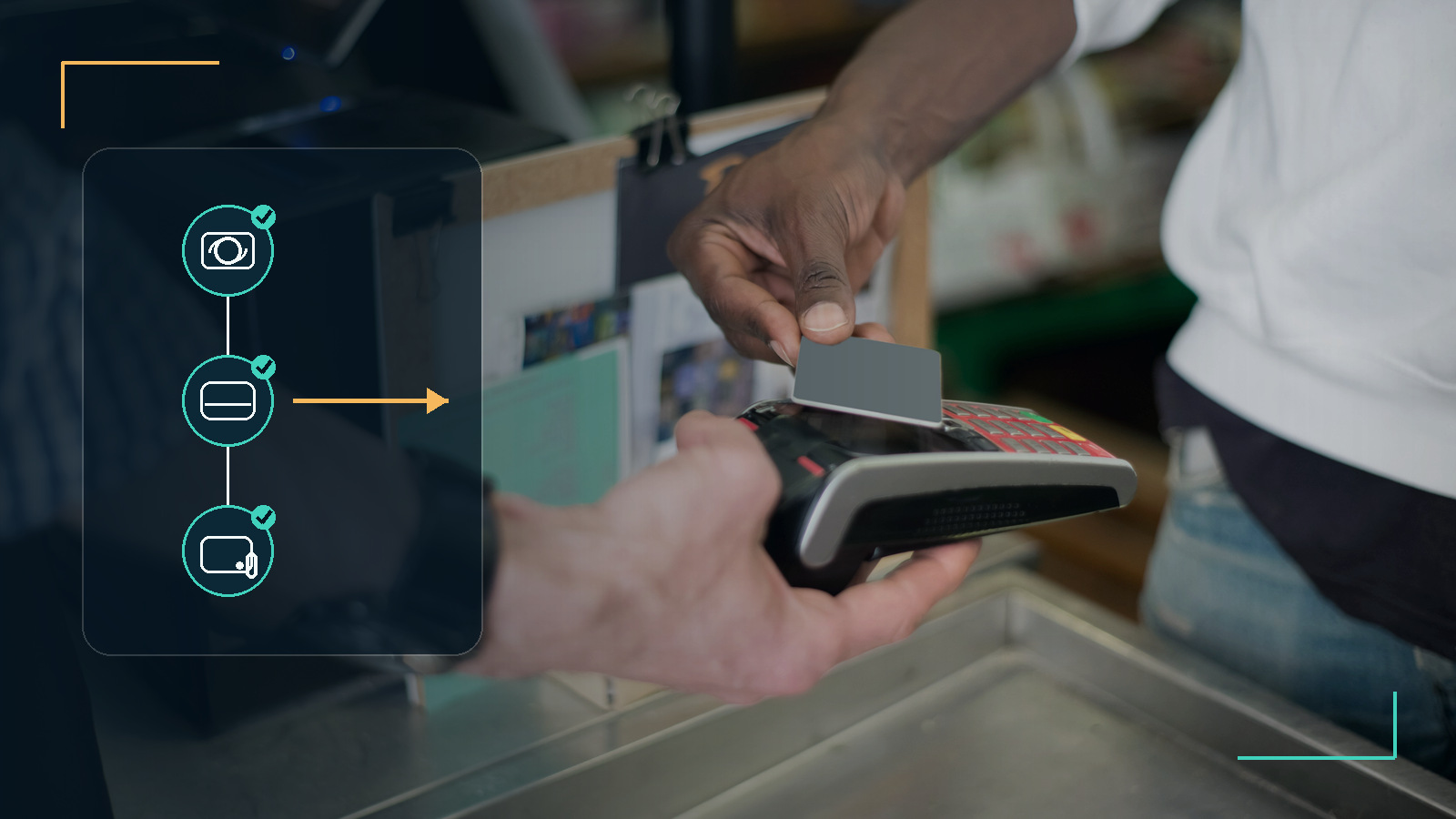
Payment types that require you to pay upfront are usually prepaid cards, gift cards, cash payments, wire transfers, money orders, cryptocurrency payments, deposits, and pay-in-advance services or subscriptions. In these cases, money is paid before you receive the product, service, or full benefit.
By contrast, credit cards typically let you buy now and pay later, while debit cards pull money from your bank account at the time of purchase. Prepaid cards must generally be loaded with funds before use, and consumer agencies recommend comparing fees and protections before choosing one.


Last Updated: September 2026
Key Takeaways
Upfront payment means you pay before receiving the full value of a product or service.
The most common upfront payment types include prepaid cards, gift cards, cash, money orders, wire transfers, crypto, security deposits, and subscription prepayments.
Upfront payments can be normal in many situations, but they can also create risk if the seller is unknown, unverified, or pressures you to use hard-to-reverse methods.
The FTC warns that sellers demanding unusual payment methods such as gift cards, wire transfers, or cryptocurrency may be a scam risk, especially in online shopping or urgent-payment situations.
Editorial Disclaimer
This article is for general educational purposes only and is not financial, legal, or fraud-prevention advice. Payment rules, card protections, dispute rights, fees, and availability can vary by country, provider, payment network, and account terms. Always verify details with your bank, card issuer, merchant, or a qualified professional before making a significant payment.
Read More:
Law of Increasing Opportunity Cost
What Does Pay Upfront Mean?
To pay upfront means you provide money before the product, service, reservation, access, or full delivery is completed.
For example, you may pay upfront when you:
- Load money onto a prepaid card before using it
- Pay a security deposit before renting an apartment
- Buy a gift card before the recipient spends it
- Pay a contractor deposit before work begins
- Prepay for a hotel, course, subscription, or event ticket
- Send a wire transfer before receiving goods
The key idea is simple: your money leaves your control before you receive the full benefit.
Payment Types That Usually Require Upfront Payment
| Payment Type | Requires Upfront Payment? | How It Works | Main Risk |
| Prepaid card | Yes | You load money before spending | Fees, limited balance, weaker protections than credit in some cases |
| Gift card | Yes | You buy stored value before use | Commonly abused in scams |
| Cash | Yes | You hand over money immediately | Hard to recover if something goes wrong |
| Money order | Yes | You pay first, then send the money order | Refunds and tracing may be limited |
| Wire transfer | Usually yes | Funds are sent directly from one account or service to another | Difficult to reverse |
| Cryptocurrency | Yes | You send digital assets before receiving goods or services | Often irreversible and fewer legal protections |
| Deposit | Yes, partially | You pay part of the total before delivery or service | Refund disputes |
| Prepaid subscription | Yes | You pay before the service period | Cancellation and refund limits |
| Debit card | Not exactly upfront, but immediate | Money is taken from your account at purchase | Fast account withdrawal |
| Credit card | Usually no | You borrow from the issuer and pay later | Interest, debt, late fees |
1. Prepaid Cards
A prepaid card is one of the clearest examples of an upfront payment method. You generally need to load money onto the card before you can use it.
Unlike a credit card, a prepaid card is not usually a borrowing tool. You are spending money that has already been placed on the card. The CFPB recommends comparing fees and restrictions before buying or choosing a prepaid card, and prepaid providers must disclose certain fees before purchase.
Best for
Prepaid cards may be useful for budgeting, controlled spending, travel, or situations where someone does not want or cannot use a traditional bank account.
Watch out for
Check activation fees, monthly fees, reload fees, ATM fees, inactivity fees, balance limits, and error-resolution protections before using one.
2. Gift Cards
Gift cards require upfront payment because you buy stored value first. The card can then be used later at a specific retailer, restaurant, online store, or payment network.
Gift cards are normal for gifts, promotions, and personal spending. However, they are risky when someone asks you to use them as a payment method for bills, taxes, fees, emergencies, online deals, or debt. The FTC states that gift cards are for gifts, not payments, and warns that anyone who tells you to pay with a gift card is likely a scammer.
Best for
Gift cards are best for personal gifting or controlled spending with known retailers.
Watch out for
Avoid paying strangers, government impersonators, online sellers, tech-support callers, or job recruiters with gift cards.
3. Cash Payments
Cash is an upfront payment because you hand over money immediately. Once paid, there may be no built-in dispute process unless the seller voluntarily provides a refund or you have a written agreement.
Cash can be convenient for small, local, in-person transactions. But for large purchases, deposits, repairs, rentals, or online arrangements, it can be harder to prove payment or recover funds.
Safer use
Ask for a receipt, keep written terms, verify the seller, and avoid paying large amounts before receiving goods or services.
4. Wire Transfers
A wire transfer usually requires funds to be available before the transfer is sent. It is often treated as upfront payment because money moves directly to the recipient.
Wire transfers can be appropriate for legitimate transactions, such as real estate closings or business payments. However, they can be risky with unknown sellers because they may be difficult to reverse after completion. The FTC warns consumers to be cautious with online sellers that insist on wire transfer payments.
Best for
Verified, documented transactions with trusted parties.
Watch out for
Urgent requests, last-minute bank-detail changes, fake invoices, rental scams, online marketplace scams, and sellers refusing safer payment options.
5. Money Orders
A money order is typically purchased upfront. You pay the amount plus any fee, then send or give the money order to the recipient.
Money orders can be useful when a person does not want to use cash, checks, or digital payments. Still, they may be harder to dispute than credit card payments, especially if sent to an unknown person.
Safer use
Keep the receipt, confirm the recipient, and avoid sending money orders for suspicious online purchases or pressure-based requests.
6. Cryptocurrency Payments
Cryptocurrency payments are upfront because you send digital assets before receiving the product or service. They can also be difficult or impossible to reverse.
The FTC warns that cryptocurrency payments generally do not have the same legal protections as credit and debit card payments, and crypto payments are often not reversible once sent.
Best for
Only situations where you understand the asset, wallet, recipient, fees, volatility, and risks.
Watch out for
Investment promises, fake sellers, romance scams, job scams, impersonators, and anyone pressuring you to move money quickly.
7. Deposits and Down Payments
A deposit or down payment is a partial upfront payment. You do not pay the full amount immediately, but you pay something before the service, rental, booking, or purchase is completed.
Common examples include:
- Apartment security deposits
- Contractor deposits
- Hotel booking deposits
- Event venue deposits
- Car reservation deposits
- Custom product deposits
- Course or coaching deposits
Deposits are not automatically suspicious. They are common in many industries. The risk depends on the seller’s reputation, contract terms, refund policy, and whether the deposit is reasonable.
Safer use
Get written terms that explain what the deposit covers, whether it is refundable, cancellation deadlines, delivery dates, and what happens if either party cancels.
8. Prepaid Subscriptions and Pay-in-Advance Services
Some subscriptions require payment before access begins. Examples include annual software plans, gym memberships, online courses, prepaid phone plans, streaming services, and professional retainers.
Prepaid services can sometimes reduce monthly cost, but they may also limit flexibility if you cancel early. Always check renewal terms, cancellation rules, refund windows, and auto-renewal settings.
Is a Debit Card an Upfront Payment Type?
A debit card is not usually called “prepaid,” but it does remove money from your bank account at or near the time of purchase. The FTC explains that debit cards draw from your bank account, while credit cards involve borrowing from the card issuer.
So the practical answer is:
A debit card is an immediate-payment method, not a classic upfront-payment method.
You do not load a debit card before every purchase, but you must have funds available in the linked account.
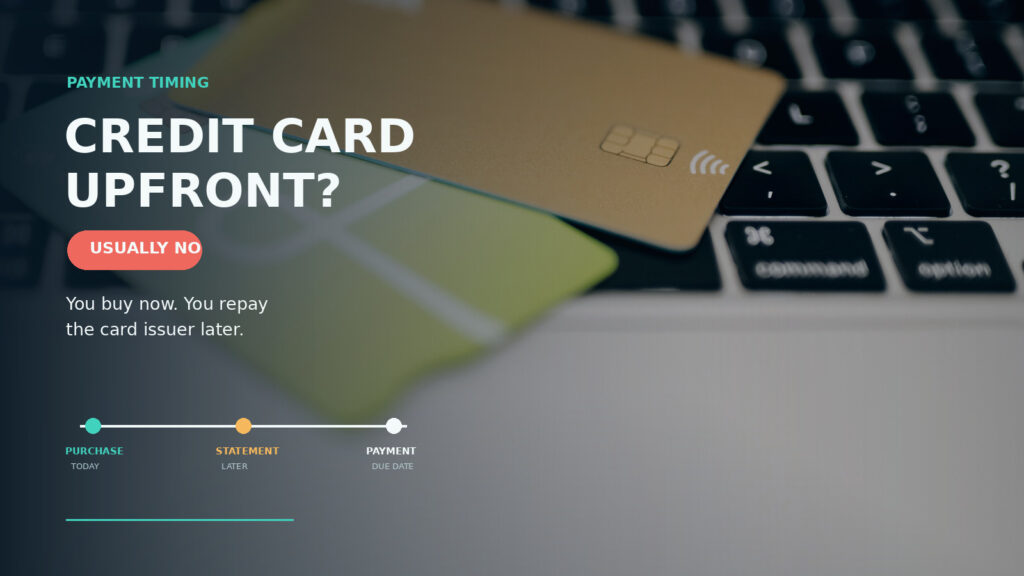
Is a Credit Card an Upfront Payment Type?
A credit card usually does not require upfront payment for each purchase. Instead, the issuer pays the merchant, and you repay the issuer later.
That does not mean credit cards are risk-free. If you carry a balance, you may pay interest and fees. But compared with many upfront methods, credit cards often offer stronger dispute processes and consumer protections for purchases.
How to Tell Whether a Payment Type Requires Upfront Payment
Ask this simple question:
Do I need to provide money before receiving the product, service, or full access?
If the answer is yes, it is likely an upfront payment.
Also ask:
- Can I dispute the payment if something goes wrong?
- Is the seller verified?
- Are the refund terms written clearly?
- Is the payment method reversible?
- Am I being pressured to act quickly?
- Is the seller refusing safer payment options?
- Does the payment method match the situation?
Red Flags Before Paying Upfront
Be careful when a seller or caller:
- Demands gift cards, crypto, wire transfers, or cash only
- Says the offer will disappear immediately
- Refuses written terms or receipts
- Uses threats, urgency, or secrecy
- Changes payment details at the last minute
- Has no verifiable business identity
- Offers a price that seems unusually low
- Claims a payment is required to unlock a prize, job, refund, or government benefit
The FTC specifically warns consumers not to buy from online sellers that insist on payment only by gift card, wire transfer, or similar hard-to-recover methods.
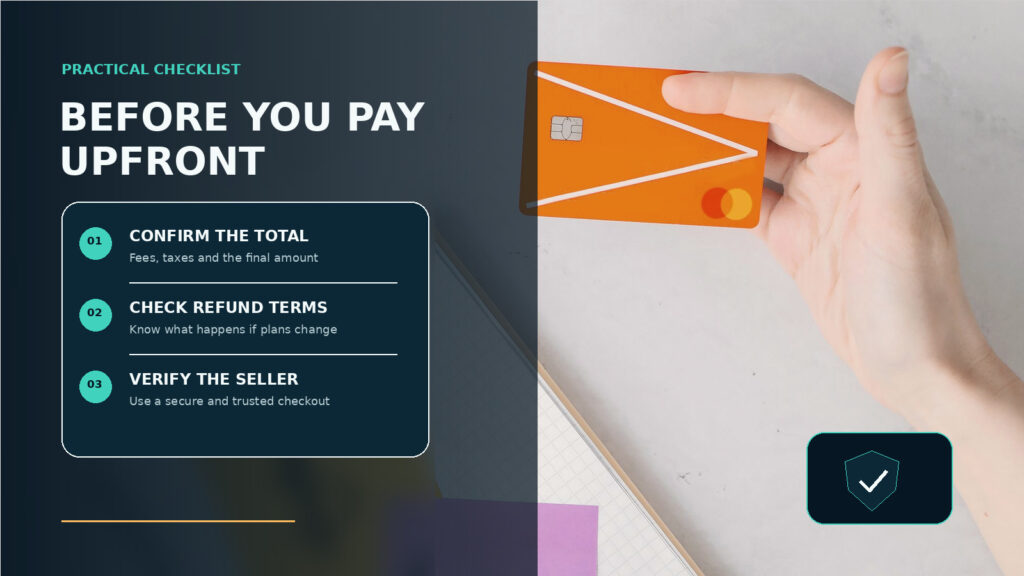
Practical Next Steps Before You Pay Upfront
Before making an upfront payment, take a few minutes to protect yourself:
- Verify the seller or provider. Check the official website, business registration, reviews, address, and contact details.
- Use safer payment methods when possible. Credit cards may offer stronger purchase-dispute options than cash, gift cards, wire transfers, or crypto.
- Get written terms. Save invoices, contracts, refund policies, screenshots, and emails.
- Avoid pressure. Legitimate sellers usually allow time to review payment terms.
- Confirm refund rules. Know whether the payment is refundable, partially refundable, or nonrefundable.
- Start small when possible. Avoid paying the full amount upfront for custom work, rentals, or services unless the provider is well verified.
FAQs
Which payment type requires you to pay upfront?
Prepaid cards, gift cards, cash, money orders, wire transfers, cryptocurrency, deposits, and prepaid subscriptions usually require upfront payment.
Do prepaid cards require money before use?
Yes. A prepaid card usually needs funds loaded onto it before it can be used for purchases. The CFPB recommends comparing prepaid card fees and restrictions before choosing one.
Are gift cards considered upfront payment?
Yes. You pay for the value of the gift card before it is used. Gift cards should generally be used for gifts or personal spending, not as a payment method for strangers, bills, taxes, or urgent requests.
Is a debit card the same as paying upfront?
Not exactly. A debit card is an immediate-payment method because funds come from your bank account at purchase. It is different from a prepaid card because you do not usually load the card itself before each use.
Is a credit card an upfront payment?
Usually no. A credit card lets you make a purchase and repay the issuer later, subject to your card agreement, billing cycle, interest rates, and fees.
Why are upfront payments risky?
They can be risky because you may have less leverage after paying. Some upfront methods, such as cash, gift cards, wire transfers, and crypto, may be hard to reverse if the seller does not deliver.
Is paying a deposit upfront normal?
Yes, deposits are common for rentals, bookings, contractors, events, and custom services. The important step is to get written terms explaining the refund policy, delivery timeline, and cancellation rules.
Conclusion
The payment types that most clearly require upfront payment are prepaid cards, gift cards, cash, money orders, wire transfers, cryptocurrency, deposits, and prepaid subscriptions. Debit cards are better described as immediate-payment tools, while credit cards usually allow payment later.
Upfront payment is not always bad. It can be normal for bookings, subscriptions, deposits, and prepaid spending tools. The real issue is risk. Before paying upfront, verify the seller, read the refund terms, avoid pressure, and choose a payment method with protections that match the size and importance of the transaction.










Comments 1