


A high-yield savings account is a savings account that pays a higher annual percentage yield, or APY, than many traditional savings accounts. It can be a good place for emergency savings or money you expect to spend soon. Your balance earns interest while it sits in the account, and you can withdraw it subject to the institution’s rules. The rate can change after you open the account. Gold works differently because it pays no interest; our guide to why gold prices fall explains the trade-off between gold and interest-paying savings.
When comparing accounts, check the APY that applies to your actual balance, the fees, and how you will get your money out. Then verify federal deposit or share insurance. A savings account that earns a few dollars more can be a poor fit if getting the cash would take longer than you can wait.


How does a high-yield savings account work?
APY tells you what a deposit would earn over a year under the disclosed terms. It includes the effect of compounding, which happens when interest stays in the account and earns interest of its own. The interest rate alone does not capture that effect. Compare APY with APY, and read the balance and eligibility requirements behind each advertised figure. For a promotional rate, check the end date and what rate applies afterward. [1]
For a simple example, leave $10,000 in an account for a year at a constant 4.00% APY and the balance would earn $400 before fees and taxes. A traditional savings account paying 0.25% APY would earn $25 under the same assumptions, a difference of $375. These rates are hypothetical. With a variable-rate account, your actual earnings depend on rates and balances over the year. [1]
High-yield savings vs. regular savings, CDs, and money market accounts
For money you might need unexpectedly, start with the withdrawal route. For money you can set aside until a known date, compare what the institution offers in exchange for committing to a term. Every row below describes typical features. The specific account agreement determines the rate, fees, and transfer or early withdrawal rules. [1][2][4]
| Account | How interest usually works | Access and best fit |
|---|---|---|
| High-yield savings | Variable APY. Check balance tiers and qualifying activity. | Access on demand subject to bank policies. Useful for emergency savings and near-term goals. |
| Traditional savings | Usually variable. Compare the APY on the same balance. | May be convenient alongside your checking account. Compare actual transfer options and costs. |
| Money market deposit account | Usually variable. The rate may depend on the balance. | Some offer checks or a debit card. Verify the specific features and any minimums. |
| Certificate of deposit (CD) | A standard fixed-rate CD sets a rate for a term. | Useful for money you can leave until maturity. Early withdrawals may incur a penalty. |
Match the account to the job
For an emergency fund, think about when an unexpected bill would have to be paid. If an external transfer takes longer than you can wait, keeping a portion in an account you can access sooner can help. Check availability with the institution that receives the transfer as well as the one that sends it.
For a predictable cost, such as an insurance bill due in six months, a savings account can hold the money while you build a sinking fund. Keep track of how much you have assigned to that bill if several goals share one account. A CD may fit money you already have and can leave untouched until its maturity date. Check what happens at maturity, including whether the CD renews automatically and how long you have to withdraw.
Can you withdraw whenever you need to?
A savings account generally lets you request a withdrawal without waiting for a maturity date. The channel matters. A bank transfer can have cutoff times, fees, daily limits, or a hold before funds are available. The Federal Reserve removed the federal six-per-month limit on certain savings transfers in 2020. Institutions can still set account-level limits or fees. Before you rely on an account for same-day expenses, look at the exact withdrawal options. [4]
How to compare two high-yield savings accounts
Suppose you have $10,000. Account A pays 4.00% APY on the whole balance. Account B advertises 4.50%, but its top yield applies only to the first $5,000 and the rest earns 0.50%. Compare the estimated dollars each account pays on your balance. Read the disclosure carefully, since a tier may apply to a portion of the balance or to the entire balance once you reach a threshold. [1]
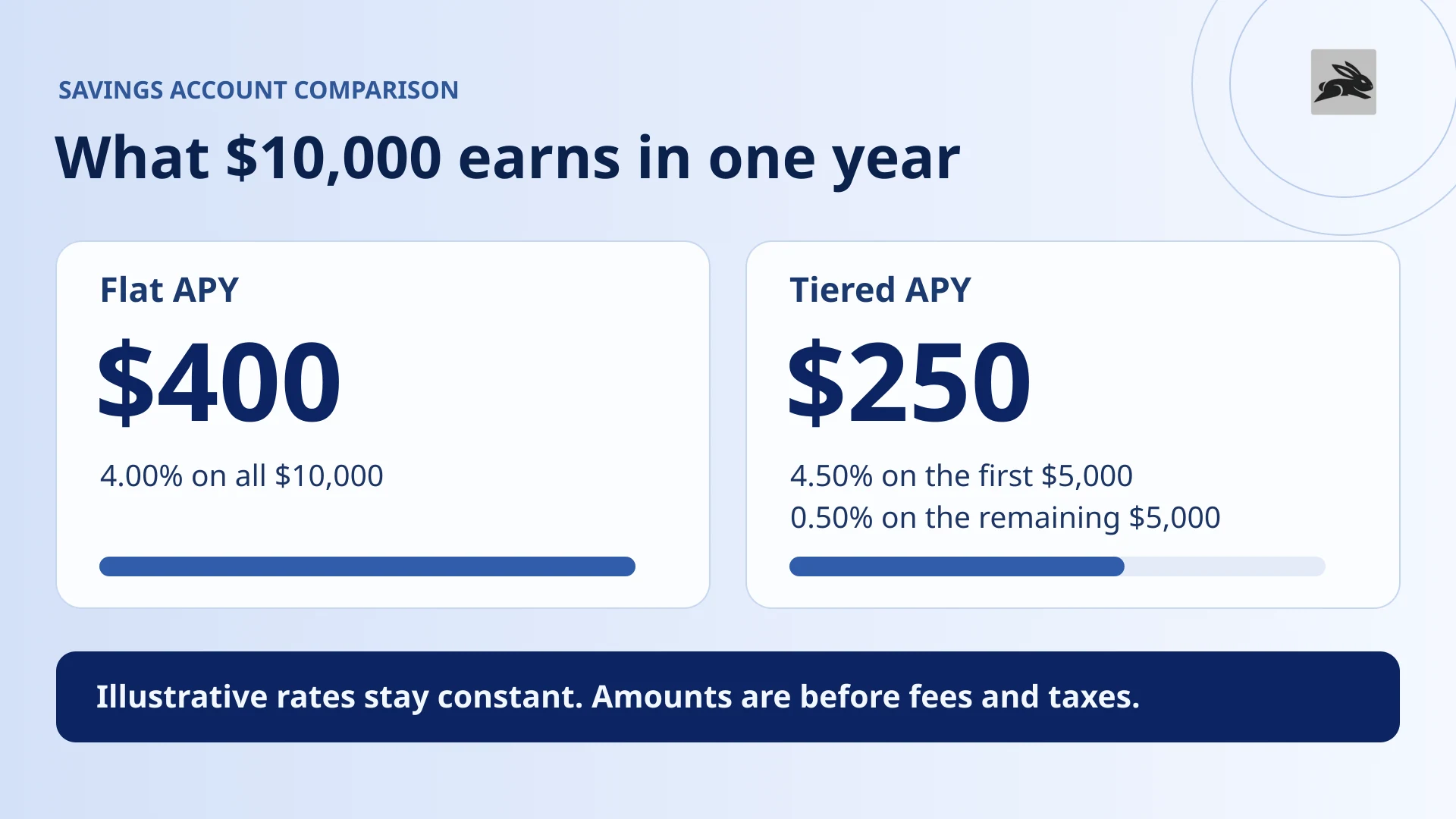
Account A earns $10,000 × 4.00% = $400. For Account B, estimate each portion separately. The first $5,000 earns $225, and the remaining $5,000 earns $25, for an estimated $250. That is roughly 2.50% on the starting $10,000. Account A comes out ahead by about $150, even though Account B advertises the higher top rate.
The example assumes the rates hold for one year and treats each starting portion as earning the stated APY for that year. The tiered result is an estimate. How an institution credits interest and applies its tiers as the balance changes can affect the actual payout. Fees and taxes are excluded. [1][5]
Put small rate differences in dollars
On $10,000 at a constant rate for a year, the difference between 4.00% and 3.75% APY is $25 before taxes. A $5 monthly fee would add up to $60 over twelve months if you paid it each month. Comparing both amounts makes it easier to decide whether the advertised yield is worth the account’s conditions. In this example, you would need about $24,000 for the extra quarter percentage point to earn $60 over a year. That simple break-even estimate assumes rates hold and ignores when the fees are deducted. [1]
Are high-yield savings accounts safe?
At an FDIC-insured bank, eligible deposits are insured up to the standard limit of $250,000 per depositor, per insured bank, for each ownership category. Balances in the same ownership category at the same bank are generally added together. At a federally insured credit union, the NCUA’s Share Insurance Fund provides similar federal share insurance, with $250,000 in coverage for qualifying individual accounts at the same credit union. Verify the institution and the account’s ownership category. [2][3]
For example, suppose you have $220,000 in an individual high-yield savings account and $40,000 in an individual CD at the same insured bank. Across that one ownership category, you have $260,000 combined. With the standard $250,000 limit, $10,000 is above the limit in this example. A separate account number does not change the total. Accrued interest counts toward coverage as well. [2]
Check these terms before you open an account
| What to check | What to look for in the terms |
|---|---|
| APY and eligibility | The yield at your planned balance, any deposit or activity rules, and when a promotional rate ends. |
| Fees and minimums | Monthly maintenance fees, the balance required to waive them, and any transfer fees. |
| Access | How to link an external account, when outgoing money becomes spendable, and any transfer limits. |
| Insurance | The name of the insured institution, the product type, and your holdings in the same ownership category. |
Once the account is open, use a small transfer to check how long it takes money to reach the account you pay bills from. If you plan to fund savings monthly, use the 50/30/20 budget worksheet to choose a transfer amount you can sustain. Recheck the terms if your balance grows into a different tier or a promotion ends. The financial goal tracker can help you decide how much of each deposit to reserve for a specific goal.
High-yield savings account FAQs
Do you need a minimum balance to earn the advertised APY?
It depends on the account. Look for three separate figures in the disclosure. The minimum opening deposit tells you what you need on day one. The minimum to earn interest tells you what balance begins earning interest. A fee-waiver threshold tells you what balance can keep monthly costs down. A bank may also require a higher balance to qualify for its top rate. Compare those conditions with the lowest balance you expect to carry. [1]
Can you open more than one high-yield savings account?
Yes. Separate accounts can make it easier to track an emergency fund and a goal with a deadline. You can also keep them together if your institution lets you assign parts of one balance to different goals. If you split money among accounts at the same insured bank, add the amounts in the same ownership category when checking FDIC coverage. Nicknames for separate goals make them easier to track and leave the ownership category unchanged. [2]
Is the interest taxable even if I leave it in the account?
Generally, yes. Savings account interest is usually taxable for US federal income tax purposes when it is credited and available to you. The IRS says you must report taxable interest even when you receive no Form 1099-INT. The dollar amounts in the examples above are before taxes. [5]
Can I use a high-yield savings account as my only bank account?
You can keep money in savings, but the account may have limited ways to pay bills or make everyday purchases. Check whether it supports the payment methods you need. Keeping everyday expenses in checking and upcoming goals in savings can give each balance a clear purpose. If both accounts are at the same institution, confirm how quickly a transfer becomes available to spend. [4]
Sources
1. Consumer Financial Protection Bureau — Annual percentage yield calculation
2. FDIC — Deposit Insurance at a Glance
3. National Credit Union Administration — Share Insurance Coverage
4. Federal Reserve — Savings Deposits Frequently Asked Questions










Comments 4