


Your retirement savings last as long as they can cover the gap between what you spend and what comes in from Social Security, pensions, and other income. If you spend $4,700 a month and receive $2,800 after taxes, the gap is $1,900. But if $2,200 of that income starts three years into retirement, your savings have to cover $4,100 a month at first, before any tax on withdrawals or increases in spending.
Use the IncomeBunny retirement withdrawal calculator to find the first month your savings fall short under your assumptions. Run your current budget first, then see what starting budget the same savings could support. Comparing both results gives you a dollar amount to work with if the first run falls short.


Start with the amount your savings need to cover
Take the amount you need available to spend each month and subtract the after-tax income that will actually arrive that month. If income covers all of your expenses, the calculator shows no portfolio withdrawal for that month. If the rest will come from a taxable retirement account, you may need to withdraw more than the spending gap.
For a quick baseline, $480,000 divided by a $2,000 monthly gap covers 240 months, or 20 years, with zero growth, flat spending and income, and no withdrawal tax. Use that check to catch input mistakes. The calculator lets you account for changing costs, investment growth, and income that starts later.
Choose a planning age before running the numbers. Starting at 65 and entering 30 years models spending through age 95. For a couple, also run a longer horizon for the person who may live longer. The Social Security life expectancy calculator gives an average for an individual, so allow room for living beyond it.
How to use the retirement savings calculator
1. Enter savings and monthly spending at retirement
Enter the balance you expect to have when withdrawals begin, along with your age at that point. In Advanced assumptions, put any cash you want to keep separate in “Savings to keep outside this plan.” The tool excludes that reserve from withdrawals and investment returns. If you enter $700,000 in savings and exclude $30,000, the model starts with $670,000 available.
Use expected retirement expenses rather than your current take-home pay. List housing, groceries, insurance and health care, then add discretionary spending. Convert a $2,400 annual insurance bill to $200 a month. Use a sinking fund for planned expenses like replacing a car, and count each cost once. Reviewing your variable expenses makes it easier to see which costs you could reduce.

2. Enter each income source and when it starts
Enter monthly Social Security, pension, and other income after expected taxes. For a benefit that starts later, enter the payment you expect when it begins and set “Starts after (years).” If you retire at 65 and claim Social Security at 68, enter a delay of three years. Use your own estimate from the Social Security calculators and check whether it is in today’s or future dollars. Apply growth only once. Keep pension growth at zero if your payment is fixed.
3. Add growth, inflation, and an optional tax allowance
Enter an annual return after investment fees, before subtracting inflation. The calculator increases spending separately and lets you see balances in starting-year purchasing power. The optional tax fields apply only to portfolio withdrawals. For example, a 15% effective rate on 80% of a withdrawal takes 12% of the whole amount. A $2,000 spending gap would then require about $2,273 before tax. Keep the gross and net amounts straight when moving figures from statements into the calculator. If you hold mutual funds or ETFs, check how fund expense ratios reduce returns before setting your assumption.
Worked example with Social Security starting three years later
Start at age 65 with $700,000 in savings, a $30,000 excluded reserve, and $4,700 in monthly spending. Set the horizon to 30 years and spending inflation to 2.5%. Enter a fixed $600 monthly pension at retirement and $2,200 in monthly Social Security starting after three years, with a 2% annual increase after it begins. Assume both payments are net and leave the portfolio tax estimate off for this example. Enter a 4.5% annual return after fees.
In the first year, $600 in pension income leaves $4,100 a month for savings to cover. In year four, after three annual inflation increases, monthly spending is about $5,061. The pension and first Social Security payment cover $2,800, so the gap drops to about $2,261. Multiplying the first-year draw by 12 and dividing by $670,000 gives a starting withdrawal rate of about 7.34%. That percentage describes the first year of this plan. The draw changes once Social Security starts.
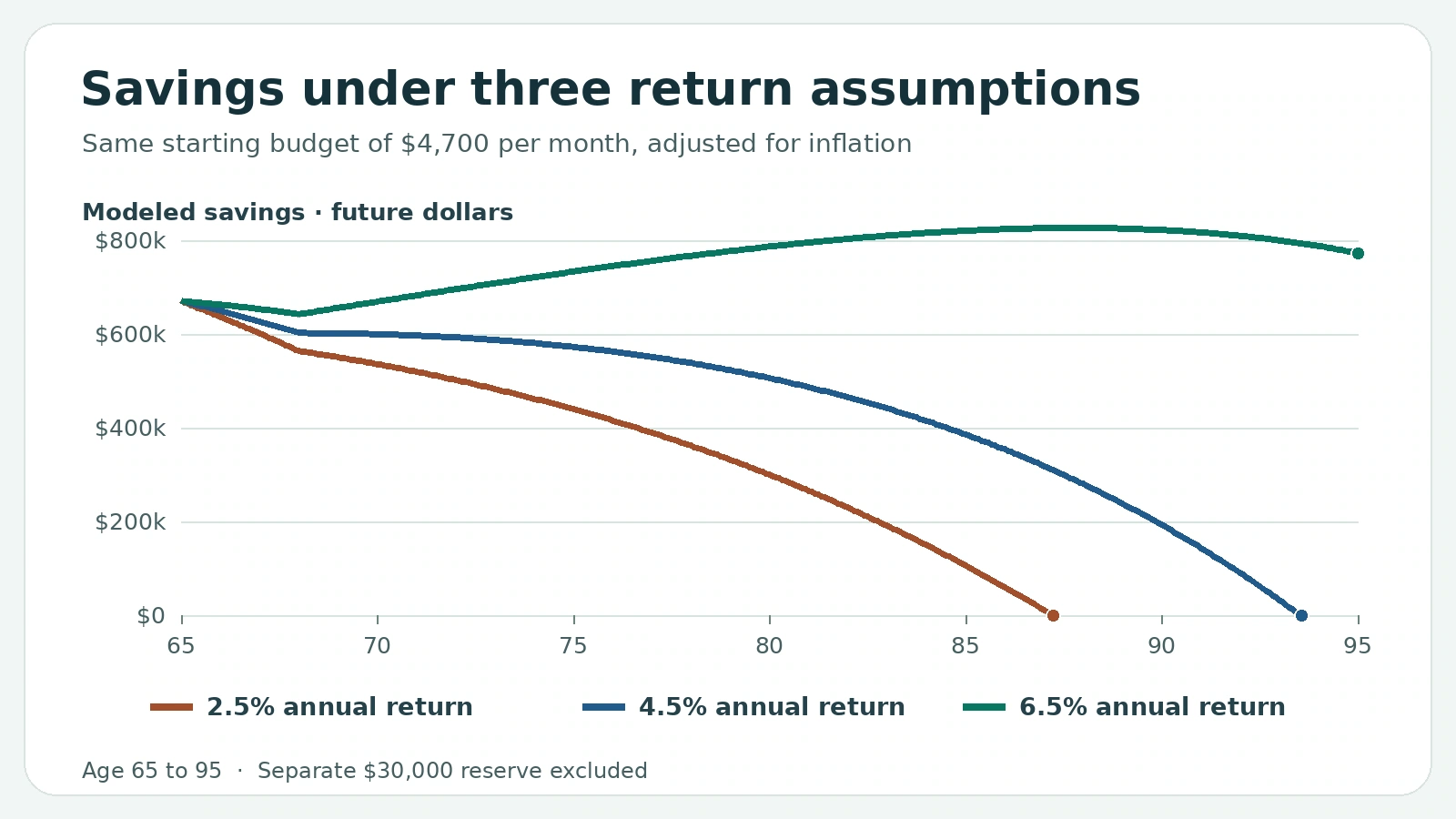
In “How long will my savings last?” the 4.5% return scenario funds 28 years and six months. The 2.5% scenario funds 22 years and two months. The 6.5% scenario covers the entire 30-year horizon. Switch to “Starting-year $” to see buying power. The roughly $773,000 left at age 95 in the 6.5% run is worth about $368,000 in starting-year dollars. Click each scenario and look for the first positive number in the “Unfunded spending” column. The year-end age labels can be higher than your age when the first shortfall occurs.
In “What monthly budget could they cover?” the 4.5% run estimates a starting budget of about $4,605 a month. The lower-return run gives about $4,038. Both include income and spend almost all modeled savings by age 95. The result is a budget ceiling for that scenario. If you want a cushion beyond the horizon, try a lower budget or extend the horizon and recalculate.
Stress-test the result before relying on it
Keep the original run as a reference. Download the year-by-year CSV for the selected scenario, then change one assumption at a time. Compare the first unfunded month and the amount left at your chosen planning age. Look at both numbers if a change makes the budget work through the horizon.
| Change in the worked example | What the calculator shows |
|---|---|
| Raise spending inflation from 2.5% to 3.5%. | At 4.5%, the first shortfall comes after 22 years and eight months, at about age 88. |
| Lower starting monthly spending from $4,700 to $4,450. | At the 4.5% return, the budget is covered through age 95 with about $156,839 left in future dollars. The reserve is separate. |
| Switch the $4,450 run to the 2.5% return. | The budget is funded for 24 years and eight months, about two and a half years longer than the original 2.5% run. |
| Keep spending at $4,700 and add a 15% effective rate on an 80% taxable share. | The first gross withdrawal rises from $4,100 to about $4,659. At the 4.5% return, spending is funded for 24 years and one month. |
How to allow for a one-time expense
The monthly spending field repeats and rises with inflation, so it cannot schedule a single $20,000 roof replacement for a future year. If you want to set that money aside at retirement, increase the excluded reserve from $30,000 to $50,000. That brings the first shortfall forward from 28 years and six months to 27 years and four months at 4.5%. The extra cash is set aside from day one and earns no modeled return. If you plan to leave it invested until the bill comes due, use a year-by-year worksheet that can place the cost in the year you expect to pay it.
Why steady returns can make the result look more certain
Two portfolios can earn the same cumulative investment return and finish with different balances once you take withdrawals. Say you start with $500,000 and withdraw $20,000 at each year-end. A 20% loss followed by a 25% gain leaves $455,000. Reverse the order and you finish with $464,000. In both cases, the two investment returns multiply to a net gain of zero before withdrawals. The early loss leaves less money invested for the recovery.
The calculator’s three paths use fixed rates, so they show sensitivity to the return you enter. For a plan that barely covers essential costs, consider a separate analysis that allows year-to-year returns to vary. Schwab explains how its retirement simulations work.
What to check when the calculator shows a shortfall
If it happens before Social Security or a pension starts, focus on those bridge years. Compare two start dates using the benefit amount for each date, and see whether the higher later payment makes up for the larger early withdrawals in your model. Social Security explains the effect of delaying benefits. If the shortfall is late, check whether your spending assumptions, a longer lifespan, or rising health costs leave too little room. Try a specific spending change and record how many funded months it adds.
If you have required minimum distributions, account for them separately. The model calculates what you need to withdraw for spending and its optional tax allowance. An RMD can require a larger distribution. Include its tax effect and count only the dollars you actually expect to spend as expenses. Check the IRS rules for required distributions for your accounts. If you also have taxable investment income, check how taxable retirement withdrawals can affect the net investment income tax.









Comments 2