


Start with Get Good with Money by Tiffany Aliche if you’re learning to budget, build a cash buffer, and deal with debt. Pick I Will Teach You to Be Rich by Ramit Sethi if you already cover your bills and want a routine that automates part of the work. For a first investing book, choose John C. Bogle’s The Little Book of Common Sense Investing when you’re ready to compare funds.
These five picks solve different problems. Choose one by the decision you need to make this month. Each recommendation includes an exercise you can do with a statement, pay stub, or fund document, so you can put the idea to use before starting another book.


Which personal finance book should you read first?
| What you want to do | Book | Where to begin |
|---|---|---|
| Make a budget after a setback | Get Good with Money | List expenses you’d still pay in a lean month. |
| Automate saving and bills | I Will Teach You to Be Rich | Map one payday and the bills that follow it. |
| Learn the basics quickly | The Index Card | Write three rules that would change what you do now. |
| Make steadier money decisions | The Psychology of Money | Write a rule for the next time you feel rushed. |
| Understand index funds and fees | The Little Book of Common Sense Investing | Compare two funds that track the same index. |
Best books for budgeting and money basics
1. Get Good with Money by Tiffany Aliche
Aliche starts with day-to-day money and uses a ten-part approach that goes well beyond budgeting. The publisher’s excerpt introduces her “noodle budget,” a stripped-down list of what you’d have to cover in a financially tight month. It gives you a realistic baseline if your income has changed or you need to rebuild your finances after a setback.
The breadth is valuable because a working budget can lead to questions about credit, insurance, or estate planning. Expect an introduction to those topics. If you need to resolve a specific disputed account or compare investment funds, pair the book with current guidance for that decision.
Put it to work by pulling one month of statements. Write down housing, essential transportation, food, and required payments. Include an estimate for costs you’d still incur that month even if they don’t appear on the statement. Use that total to check how much your emergency fund could cover.
2. I Will Teach You to Be Rich by Ramit Sethi
The revised second edition lays out a six-week program that ties together banking, credit, saving, and investing. Its spending plan gives money a purpose before bills and purchases compete for it. The strongest idea for someone with a steady paycheck is to use a repeatable schedule, so funding an important goal takes fewer decisions each month.
A calendar matters as much as the categories. If your income varies, a fixed transfer that works in an average month could leave you short before the next check arrives. Set the amount against a conservative month first. Treat specific bank or credit card examples as illustrations and check current fees and terms.
Put it to work by marking your next two paydays and every bill due before the following paycheck. Pick one transfer or payment to schedule once you’ve checked the available cash. If you want a second way to organize spending, use the 50/30/20 budget worksheet as a reference for your categories. The monthly budget template and payday calendar gives you a place to map those dates.
3. The Index Card by Helaine Olen and Harold Pollack
The authors organize personal finance around ten rules that fit on an index card. Their scope includes saving, paying down debt, retirement investing, insurance, and getting financial advice. It’s a useful first read if you’d like enough vocabulary to make sense of several areas before choosing one to study in depth.
The card format is good for recall. It leaves less room for exceptions, such as which bills to prioritize when cash runs short. Turn one rule into a practical question. If your goal is to pay down debt, list every balance, interest rate, and required payment before choosing a method. The debt snowball guide shows how a smallest-balance-first plan works and where interest costs matter.
What still holds up in an older money book?
Separate the idea from the figures printed next to it. Budgeting around your actual bills is a principle you can test today. A book’s sample savings rate, account fee, or retirement contribution limit belongs to the edition that printed it. Check the current rate, fee, or limit before using one of those figures in your plan.
When a book suggests paying yourself first, use the next payday and bill dates to decide how much you can set aside. If it suggests opening a retirement account, identify the type of account and check whether the example assumes an employer match or a tax benefit. That extra step helps you tell which parts of the advice apply to you.
If you’re deciding between two titles, borrow a digital or print copy and read the first chapter. Search the library by author as well as title to find the edition you want.
Best books for money behavior and investing

4. The Psychology of Money by Morgan Housel
Housel’s short essays look at why people make different choices with the same numbers. The book is particularly useful if you know the basics but struggle with comparison, impatience, or uncertainty. Its discussion of leaving room for error makes a good prompt for anyone whose budget depends on everything going as planned.
The essays are easier to dip into than a start-to-finish budgeting program. If you need to set up automatic payments or estimate how long savings will last, use a workbook or calculator alongside it. The book’s strength is helping you see why a plan you can live with may be easier to stick to.
Put it to work by writing down one decision you tend to make under pressure. If it’s agreeing to an expensive purchase on the spot, give yourself a day to check the budget and consider what else the money could pay for. Then write what would justify making an exception.
5. The Little Book of Common Sense Investing by John C. Bogle
Bogle’s updated edition makes the case for broad, low-cost index funds and explains how fund costs reduce what investors keep. It’s a good first investing read if you want to understand the logic behind indexing and already know what you’re saving for. Read its market examples as historical illustrations. An index fund can lose value, and a low fee tells you little about whether the fund fits your time horizon.
Put it to work by comparing the expense ratios of two funds that track the same index. On a hypothetical $10,000 held at a constant value for a year, a 0.10% annual expense ratio works out to about $10 in fund expenses. A 1.00% ratio works out to about $100. That $90 gap isolates the expense ratio. Check the prospectus for other costs and what each fund owns. Use the guide to comparing fund expense ratios when you get to the fee disclosures.
Keep the comparison within the same market exposure. A bond fund and a broad US stock fund may both track indexes and charge low fees, but they play different roles. Decide what the money is for and when you might need it before comparing expenses. If you’re saving for a bill due soon, the question of how to keep that cash available comes before the question of which fund to buy.
Turn your first book into a 30-day plan
Suppose you take home $3,800 a month. Essential costs and required payments, including debt minimums, total $3,210. You plan $260 for flexible spending. That leaves $330 for savings and any extra debt payments. Use Aliche’s baseline to see what it costs to get through a harder month, then use Sethi’s calendar approach to decide when the money can move.
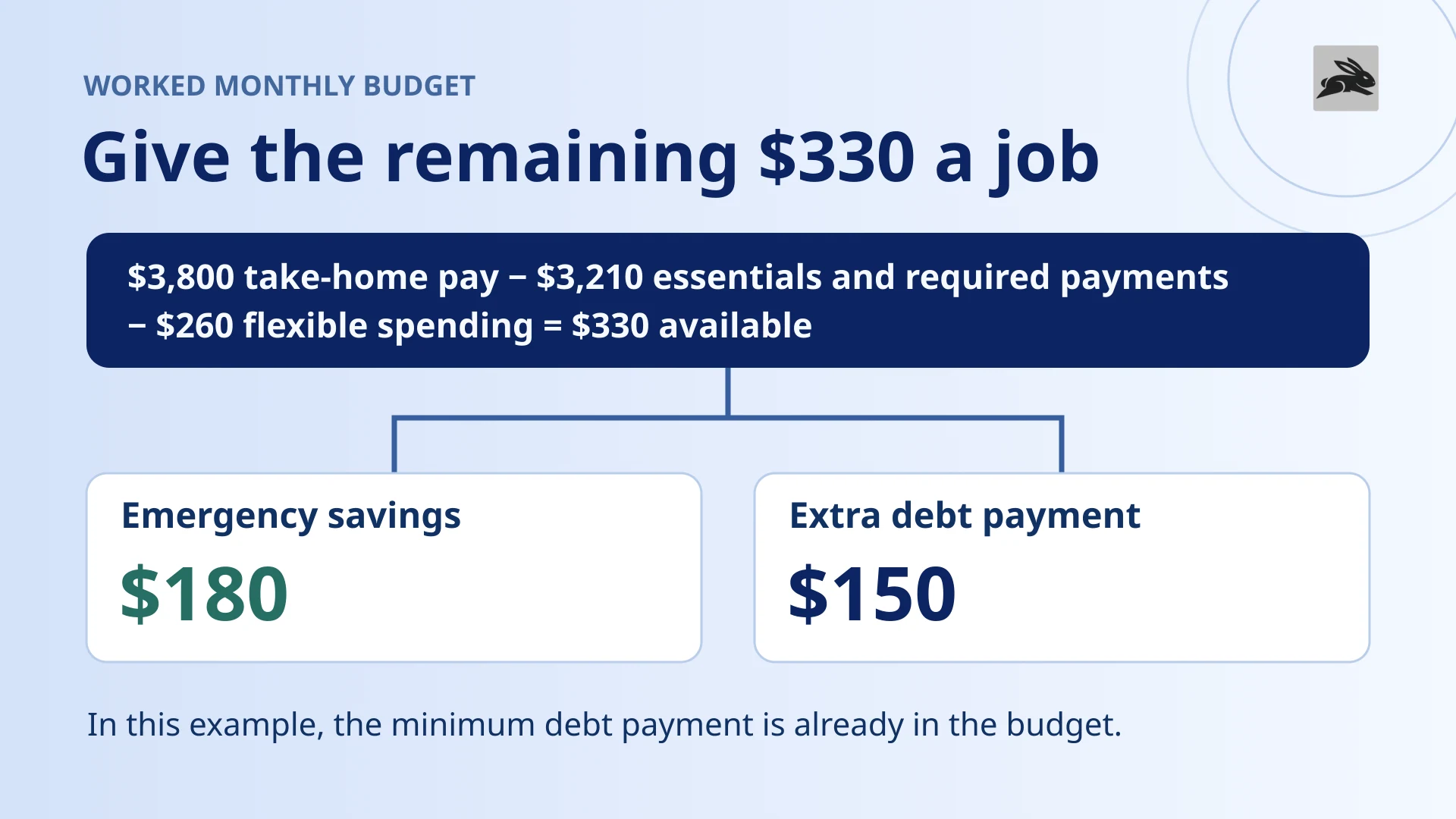
In this example, you choose to put $180 into emergency savings and send $150 extra to a debt. If you start with $420 in savings and make three $180 deposits without withdrawals, you reach $960, ignoring interest. Adjust that split if your cash cushion, due dates, or required payments change. The point of the first month is to find an amount your budget can sustain.
Check the plan against your next statement
Before the next payday, compare your actual bills with what you wrote down. If flexible spending came to $310, you’d have $280 available for the two goals, $50 below plan. Decide how much to adjust and record the actual amount you transferred. For debt, check that the payment posted, then use the new balance to measure progress. If the exercise gives you a dollar target and a due date, set a savings pace and track your progress at your next check-in. If you want to repeat this exercise digitally, compare free budgeting apps that track spending by category.
Make your next book answer the problem the numbers uncovered. If you keep moving money back out of savings, revisit the essentials and payday calendar first. If your budget works and you’re choosing between funds for a long-term account, start with Bogle’s cost comparison. Pull up the actual fund documents so you can verify what you would pay.
Sources
Penguin Random House’s excerpt from Get Good with Money
Workman’s revised edition of I Will Teach You to Be Rich
The University of Chicago’s interview on The Index Card
Harriman House’s guide to The Psychology of Money
Wiley’s table of contents for The Little Book of Common Sense Investing via O’Reilly
Investor.gov’s guide to mutual fund and ETF fees










Comments 1