

By Peyman Khosravani
IncomeBunny career guide | U.S. focus | Research verified November 5, 2026 | 2027 outlook, not a retrospective

A marketer can ask an AI tool to write ten advertisements. An AI marketing engineer can build the workflow that gathers performance data, checks the ads against business goals, proposes a test, and records what actually worked. The second capability is harder to build—and potentially more valuable to an employer.
This does not mean AI marketing engineers are automatically the highest-paid professionals in Silicon Valley. It means an emerging set of employers is actively looking for people who can connect marketing judgment with working software. You can start with modest projects, even if you are not yet a professional programmer.
This guide takes a practical route: what the job means, what employers have actually advertised in salaries, ten skills to learn, three working educational demos you can examine, and a 90-day plan to build a credible portfolio. All demonstration data below is synthetic, and results are not claimed as real client outcomes.
What is an AI marketing engineer?
An AI marketing engineer designs, connects, tests, and maintains software-driven marketing workflows. The role sits between digital marketing, growth engineering, marketing technology, analytics, and automation.
A traditional growth marketer might analyze campaign reports, coordinate creators, optimize a landing page, or run an email campaign. A marketing engineer may automate the data collection, build quality checks, integrate CRM events, and create a dashboard that helps people make better decisions faster.
The strongest distinction is accountability: an engineer should be able to explain the inputs, rules, outputs, errors, and actual business impact. Knowing how to prompt ChatGPT is useful, but it is not a substitute for data quality, software reliability, and marketing measurement.
Is there real demand for AI marketing skills in 2027?
There is growing evidence of demand going into 2027, but predictions should not be presented as settled facts. In June 2026, LinkedIn and Adobe reported that marketing job postings requiring AI literacy had risen 113% year over year. In October 2026, LinkedIn reported that job postings requiring AI literacy across occupations had risen approximately 65% over 12 months. These figures are about AI skills more broadly, not the number of AI marketing engineer openings specifically.
AI marketing engineer salary: verified examples, not invented averages
| Employer | Advertised role | U.S. annual base pay | Practical context |
|---|---|---|---|
| GOAT Group | Marketing Engineer I, remote U.S. | $80,000-$130,000 | Geographic pay tiers; emphasizes portfolio builds, LLM workflows, APIs, and evaluations |
| Profound | Marketing Engineer, Demand Generation | $140,000-$220,000 | On-site in New York or San Francisco; 5+ years of relevant experience; equity additional |
Source and date: Official employer pages checked November 5, 2026: GOAT Group job posting and Profound careers posting. These are examples of listed positions; neither the ranges nor continued availability is guaranteed for 2027.
As a separate context point, the U.S. Bureau of Labor Statistics reported a $166,790 median annual wage for marketing managers in May 2025 and projected 6% growth for advertising, promotions, and marketing managers combined during 2025-2035. Marketing manager is a different occupation, so this is not an AI marketing engineer salary statistic.
The lesson for jobseekers is to read what the employer expects you to build, not only the job title. Some opportunities lean toward CRM automation; others demand paid acquisition, SQL, production agents, or senior growth experience.
The 10 skills worth learning
1. Build an AI advertising monitoring and decision system
Learn: campaign economics, advertising APIs, Python,
automation workflows, and model output validation. Refer to Google
Ads API documentation for integration constraints and
authentication.
Build: a system that reviews advertising performance,
flags risks, and prepares human-approved recommendations.
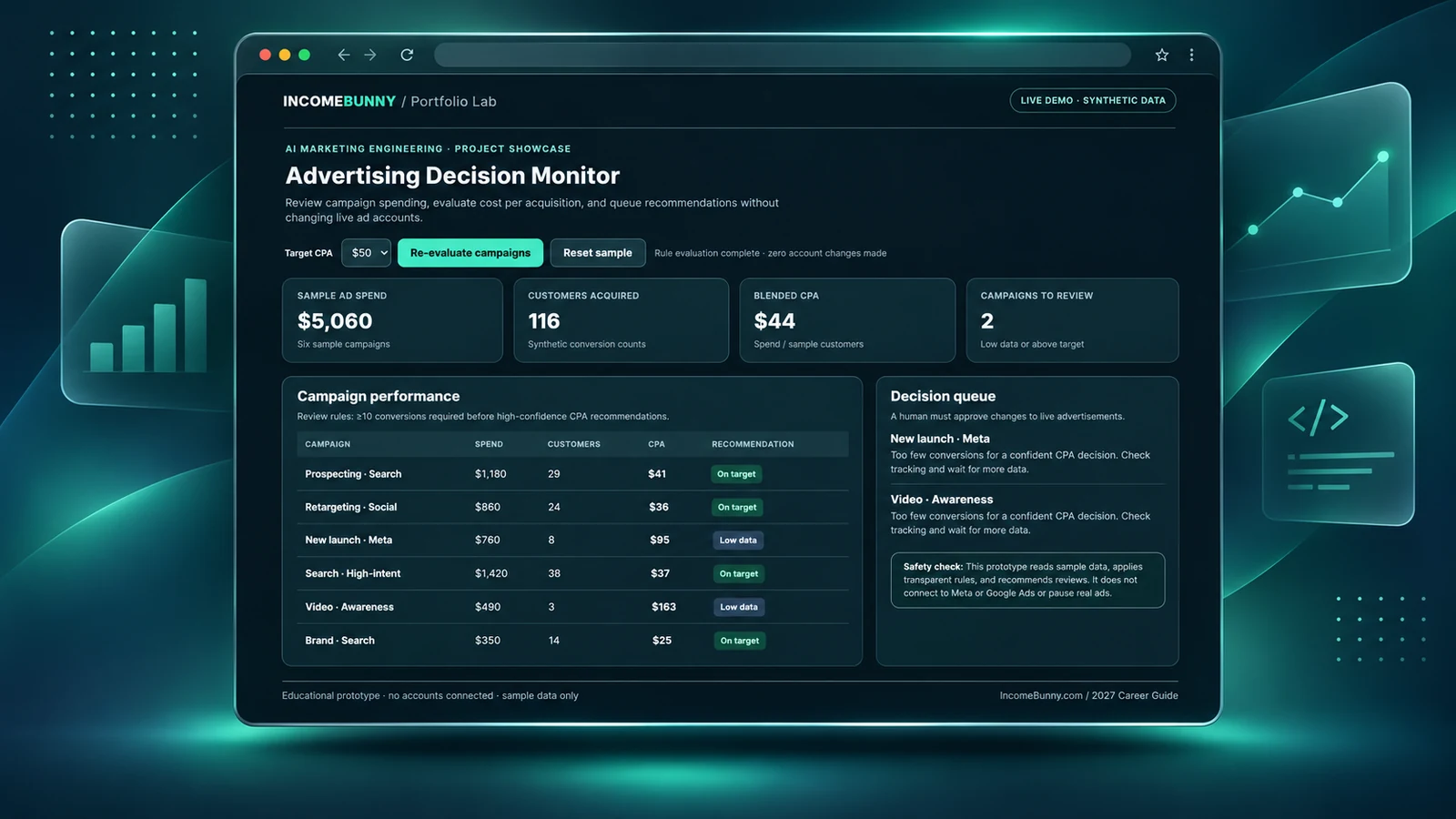
For a small company running six campaigns, start with exported data: spend, customers acquired, revenue, conversion timestamps, and the current target cost per acquisition (CPA). Calculate CPA as advertising spend / acquired customers. Add a guardrail that prevents the system from making a strong recommendation when there are too few conversions.
For example, a campaign spending $760 for eight customers has a $95 CPA. If its target is $50, it deserves review—but eight conversions may be too small a sample to justify immediately pausing the campaign. A useful agent should also consider tracking problems, delayed conversion attribution, margin, and campaign purpose.
Portfolio demo 1: Advertising Decision Monitor. We built a working browser prototype with six synthetic campaigns. Change the target CPA and the recommendation queue recalculates. It is intentionally rule-based, not a connected autonomous AI agent: production-grade AI explanations and ad-account integrations would be further work.
Interactive demo 1: spend, acquired customers, CPA and a review queue. No real ad account is connected and no advertising changes are made.
What to demonstrate in your portfolio: data ingestion, calculations, minimum-data safeguards, recommendation explanations, test cases, and an audit trail. Link to the code and disclose whether any model is involved.
2. Build helpful programmatic SEO systems
Learn: keyword research, Python, spreadsheets, APIs,
structured content, internal linking, editorial QA, and Search
Console.
Build: a publishing pipeline that uses verified
datasets to create useful page drafts rather than thin pages at
scale.
Imagine a dataset containing occupation, state, wage figures, source, reference year, qualifications, and licensing context. A good template can create consistent salary guides, but each page needs distinctive data and actual reader value. Publishing 500 pages solely because a spreadsheet contains 500 rows is a poor objective.
A robust workflow includes source verification, duplicate URL detection, meaningful differences between pages, a freshness check, editorial review, and a publication gate. For a real example of a finance-specific publishing topic, see IncomeBunny’s startup financial modeling guide: an engineer could model cost drivers, while an editor checks the financial assumptions. Google’s spam policies warn against scaled content created mainly to manipulate rankings without helping users.
Portfolio demo 2: Programmatic SEO Quality Gate. The working prototype reviews eight fictional content records for missing sources, stale years, duplicate URLs, and lack of unique detail. It prevents automatic publishing; a pass means ready for editorial review, not that the information is verified.
Interactive demo 2: four sample records pass the automated rules and four require correction. This does not establish real-world source validity.
Portfolio exercise: generate 20 carefully reviewed pages from genuinely useful source data. Publish only after subject-matter and factual review. Measure relevant impressions, indexing, user engagement, and conversions—not raw page count.
3. Engineer AI video creative experiments
Learn: video planning, Google Veo, Kling, ElevenLabs
or a suitable licensed voice tool, editing, and experimental
design.
Build: a repeatable process that tests advertising
messages, not just a factory for unlimited footage.
Choose a product, three customer problems, two opening hooks per problem, and two visual formats per hook. That creates 12 distinct creative concepts. Generate drafts, verify factual and visual accuracy, confirm commercial rights, and test a smaller selection under comparable conditions. For ideas to adapt before you build your own variants, study these Instagram ad examples by format.
A video with many views is not necessarily a profitable advertisement. Measure qualified clicks, cost per acquisition, retention, and outcomes. Avoid unauthorized likenesses, fake reviews, deceptive demonstrations, and misleading product imagery.
Portfolio exercise: document the brief, 12 concepts, four approved drafts, quality review, and an experiment plan. If you run tests, distinguish observed outcomes from assumptions.
4. Reverse-engineer competitor positioning ethically
Learn: Meta Ad Library, offer
analysis, messaging, landing-page research, and creative
classification.
Build: a database of public competitor creative
themes.
Review advertisements from five relevant brands. Record the hook, target problem, format, offer, call to action, landing page, and observed start date. Use AI to group common themes and identify underexplored customer needs.
Do not label a long-running ad a proven winner: public ad-library records generally do not disclose the advertiser’s actual profitability. Do not reproduce copyrighted creatives. Use the research to generate original hypotheses.
Portfolio exercise: analyze 50 public ads and propose five original campaign tests, explaining your evidence and uncertainty.
5. Automate influencer discovery and partnership operations
Learn: creator discovery, CRM systems, audience fit,
outreach drafting, tracking links, and sponsorship disclosure.
Build: a human-reviewed recruitment pipeline for one
niche.
For a budgeting app, research creators covering student finance, household budgeting, or responsible spending. Start by understanding real consumer problems, such as distinguishing fixed expenses in a household budget from costs that fluctuate. Record public business contact methods, relevant content, sponsorship fit, agreed deliverables, and outcomes. Have AI help summarize fit and draft personalized outreach—then review before sending.
Track qualified conversations, accepted partnerships, content delivery, and attributable acquisitions. Follow applicable advertising and endorsement disclosure rules, including the FTC’s guidance.
Portfolio exercise: create a 30-creator sample pipeline and a consent-aware workflow with clear stop conditions. Never present synthetic creator engagement as verified data.
6. Improve visibility in AI answers and search
Learn: SEO, Ahrefs or equivalent keyword tools,
original research, question analysis, and repeatable citation
measurement.
Build: a buyer-question library and a visibility
tracker.
Research specific questions customers ask before buying: how products compare, who each product is for, what they cost, limitations, and decision criteria. Produce transparent comparisons, original demonstrations, and sourced facts. Test a fixed set of questions at recorded intervals, documenting whether an answer cites your page and under what conditions.
No one can promise ChatGPT citations, and volume alone does not produce credibility. Monitor meaningful discovery and conversions as well as mentions.
Portfolio exercise: publish five substantial buyer-question resources and record repeated citation tests, including failed tests and methodology.
7. Build customer lifecycle and email automation
Learn: CRM events, segmentation, triggered
workflows, opt-in requirements, suppression lists, and message QA.
Review the FTC’s
CAN-SPAM compliance guide before designing commercial-email
automations.
Build: a safe onboarding and re-engagement journey.
Suppose a budgeting app has new users who never finish setup, users who complete their first budget, and users who have been inactive for two weeks. Selecting the right goal-setting app and workflow is another practical example of matching automation to a specific user need. They should not all receive the same email. A workflow can map a verified event to the appropriate educational message, exclude users who have opted out, and stop once the action is complete.
Portfolio demo 3: Customer Lifecycle Automation. Our browser prototype simulates 1,200 users divided among three segments and previews the corresponding steps and draft messages. Segment choices change the output. The safeguards are defined as structural rules; they are not connected to a live permissions database, so no messages are sent.
Interactive demo 3: event-triggered journey, message preview, and explicit safety gates with zero messages sent.
Portfolio exercise: add a mocked event history and unit tests covering opt-outs, duplicate events, and changes of user state. In production, comply with relevant privacy and email-marketing rules.
8. Run conversion-rate experiments
Learn: funnel analytics, UX research, A/B testing,
landing-page implementation, and statistical reasoning.
Build: a testable landing-page variant and results
dashboard.
A landing page receiving 10,000 visits at a 2% conversion rate produces 200 conversions. If a properly measured new experience reaches 3%, that would be 300 conversions—100 more from the same traffic. This is a mathematical illustration, not a measured result.
Start with evidence: form abandonment, confusing instructions, customer questions, or slow loading. Form a clear hypothesis and determine the primary success metric before running the test. Avoid declaring a winner from a few hours of data.
Portfolio exercise: design two versions of one page and document sample-size planning, QA checks, and a results interpretation template.
9. Connect marketing data to business economics
Learn: SQL, GA4 or another analytics platform,
reporting APIs, data quality, attribution, and contribution
margin.
Build: a dashboard that explains how acquisition
affects profitability.
Revenue does not equal profit. For a business-focused explanation, see gross versus net income. If advertising spend is $5,000 and 100 customers are acquired, CPA is $50. If attributed revenue is $12,000, reported ROAS is 2.4x. That does not prove profit: delivery costs, refunds, overhead, and attribution errors may change the answer.
A high-quality dashboard states what is known, how conversions are counted, and where numbers are incomplete. The Google Analytics event documentation is a starting point for designing consistent event collection. When feasible, controlled tests and incrementality analysis provide stronger evidence than attribution dashboards alone.
Portfolio exercise: combine simulated advertising and order records, reconcile totals, and include an explicit margin and attribution limitations section.
10. Make AI workflows reliable enough to use
Learn: Python, REST APIs, JSON, authentication, Git,
testing, monitoring, evaluations, and human approvals.
Build: an integrated assistant that receives data,
produces a recommendation, catches exceptions, and logs decisions.
A useful production workflow must handle missing data, API errors, ambiguous instructions, duplicate actions, unauthorized access, and model mistakes. Start with permissions limited to reading information. Require approval before actions involving spending, publishing, or contacting customers.
Portfolio exercise: connect three sample inputs into one weekly marketing briefing, include tests for incorrect data, and provide a short operations manual. A reliable small tool is more convincing than an enormous untested autonomous agent.
Four timely business opportunities to practice in 2027
| Opportunity | Suggested engineering project | What to measure |
|---|---|---|
| January budgeting season | Personal finance onboarding and expense education | Successful setup and paid activation |
| U.S. tax season | Verified educational content workflow and lead routing | Qualified inquiries and content accuracy |
| Back-to-school shopping | Creator research and 12-variant creative experiment | Incremental purchases and CPA |
| Black Friday / holiday promotions | Campaign monitoring with spending guardrails | Contribution profit and avoided errors |
These are proposed campaign occasions, not predictions that a specific campaign will succeed. The business problem and legal environment determine whether a tactic is suitable.
Three realistic ways to earn money
Employment. Search for titles such as Marketing Engineer, Growth Engineer, Marketing Automation Engineer, AI Growth Specialist, Lifecycle Engineer, and Revenue Operations Engineer. Compare required projects and salary transparency, not just titles.
Freelance delivery. An illustrative consultant charging four clients $1,500 per month would generate $6,000 in monthly gross revenue, before tax and expenses and assuming the contracts remain active. This is an arithmetic example, not a market rate or income promise.
Software products. A small subscription tool with 200 customers paying $49 monthly would have $9,800 in monthly recurring revenue before churn and operating costs. Getting those customers and supporting the software is usually harder than the calculation suggests.
The 90-day AI marketing engineering learning plan
| Time | What to learn | What to show |
|---|---|---|
| Days 1-15 | Python basics, JSON, APIs, marketing KPIs | Script that validates and summarizes a campaign export |
| Days 16-30 | Advertising logic and human approvals | Working ad decision monitor and test cases |
| Days 31-45 | SEO datasets, uniqueness checks, editorial QA | Programmatic SEO quality gate |
| Days 46-60 | CRM events, permission rules, lifecycle segmentation | Working journey prototype |
| Days 61-75 | SQL, measurement, experiment design | Conversion and revenue dashboard |
| Days 76-90 | Integration, documentation, evaluations | Portfolio with three demos, limitations, and README files |
Your free AI marketing portfolio workbook
Turn the guide into a practical build plan. Get the 4-page PDF with a 10-project checklist, a 90-day learning roadmap, and a portfolio evaluation scorecard.
Free download · PDF · No sign-up required
What makes a convincing portfolio?
Every project should answer seven questions: What business problem did you choose? What data did it use? What did you actually build? How did you validate it? What did it cost? What failed? What measurable result did you observe?
Be specific about whether a demonstration is rule-based, AI-assisted, or autonomous. Disclose synthetic data. Do not invent campaign wins, customer testimonials, or revenue lifts. Employers can often assess engineering judgment from the quality of your documentation as readily as from your interface.
FAQ
Is AI marketing engineer an established occupation?
It is an emerging job title, not a single standardized occupation. Comparable responsibilities may appear under growth engineering, marketing technology, lifecycle engineering, or automation roles.
Do AI marketing engineers need a degree?
Requirements vary. Some employers emphasize proven builds while others expect engineering experience or formal education. A portfolio can help demonstrate ability but does not guarantee eligibility.
Can I start without knowing Python?
Yes. You can prototype with low-code tools, then add Python and API knowledge to build, debug, and maintain more complex systems. Understanding data quality and security becomes essential as you progress.
How much can an AI marketing engineer earn in 2027?
There is no validated nationwide 2027 median for this emerging title as of November 2026. The two verified U.S. employer examples above advertised base salary ranges from $80,000 to $220,000 for different roles and experience levels; they are not a general wage distribution.
Will AI replace marketers?
Some repetitive tasks may be automated, but marketing still requires customer understanding, strategy, editorial judgment, creative direction, ethical decisions, and accountability. These projects focus on building systems that support those responsibilities.
Related IncomeBunny reading
Start with marketing fundamentals to connect technical projects to customer needs and business goals. If you are choosing software for sales measurement, compare our revenue intelligence platforms guide. For freelance services or an automation product, use our startup financial modeling guide to evaluate costs, cash flow and revenue assumptions.
The bottom line
The most useful AI marketing skill is not producing more content or more ads. It is being able to build a working system, explain how it makes decisions, measure its outcomes, and catch its mistakes.
Start with one of the three sample demos, modify its rules, document your decisions, and turn it into a portfolio project of your own. Then use the project checklist to decide what to build next.
Editorial verification note: Salary postings and labor-market references were reviewed on November 5, 2026. Before publishing or updating this article in 2027, confirm whether the roles remain live, whether salary ranges have changed, and whether newer labor-market data or platform rules supersede the cited sources. All images are screenshots of locally executed educational prototypes using synthetic data; none depicts a real company’s dashboard.
Sources and further reading
- GOAT Group — Marketing Engineer I (job posting; checked Nov. 3, 2026)
- Profound — Marketing Engineer, Demand Generation (job posting; checked Nov. 3, 2026)
- LinkedIn + Adobe: AI literacy in marketing jobs (June 16, 2026)
- LinkedIn: Opportunity as work changes (October 2026)
- BLS: Advertising, promotions, and marketing managers (May 2025 wages)
- Google Search Central: Spam policies
- FTC: Endorsements, influencers and reviews
- Google Ads API: introduction
- Google Analytics: event collection
- FTC: CAN-SPAM compliance guide












Comments 2