

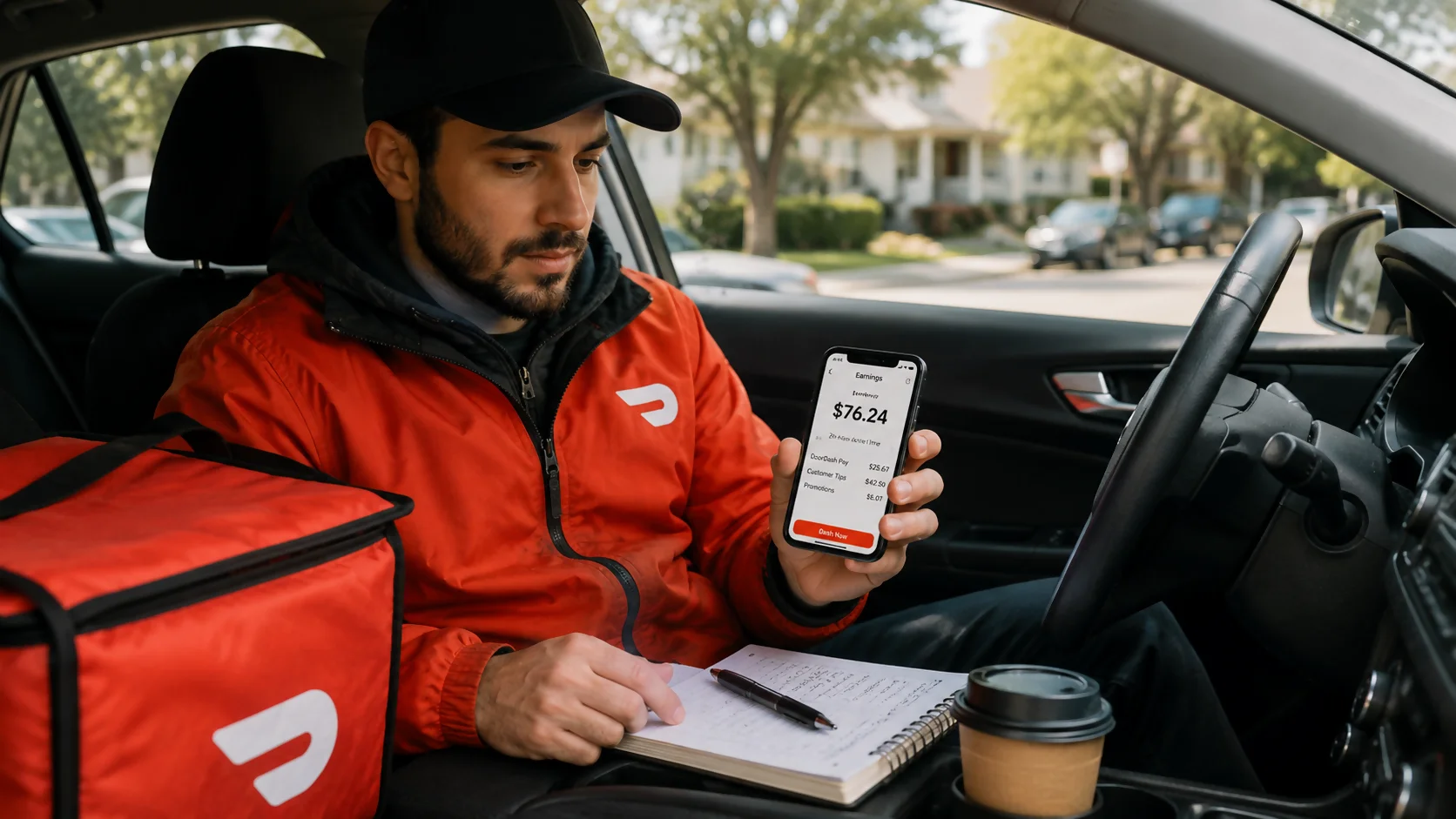
DoorDashers can make very different amounts depending on location, tips, order volume, expenses, and when they work. A realistic answer is that DoorDash pay should be measured in two ways: gross earnings before expenses and net earnings after expenses.
Some Dashers may gross around $10 to $15 per hour in slower markets or weak shifts. Others may gross $15 to $25+ per hour during better times, especially dinner rushes, weekends, bad weather, or busy areas with strong tipping. Third-party gig data also shows that median DoorDash hourly earnings can be much lower than what top drivers report, so new Dashers should test their own market before relying on it as steady income.


The important part is this: gross pay is not take-home profit. Gas, maintenance, depreciation, insurance, self-employment taxes, and unpaid waiting time can reduce real earnings.
Key Takeaways
- DoorDash pay comes from base pay, customer tips, and promotions.
- DoorDash says Dashers receive 100% of customer tips received by DoorDash.
- Earn per Offer and Earn by Time are different earning modes.
- Earn by Time pays based on active time, not all time spent waiting for offers.
- Expenses can significantly reduce take-home earnings.
- A profitable shift depends on dollars per mile, tips, distance, wait time, and order selection.
- The best-paying times are often lunch, dinner, weekends, holidays, and bad-weather periods.
- DoorDash can work as flexible side income, but it is not guaranteed income.
- Dashers are generally treated as independent contractors for tax purposes in the U.S.
- Track mileage, expenses, and gross earnings from the beginning.
How DoorDash Pay Works
DoorDash pay is built around three main parts:
- Base pay
This is DoorDash’s contribution for an order. Base pay can vary depending on factors like estimated time, distance, and how desirable the order is. - Customer tips
Customers can tip before or after delivery. Tips can make a major difference in earnings. - Promotions
Promotions may include Peak Pay, Challenges, or other bonus opportunities in certain zones and times.
DoorDashers do not earn the same amount on every delivery. One order may be short, fast, and well-tipped. Another may take longer, involve traffic, include a long restaurant wait, or require more driving than it is worth.
Earn per Offer vs Earn by Time
DoorDash offers different earning modes in many markets. The two main options are Earn per Offer and Earn by Time.
Earn per Offer
With Earn per Offer, you see an offer amount before accepting an order. That offer usually includes base pay, customer tip information available at the time, and any applicable promotions.
This mode gives Dashers more control over which offers they accept. Many experienced Dashers prefer to judge orders by:
- Total payout
- Miles driven
- Restaurant wait time
- Drop-off distance
- Traffic
- Parking difficulty
- Whether the order takes them out of a busy zone
A common strategy is to think in terms of dollars per mile, not only dollars per order.
Earn by Time
With Earn by Time, DoorDash pays a guaranteed active hourly rate plus tips. The key phrase is active time. Active time generally starts when you accept an offer and ends when the order is completed or canceled.
That means Earn by Time does not necessarily pay for every minute you are logged into the app. Time spent waiting for an offer may be idle time, not active time.
Earn by Time may be useful when:
- Restaurant waits are long
- Traffic is slow
- Orders take more time than expected
- You want more predictable active-time pay
- Your market has many longer deliveries
Earn per Offer may be better when:
- You can choose short, profitable orders
- Tips are strong
- You know your zone well
- You want more control over order selection
- You can avoid low-value routes
Neither mode is always better. Test both if available in your area.

Gross Pay vs Net Pay
When people ask how much DoorDashers make, they often talk about gross pay. But net pay is what matters more.
Gross pay includes:
- DoorDash base pay
- Customer tips
- Promotions
- Peak Pay
- Challenges
- Other platform incentives
Net pay subtracts:
- Gas
- Vehicle maintenance
- Tires
- Oil changes
- Depreciation
- Extra insurance costs
- Parking fees
- Tolls
- Phone data
- Hot bags or delivery gear
- Self-employment taxes
- Income taxes
A Dasher who grosses $100 in a shift did not necessarily make $100 in profit. If that shift required heavy mileage, fuel, and wear on the car, the real earnings are lower.
Example: DoorDash Earnings Before and After Expenses
Here is a simple example.
| Item | Example Amount |
| Gross DoorDash earnings | $120 |
| Miles driven | 80 miles |
| Estimated vehicle cost at $0.50/mile | -$40 |
| Estimated parking/tolls | -$5 |
| Estimated pre-tax profit | $75 |
This is only an example. Your real cost per mile could be higher or lower depending on your car, fuel price, maintenance, insurance, and depreciation.
The main lesson is simple: track both earnings and miles. Without mileage tracking, it is easy to overestimate DoorDash profit.
How Much Do DoorDashers Make per Delivery?
DoorDash pay per delivery varies widely. Some deliveries may pay only a few dollars. Others may pay much more if they include a strong tip, promotion, large order, or longer distance.
A delivery payout can depend on:
- Base pay
- Customer tip
- Peak Pay
- Distance
- Estimated time
- Restaurant wait
- Batch or stacked orders
- Market demand
- Drop-off difficulty
- Shopping or grocery requirements
A $6 delivery that takes 12 minutes and 2 miles may be better than a $14 delivery that takes 50 minutes and 18 miles. Always compare payout against time and mileage.
How Much Do DoorDashers Make per Hour?
There is no universal hourly rate for DoorDashers. DoorDash does not guarantee the same hourly pay in every market, and actual earnings depend heavily on order availability, tips, expenses, and active time.
A practical way to think about gross hourly earnings:
| Shift Type | Possible Gross Range | Notes |
| Slow weekday shift | $8–$15/hour | More idle time, fewer tips, weaker order volume |
| Average busy shift | $15–$25/hour | Common target range in decent markets before expenses |
| Strong peak shift | $25+/hour | Usually requires good tips, promotions, short distances, and busy demand |
| Poor market or bad strategy | Below $10/hour | Long waits, low tips, high mileage, weak demand |
These are not guaranteed numbers. Some Dashers may do better. Some may do worse. Your own market test is more reliable than any national average.
Why DoorDash Earnings Vary So Much
DoorDash earnings vary because every market is different.
Factors include:
- City size
- Restaurant density
- Customer tipping habits
- Traffic
- Parking
- Weather
- Gas prices
- Number of active Dashers
- Order volume
- Promotions
- Time of day
- Day of week
- Distance between restaurants and customers
- Apartment delivery difficulty
- Local competition from Uber Eats, Grubhub, Instacart, and other apps
A Dasher in a dense city may complete more short deliveries. A Dasher in a suburban area may drive farther per order. A Dasher in a weak tipping market may rely more on base pay and promotions.
Best Times to DoorDash
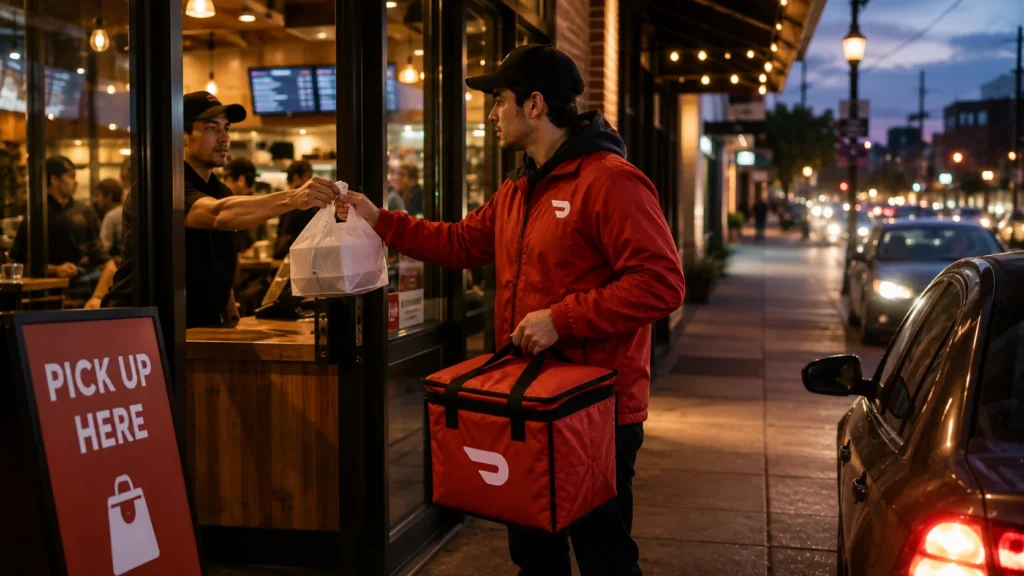
The best DoorDash times are usually when customers are ordering meals and restaurants are active.
Common higher-demand windows include:
- Lunch rush
- Dinner rush
- Friday evenings
- Saturday evenings
- Sunday afternoons and evenings
- Rainy or snowy weather
- Holidays and event days
- Late-night food areas
- College-town peak hours
- Office lunch zones
The best schedule depends on your market. Track your own results by day and hour.
Best Places to DoorDash
Good DoorDash zones often have:
- Many restaurants close together
- Short delivery distances
- Easy parking
- Customers who tip consistently
- Dense apartments or neighborhoods
- Office lunch demand
- Weekend dinner demand
- Low restaurant wait times
- Promotions during busy windows
A zone with many orders is not always profitable. If deliveries are long, parking is bad, or restaurants are slow, your hourly rate can fall.
DoorDash Expenses to Track
A Dasher should track expenses from the beginning. DoorDash is flexible, but it is also vehicle-heavy work.
Track:
- Business miles
- Gas
- Oil changes
- Tires
- Maintenance
- Car washes if used for business presentation
- Parking fees
- Tolls
- Delivery bags
- Phone mount
- Phone plan portion if applicable
- Roadside assistance
- Insurance changes
- App fees or mileage-tracking tools
Mileage is especially important because it affects real profit and taxes.
Taxes for DoorDashers
In the U.S., Dashers are generally treated as independent contractors. That means DoorDash does not withhold taxes the same way an employer withholds from a paycheck.
Dashers may need to think about:
- 1099-NEC forms
- Self-employment tax
- Federal income tax
- State income tax
- Estimated quarterly taxes
- Mileage deductions
- Business expense records
- Tax deadlines
If you earn enough on DoorDash, you may receive a 1099-NEC. Even if you do not receive a tax form, you may still need to report income. A tax professional can help you understand your own filing situation.
Simple DoorDash Profit Formula
Use this formula after every shift:
Gross earnings – estimated vehicle expenses – other expenses – tax set-aside = estimated take-home profit
Example:
| Item | Example |
| Gross earnings | $100 |
| Vehicle cost estimate | -$25 |
| Parking/tolls | -$5 |
| Tax set-aside | -$20 |
| Estimated take-home | $50 |
This does not mean every $100 shift becomes $50. It simply shows why gross earnings can be misleading.
How to Make More Money on DoorDash
There is no guaranteed way to make high earnings, but good habits can help.
1. Track Dollars per Mile
A high-paying order can still be bad if it requires too many miles. Many Dashers use a minimum dollars-per-mile rule.
2. Work Peak Hours
Dinner, weekends, and busy weather can improve order volume and tips.
3. Avoid Long Restaurant Waits
A $10 order is less attractive if you wait 25 minutes at the restaurant.
4. Learn Your Zone
Know which restaurants are fast, which buildings are difficult, and which areas tip better.
5. Watch Return Miles
If an order takes you far from restaurants, include the drive back in your decision.
6. Use Promotions Carefully
Peak Pay can help, but it may also attract more Dashers to the area. More Dashers can mean fewer orders per person.
7. Keep Vehicle Costs Low
A fuel-efficient and reliable car can make a major difference.
8. Track Every Shift
Record hours, active time, gross pay, miles, tips, and expenses. Patterns become clearer after a few weeks.
Is DoorDash Worth It?
DoorDash can be worth it if you want flexible side income, live in a decent market, drive an efficient vehicle, and work during profitable hours.
DoorDash may be worth trying if:
- You want flexible work
- You have a reliable vehicle
- Your area has strong demand
- You can work lunch or dinner rushes
- You track mileage and expenses
- You are comfortable with independent contractor taxes
- You do not depend on DoorDash as guaranteed income
DoorDash may not be worth it if:
- Gas is expensive in your area
- Your car has high maintenance costs
- Orders are low-paying
- Tips are weak
- You spend too much time waiting
- Deliveries require long distances
- You need stable hourly wages
- You dislike variable income
The best way to know is to test it for two to four weeks and track real profit, not just app earnings.
DoorDash Full-Time vs Part-Time
DoorDash often works better as part-time income than full-time income for many drivers. Part-time Dashers can focus on the most profitable hours. Full-time Dashers may need to work slower periods too, which can lower average hourly earnings.
Part-time may be better if:
- You only work peak windows
- You want side income
- You can avoid slow hours
- You have another stable income source
Full-time may be harder if:
- Your market is inconsistent
- You rely on every hour being profitable
- Vehicle expenses are high
- You need benefits
- You need predictable income
- You cannot afford slow weeks
DoorDash flexibility is valuable, but flexibility is not the same as stability.
DoorDash vs Other Gig Apps
Some drivers use multiple apps to compare earnings. This can include Uber Eats, Grubhub, Instacart, Spark, Shipt, or rideshare apps where available.
Multi-apping can help because you are not dependent on one platform. However, it also requires careful timing. Accepting orders from multiple apps at the same time can create late deliveries, poor customer experience, and account risk.
Compare gig apps by:
- Gross pay
- Net pay after expenses
- Miles driven
- Wait time
- Tip reliability
- Stress level
- Customer support
- Deactivation risk
- Schedule flexibility
- Local demand
The best app in one city may not be the best app in another.
DoorDash Earnings Calculator
Use this simple calculator-style table for your own shifts.
| Metric | Your Number |
| Total gross earnings | |
| Total dash time | |
| Total active time | |
| Total miles driven | |
| Gross earnings per dash hour | |
| Gross earnings per active hour | |
| Gross earnings per mile | |
| Estimated fuel cost | |
| Estimated maintenance/depreciation | |
| Parking/tolls | |
| Tax set-aside | |
| Estimated net profit |
Track this for at least 10 shifts. One good or bad night does not tell the full story.
Common Mistakes New DoorDashers Make
Counting Gross Pay as Profit
The app may show what you earned, but it does not subtract all business costs.
Ignoring Mileage
High mileage can make a shift look better than it really is.
Accepting Every Order
Some orders may not be worth the time, distance, or wait.
Working Only Slow Hours
If you only dash mid-afternoon on weekdays, earnings may look much worse than dinner or weekend shifts.
Forgetting Taxes
Independent contractor taxes can surprise new Dashers.
Chasing Peak Pay Without Strategy
Peak Pay can attract many Dashers, which may reduce order volume per driver.
Not Tracking Restaurant Wait Times
Slow restaurants can quietly destroy hourly earnings.
FAQs
How much do DoorDashers make per hour?
DoorDasher earnings vary widely. Some shifts may gross under $15 per hour, while better shifts may gross $15 to $25+ per hour before expenses. Net earnings are lower after gas, maintenance, depreciation, and taxes.
How much do DoorDashers make per delivery?
DoorDash pay per delivery varies by base pay, tips, promotions, distance, time, and market conditions. A short, well-tipped order can be more profitable than a longer order with a higher total payout.
Does DoorDash pay for gas?
DoorDash generally does not pay a separate gas wage for every order. Dashers should treat fuel, maintenance, and vehicle wear as business expenses when calculating profit.
Do DoorDashers keep 100% of tips?
DoorDash states that Dashers receive 100% of customer tips received by DoorDash, on top of base pay and promotions.
What is Earn by Time on DoorDash?
Earn by Time is a mode where Dashers earn a guaranteed active hourly rate plus tips. Active time starts when an offer is accepted and ends when the delivery is completed or canceled.
Is DoorDash good money?
DoorDash can be good side income in the right market, especially during peak hours. It may be less reliable as full-time income because demand, tips, and expenses vary.
How much can you make DoorDashing full-time?
Full-time earnings depend on hours, market, tips, promotions, expenses, and strategy. Full-time Dashers should calculate weekly net profit after mileage, fuel, maintenance, and taxes before relying on it.
Should I DoorDash part-time or full-time?
Part-time DoorDash often lets you focus on the most profitable hours. Full-time DoorDash may require working slower periods, which can lower average earnings.
Conclusion
How much DoorDashers make depends on more than the number shown in the app. The real answer depends on gross earnings, tips, promotions, miles driven, active time, idle time, gas, maintenance, depreciation, and taxes.
DoorDash can be useful flexible income, especially for people who work busy times in strong markets with efficient vehicles. But it is not guaranteed pay, and the difference between gross pay and net profit can be large.
Before relying on DoorDash, test your market, track every shift, measure dollars per mile, and calculate real take-home profit. The best Dashers are not only busy. They are selective, organized, and honest about their costs.











Comments 2