


A traditional IRA may give you a tax deduction now, with taxes generally due when you withdraw the money. A Roth IRA gives you no contribution deduction, but qualified withdrawals are tax-free. The better choice starts with eligibility, then the tax rate you save today versus the tax rate you would pay on future withdrawals.
A Roth IRA is itself an individual retirement account. When people compare an “IRA vs Roth IRA,” they usually mean a traditional IRA versus a Roth IRA. Neither account is an investment by itself: you still choose what to hold inside it.


Traditional IRA vs Roth IRA at a glance
Both accounts offer tax advantages for retirement saving. Their main differences concern deductions, contribution eligibility, and access to the money—not a built-in investment return.
| Feature | Traditional IRA | Roth IRA |
|---|---|---|
| Contribution tax treatment | May be deductible, fully or partly | Never deductible |
| Investment growth inside the account | Generally tax-deferred | Can ultimately be tax-free with qualified withdrawals |
| Withdrawals in retirement | Deductible contributions and earnings generally taxable; after-tax basis is excluded under IRS rules | Qualified distributions tax-free |
| High-income restrictions | No upper income cap on contributing; deduction may be limited | Direct contributions phase out with income |
| Early access | Taxable withdrawals generally face income tax plus a 10% additional tax before 59½, unless an exception applies | Regular contributions come out first, generally tax- and penalty-free; earnings and conversions have separate rules |
| Required withdrawals during the original owner’s lifetime | Yes; starting age depends on birth year | No |
| 2026 and 2027 regular contribution ceiling | Shares one combined limit with Roth IRAs | Shares one combined limit with traditional IRAs |
The IRS explains the account structure in Topic 451 on IRAs. “Tax-free” describes qualifying tax treatment, not protection against investment losses.
Check eligibility before comparing tax brackets
Three questions determine which benefits you can actually use: Do you have eligible compensation? Can you deduct a traditional contribution? Can you contribute directly to a Roth?
One contribution limit covers both accounts
For both 2026 and 2027, your combined regular contributions to traditional and Roth IRAs generally cannot exceed $7,500, or $8,600 if you are 50 or older by year-end. Your limit can be lower if you have less eligible taxable compensation. These figures come from the IRS’s 2026 limits and 2027 announcement.
You can own and fund both account types. For example, an eligible person under 50 could contribute $3,000 to a traditional IRA and $4,500 to a Roth IRA for 2026. Opening another account does not create another allowance. Rollovers and conversions follow separate rules and are not ordinary annual contributions.
There is no upper age limit for regular contributions when you meet the compensation rules. A spouse without sufficient compensation may qualify using a working spouse’s compensation on a joint return; the IRAs remain separately owned. The IRS’s contribution-limit guidance explains this spousal rule.
Traditional IRA income limits usually restrict the deduction
A traditional IRA contribution does not automatically reduce your tax bill. Deductibility depends on modified adjusted gross income, or MAGI, filing status, and whether you or your spouse is covered by a retirement plan at work.
If neither spouse is covered by a workplace retirement plan, the income-based deduction phaseouts generally do not apply. If either is covered, check the applicable range. For Roth IRAs, income affects the ability to contribute directly, regardless of workplace coverage.
The following common situations use different tests:
| MAGI phaseout applies to | 2026 range | 2027 range |
|---|---|---|
| Traditional deduction: single or head of household, contributor covered at work | $81,000–$91,000 | $83,000–$93,000 |
| Traditional deduction: married filing jointly, contributor covered at work | $129,000–$149,000 | $133,000–$153,000 |
| Traditional deduction: married filing jointly, contributor not covered but spouse covered | $242,000–$252,000 | $250,000–$260,000 |
| Direct Roth contribution: single or head of household | $153,000–$168,000 | $158,000–$173,000 |
| Direct Roth contribution: married filing jointly | $242,000–$252,000 | $250,000–$260,000 |
Within a phaseout, the deduction or permitted Roth contribution is reduced; at or above the upper endpoint, that benefit is unavailable. The IRS’s 2027 announcement also lists the corresponding 2026 ranges.
Married filing separately requires special care. For spouses who lived together during the year, the direct Roth phaseout is $0–$10,000 in both years; a special $0–$10,000 traditional deduction phaseout can also apply when workplace coverage is involved. Other filing circumstances have different rules. Use the relevant IRS worksheet rather than applying the joint-filer thresholds.
Example: A single worker covered by a 401(k), with 2026 MAGI of $110,000, cannot deduct a traditional IRA contribution but is below the direct Roth phaseout. The usual “high tax bracket means traditional” shortcut misses this person’s actual choices.
Compare the same savings budget, not just account balances
A $6,000 deductible traditional contribution and a $6,000 Roth contribution do not impose the same after-tax cost. Comparing only the future balances gives the Roth more money from your current budget.
Consider this hypothetical example:
- You qualify for a full traditional deduction and a direct Roth contribution.
- Every dollar of the traditional deduction saves 24% in federal income tax.
- You can devote $4,560 of after-tax money to retirement saving.
- Both investments eventually double, solely to make the arithmetic easy.
- Roth withdrawals are qualified; traditional withdrawals are fully taxable.
The traditional contribution can be $6,000, because its $1,440 tax saving reduces the net cost to $4,560. The Roth contribution is $4,560, with no deduction. Both are below the regular contribution ceiling.
After doubling, the traditional balance is $12,000 before withdrawal taxes. The Roth balance is $9,120, available tax-free under the assumptions.
| Federal tax rate applied to the traditional withdrawal | Traditional spendable amount | Roth spendable amount |
|---|---|---|
| 12% | $10,560 | $9,120 |
| 24% | $9,120 | $9,120 |
| 32% | $8,160 | $9,120 |
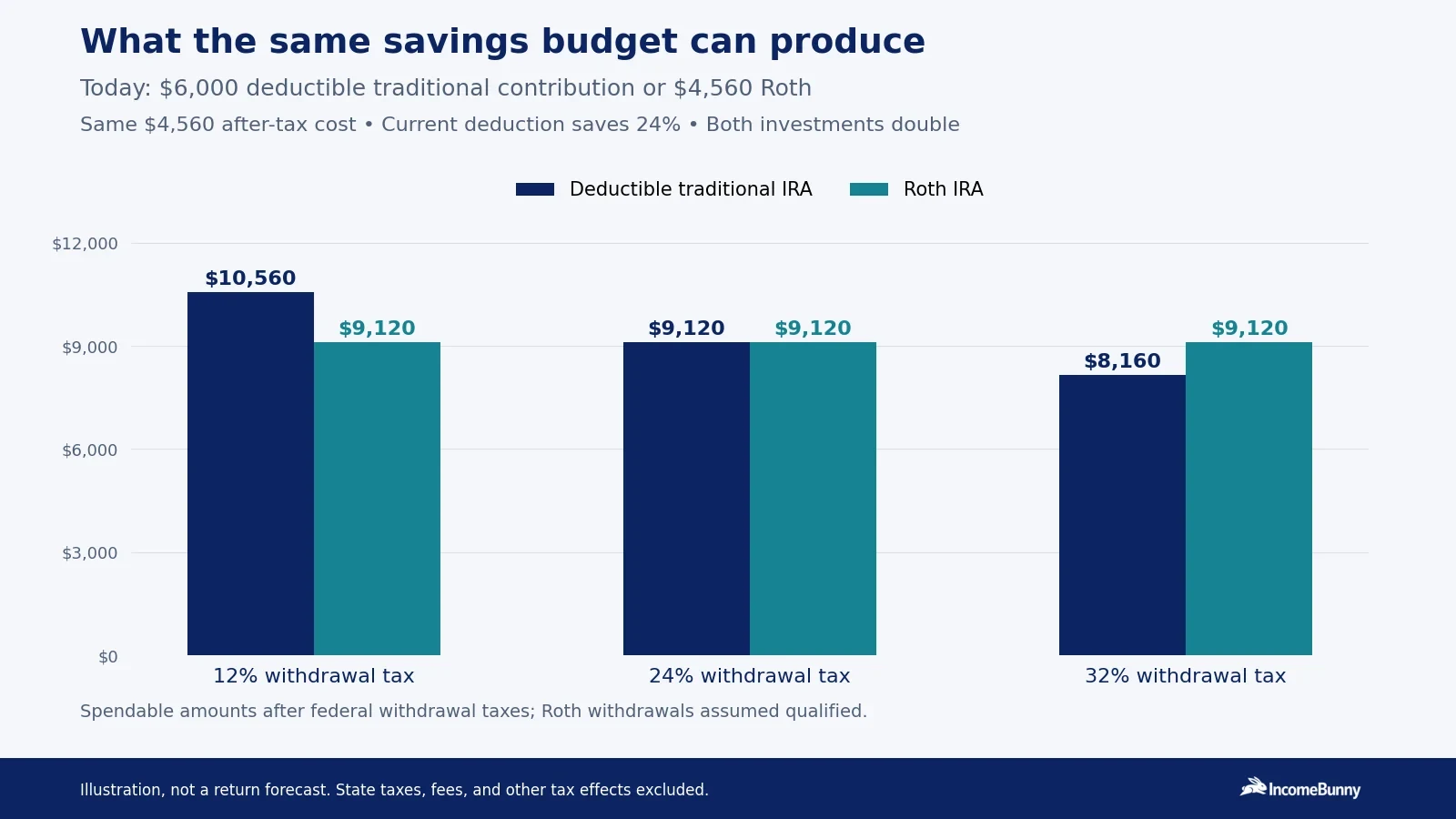
Same $4,560 after-tax savings cost, different withdrawal tax rates. The assumed doubling is an illustration, not a return forecast.
The formulas are straightforward: traditional spendable money equals $6,000 × 2 × (1 − withdrawal tax rate); Roth spendable money equals $4,560 × 2.
At equal tax rates, the results tie in this simplified comparison. A lower future withdrawal tax rate favors the deductible traditional contribution; a higher rate favors the Roth. More years of growth alone do not break that mathematical tie when both accounts have the same growth factor.
This example ignores state taxes, fees, inflation, credits, income-related benefit effects, and tax-law changes. It assumes the full contribution and withdrawal face the stated rates. Actual withdrawals may cross brackets. Compare the tax effect of the specific dollars, not your current marginal bracket against an unrelated average retirement tax rate.
There is a cash-flow condition, too: funding the $6,000 traditional contribution requires the cash before you receive any tax refund, unless you adjust withholding appropriately. Spending the tax saving instead of preserving the same savings budget changes the comparison.
If you can afford to maximize either account, a full Roth contribution places more eventual after-tax spending power inside the annual dollar ceiling. But it also uses more current after-tax money than an equally sized deductible traditional contribution. A fair comparison must account for what happens to the traditional tax saving outside the IRA.
Withdrawal rules are more detailed than “tax now or later”
Traditional IRA withdrawals
Deductible contributions and investment earnings generally become ordinary taxable income when withdrawn. Before age 59½, the taxable amount generally also faces a 10% additional tax unless an exception applies.
An exception to that additional tax does not necessarily make the withdrawal income-tax-free. For instance, qualifying higher-education expenses can avoid the additional tax while leaving the taxable portion subject to ordinary income tax. Check the IRS’s Publication 590-B distribution rules before treating a planned withdrawal as an exception.
If you made nondeductible traditional contributions, keep your basis records and required Forms 8606. IRS calculations generally allocate taxable and nontaxable amounts across your traditional, SEP, and SIMPLE IRAs; you cannot simply label a withdrawal as coming only from the after-tax dollars in one account.
Roth IRA contributions, earnings, and conversions
Regular Roth contributions generally come out first and can be withdrawn without income tax or the 10% additional tax. That treatment applies to your remaining regular-contribution basis, not the entire account balance.
For a hypothetical Roth containing $15,000 of remaining regular contributions and $4,000 of earnings, with no conversions, a $5,000 withdrawal comes from contributions under the ordering rules. It does not mean the $4,000 of earnings is equally accessible tax-free.
For earnings to be part of a qualified distribution, you generally need both the Roth five-tax-year holding period and age 59½. Disability, death, and qualifying first-home distributions can also satisfy the qualifying-event condition, subject to their rules. The five-year requirement still matters.
The holding period starts January 1 of the first tax year for which you contributed to a Roth IRA. If your first contribution is designated for 2026—even if made timely in March 2027—the period starts January 1, 2026. It is satisfied beginning January 1, 2031; age or another qualifying condition must also be met.
Conversions are a separate category. Distributions generally follow this order across your Roth IRAs: regular contributions, conversions and applicable rollovers, then earnings. Each conversion has a separate five-year period relevant to potential early-distribution tax. Do not apply the regular-contribution withdrawal rule to converted money. These distinctions come from Publication 590-B’s Roth IRA rules.
Required minimum distributions
Traditional IRAs require minimum withdrawals during the owner’s lifetime. The applicable starting age depends on birth year, with current legislation providing ages 73 or 75 for newer cohorts; older owners may already be subject to earlier starting rules. The IRS explains the age changes in Notice 2023-54.
Roth IRAs have no lifetime required minimum distributions for the original owner. Inherited Roth IRAs have separate distribution requirements. That distinction can make a Roth useful when you want flexibility over when to draw retirement income, without making the account free of inheritance rules.
Which IRA fits your situation?

Compare actual deduction eligibility and the household savings budget before choosing the account.
A Roth IRA deserves consideration when your current tax rate is relatively low, you qualify for direct contributions, and you expect higher rates on future retirement withdrawals. An early-career or temporarily lower-income year can fit that pattern, but age alone does not prove it.
A deductible traditional IRA deserves consideration when today’s tax saving is substantial and you reasonably expect lower tax rates on the withdrawals. Confirm deductibility first and decide how you will preserve the tax saving in your retirement plan.
If the traditional contribution is nondeductible but you qualify for a Roth, compare the Roth carefully. A nondeductible traditional IRA does not supply the upfront deduction in the worked example, and its earnings can still be taxable on withdrawal. Required Form 8606 reporting tracks after-tax basis; it does not turn the account into a Roth.
If you qualify for neither a deduction nor direct Roth contributions, investigate alternatives before depositing money automatically. A backdoor Roth involves a traditional contribution and a conversion, with reporting and potential pro-rata taxation. Existing pre-tax IRA money can materially change the tax result. It is a separate planning decision, not another annual contribution allowance.
If future tax rates are uncertain, holding both traditional and Roth savings can provide withdrawal flexibility. You can split annual IRA contributions within the combined limit and revisit the allocation as income changes. A workplace retirement plan is a separate decision with its own rules.
Compare the spending each account could support with the retirement withdrawal calculator. Our guide to how long retirement savings may last explains why withdrawal taxes and the timing of other income matter.
Before opening or funding an account, write down five items: your contribution tax year, filing status and estimated MAGI, workplace-plan coverage for each spouse, expected deduction, and the investment you intend to buy. Then compare provider account fees, fund expenses, automation, and support. The tax label alone does not select a portfolio or put an uninvested cash deposit to work.
Practical questions before you contribute
Can I change from a traditional IRA to a Roth IRA later?
You can generally convert traditional IRA money to a Roth IRA, paying tax on the taxable portion in the conversion year. Conversion eligibility is not the same as direct Roth contribution eligibility. A conversion can create a substantial tax bill and cannot be undone by recharacterizing it under current rules. Review the IRS’s conversion guidance in Publication 590-A before proceeding.
Is the contribution deadline the same for both accounts?
Under the IRS contribution rules, regular contributions generally must be made by the tax-return filing deadline for that year, excluding extensions. Early in the calendar year, specify whether a deposit is for the prior year or the current one. Check the applicable deadline and any special relief before relying on a last-minute transfer.
Do Roth and traditional IRAs earn different returns?
The account type does not set a universal return. Investments, fees, and market performance determine growth; tax treatment determines how much of a withdrawal you keep. Choose the eligible tax structure and the investments as two related decisions, with enough accessible savings outside the IRA for near-term needs.
Keep near-term needs separate from retirement investments. The emergency fund guide helps you estimate an accessible cash reserve.










Comments 5