


Choose YNAB if you want to decide what your available cash must cover before you spend it. Choose Monarch Money if you want flexible monthly budgeting alongside a shared view of accounts, investments, recurring expenses, and net worth. YNAB is the stronger fit for active spending control; Monarch is the stronger fit for a household financial overview.
The annual price difference is small: YNAB costs $109, while Monarch’s standard Core plan costs $99.99 before applicable taxes. The more important question is which routine you will keep using. Both import transactions and require review; neither manages your money for you.


YNAB vs Monarch at a glance
This comparison focuses on YNAB and Monarch Core. Monarch Plus adds advanced planning features at an additional cost. Both services work on the web, iOS, and Android.
| Comparison | YNAB | Monarch Money |
|---|---|---|
| Best fit | Assigning available cash to priorities before spending | Monthly budgeting and a consolidated household overview |
| Budget approach | Cash-based, zero-based planning with categories and targets | Flex budgeting or detailed category budgets |
| Annual subscription | $109 | Core: $99.99 |
| Monthly subscription | $14.99 | Core: $14.99 |
| Standard trial | 34 days; no card on direct signup | 7 days; check checkout terms and cancellation date |
| Sharing | Up to six people with separate logins; group manager sees members’ plans | Household members have separate logins and a shared view |
| Net worth and investments | Net worth reports; not a full portfolio-analysis dashboard | Broader account and investment overview; advanced tools depend on tier |
| Main trade-off | More decisions about category funding and cash timing | Monthly targets need a separate check against actual cash and bill dates |
Our verdict: Pick YNAB when your main question is “Can I afford this before payday?” Pick Monarch when it is “How is our whole financial picture doing?” Either can serve a couple, track goals, and help organize spending. This is a comparison of documented features and workflows, not a claim of hands-on product testing.
Budgeting methods and daily effort
YNAB for deciding what your cash should do next
YNAB stands for You Need a Budget. Its zero-based approach assigns money already in your cash accounts until Ready to Assign reaches zero. Zero does not mean emptying your bank account: money assigned to rent, emergencies, or a vacation remains in the account until used.
You can set targets for future expenses, but a target is different from funded cash. When income arrives, you assign it to priorities. If dining out runs over, you decide which other category will give up money. That makes the trade-off visible while there is still time to change the plan.
YNAB’s getting-started guidance explains this distinction between targets, available money, and reconciliation. The method suits someone who wants to break a pattern of using the next paycheck to cover purchases already made. It also works with irregular income because it starts with received cash rather than assuming every expected payment will arrive.
The cost is attention. Automatic imports reduce typing, but you still review transactions, cover overspending, and check category balances. YNAB is less appealing if assigning money feels like work you will avoid.
Monarch for flexible monthly planning
Monarch offers category budgeting as well as Flex budgeting. Flex groups expenses into Fixed, Non-monthly, and Flex buckets. You can monitor one overall flexible-spending amount instead of maintaining a strict limit for every restaurant, grocery, and shopping category.
Under Monarch’s Flex budgeting rules, non-monthly expenses need appropriate targets and rollovers. Setting aside a monthly amount for an annual bill works only if you also preserve the actual cash. To work out how much to save each month, set up a sinking fund for annual bills. A rollover in the app does not move money into a bank account.
Label fixed commitments and expenses that vary month to month consistently before comparing the two apps. Otherwise, a category change can look like a spending improvement even when no cash has been saved.
Monarch can therefore reduce the number of category-level decisions, but it is not purely retrospective tracking. You can plan ahead, move budgeted amounts, and review spending against targets. The important limitation is timing: an expected monthly income figure does not ensure enough cash is available for a bill due tomorrow.
Winner for active cash allocation: YNAB. Winner for budgeting flexibility: Monarch. These are judgments about the workflow, not evidence that one app produces better financial outcomes for everyone.
A worked example using the same household
Suppose a household expects $5,000 in take-home income this month but currently has only $2,500 available to allocate. Its next paycheck has not arrived. The figures below are illustrative, not a recommended budget.
Build the plan from money you can actually use. Our gross vs net income guide explains why a headline salary and spendable take-home pay are different starting points.
In YNAB, it could fund $1,800 of bills due before payday, $400 of groceries, $100 of transportation, and a $200 buffer. Those assignments total $2,500. Other targets wait for additional income or require a change in priorities.
In Monarch, the household could plan the full month around $1,800 of fixed expenses, $300 for non-monthly costs, $1,300 of flexible spending, and $1,600 of savings contributions. Those amounts total $5,000. The plan still needs a cash check: which bills must clear before the remaining income arrives?
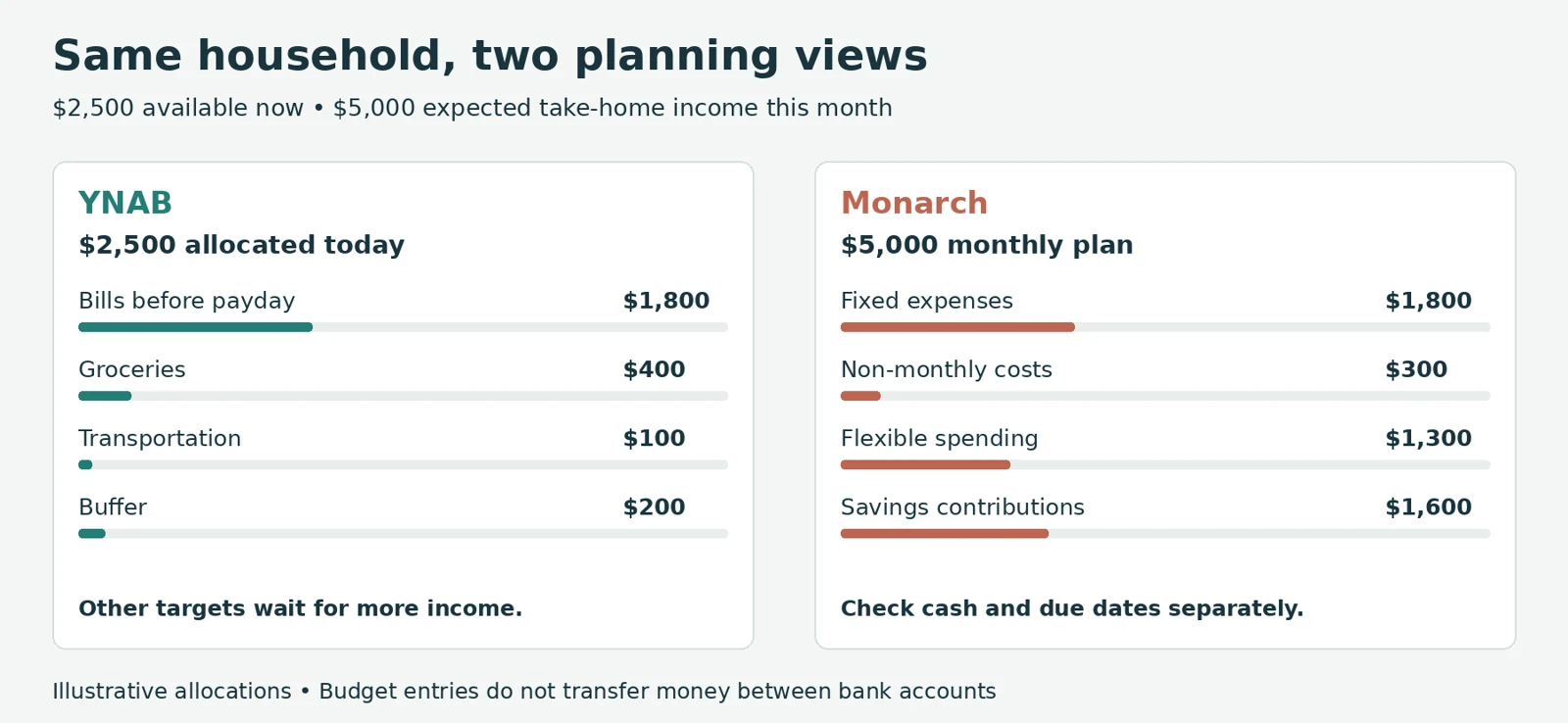
Now suppose a $120 repair appears. In YNAB, the household could move $120 from its funded buffer to Repairs, leaving $80 in the buffer. In Monarch, it could revise the relevant expense budget and reduce another allocation. Neither action creates cash; both make the revised trade-off visible.
The deciding question is whether you want the app’s central routine to begin with available dollars or with the monthly household plan. If money is tight between paychecks, that difference matters more than a dashboard preference. To test either app on a real decision, pick one dollar target and use this method for tracking financial goals by deadline.
Credit cards and debt management
YNAB has a particularly useful credit-card workflow. For a purchase in a funded category, it moves the corresponding cash allocation into the card’s payment category. A funded $60 grocery purchase reduces grocery money and reserves $60 for the card payment. You still make the actual payment through your bank or card issuer.
There is a setup trap: a balance that existed before you started YNAB needs its own funding. Importing the card does not make that debt covered. YNAB’s credit-card guide explains the distinction between new funded purchases and an existing balance.
Reserving cash for a card bill is different from credit cycling. A budgeting category does not increase your issuer’s approved limit or eliminate payment-processing delays.
Monarch gives you a wider view of card and loan balances, spending, and goals. For ordinary tracking, classify card repayments as transfers so purchases are not counted again as new spending when the bill is paid. Review that classification during setup.
Choose YNAB if separating spending money from money reserved for the card bill is the missing habit. Choose Monarch if you primarily want balances and repayment progress within the broader household picture. Neither subscription pays down a balance automatically simply because you enter a goal.
If you want alternatives with different sharing arrangements, compare our best budgeting apps for couples. The guide also covers selective account visibility, shared logins, and settling bills while keeping separate accounts.
Couples and household privacy
Both apps support collaboration without sharing one password. The privacy model deserves more attention than the number of included users.
YNAB Together covers the subscriber plus up to five trusted people. The group manager can access group members’ plans, including plans members do not share with other members. The manager can keep their own plans private. This is not a symmetrical “everyone has a completely private budget” arrangement.
Monarch is built around a shared household space. Its couples documentation says members can see all accounts and transactions associated with that shared space. Separate logins provide individual access, not account-level secrecy from the other household members.
Winner for one combined household overview: Monarch. YNAB is attractive when you want several distinct plans under one subscription, provided everyone understands the manager’s access. If keeping specific finances private is essential, settle that requirement before connecting accounts or inviting anyone.

Agree on which accounts to include, who reviews transactions, and when to check the plan together.
For a broader household shortlist, compare our best household budgeting apps on member access, device limits, annual costs, and a seven-day shared setup check.
Bank syncing and the broader financial picture
Both apps can import bank transactions. Connection quality depends on your particular institution, account type, and data provider, so there is no reliable universal winner for syncing.
Monarch supports Plaid, Finicity, and MX, with alternative providers available for some institutions. YNAB uses Plaid and MX for linked imports. Multiple providers can give you another route when one connection fails; they do not guarantee that every bank or account will work.
During a trial, connect your primary checking account, a credit card, and any account essential to your decision. Confirm balances, transaction dates, transfers, and whether imports resume over several days. Do not judge syncing from the initial connection alone. Keep a fallback method for recording spending when an import is delayed. If you want to keep tracking after a trial ends without paying for a subscription, compare these free budgeting apps with manual entry or bank sync.
For investment and net-worth visibility, Monarch is the better fit. YNAB also has net-worth reports, so describing it as offering no net-worth tracking would be inaccurate. Its emphasis is spending decisions and funding priorities rather than detailed portfolio monitoring.
Monarch’s tier matters here. Core includes budgeting, goals, cash flow, and net worth; the Plus tier adds forecasting, business tracking, and advanced investment tools. Confirm the Plus price at checkout if those features drive your purchase. A projected retirement outcome is a model based on assumptions, not a guaranteed result.
Pricing and trials compared
According to the current YNAB pricing page and Monarch pricing page, both standard monthly subscriptions cost $14.99. Paying monthly for 12 months totals $179.88 before applicable taxes.
At regular annual rates, YNAB costs $109 and Monarch Core costs $99.99. That makes Monarch $9.01 cheaper per year, about 75 cents per month. Annual billing saves $70.88 on YNAB or $79.89 on Monarch Core compared with 12 monthly payments at today’s rate. Those savings assume you keep the service for the full year.
Prices were checked October 29, 2026. Promotions, app-store terms, and taxes can change the amount charged. Compare the renewal price as well as the introductory offer; the annual equivalent is not a monthly payment plan.
YNAB’s standard trial lasts 34 days with no card required when you sign up directly. Eligible college students can apply for a 365-day trial. Monarch advertises a seven-day trial. Neither has a permanent free plan for ordinary users. Check the selected plan and billing date before starting, and set a cancellation reminder if you are undecided.
Winner on regular annual price: Monarch Core. Winner for time to evaluate: YNAB. The $9.01 yearly difference should rarely outweigh choosing a method you will actually maintain.
Security and account access
YNAB and Monarch describe encrypted data and read-only bank connections, so the budgeting app cannot use that connection to move your money. Their published controls do not justify declaring either app risk-free or conclusively safer without a comparable security assessment.
Use a unique password, enable two-factor authentication, and keep recovery options accessible. Resolve sign-in problems through the service’s official support before removing a working authentication method.
Protecting your device is a separate task from choosing a budgeting service. Keep its software updated and review app permissions. A VPN does not hide information you deliberately share with a signed-in budgeting account or its household members.
Which app should you choose
Choose YNAB if you want spending decisions to change
YNAB is the better starting point if you routinely wonder whether your checking balance is already committed, have uneven paychecks, or need a clearer distinction between credit-card spending and payment money. Expect to review categories and reconcile accounts rather than treating it as a background tracker.
Choose Monarch if you want one household overview
Monarch is the better starting point if you want spending, recurring charges, investments, and net worth together, and prefer flexible monthly targets. Core is the relevant comparison for everyday budgeting; evaluate Plus separately when advanced planning is the reason you are subscribing.
If recurring charges and cancellation assistance matter more than detailed category funding, compare Rocket Money vs Monarch before paying for a broader planning system.
Before committing, use the same small test in each app: record a purchase and refund, review a card payment, account for an irregular bill, and explain the available-to-spend figure to your partner or to yourself. Check that your important bank connections keep updating. Choose the app whose numbers you understand and whose routine you can repeat.
Need desktop registers, manual imports, or a wider range of software? Our guide to Quicken alternatives separates those requirements from everyday budgeting.












Comments 8