


Dermatologists employed by US organizations earn a mean annual wage of $323,530, or $155.55 per hour, according to the latest Bureau of Labor Statistics occupational wage data, covering May 2025. Broader physician compensation surveys report higher figures: Medscape reported average dermatologist compensation of approximately $454,000 for 2024, while Doximity’s 2025 physician compensation report listed $508,401.
These numbers are not directly interchangeable. BLS measures wages paid to employees and excludes self-employed dermatologists, nonwage benefits, and certain types of bonus and ownership income. Physician surveys use different samples and broader compensation definitions. The practical answer to “How much do dermatologists make?” therefore depends on whether the reader needs an official employee-wage benchmark or a broader estimate of physician compensation.


Data note: All figures in this guide are gross amounts before taxes. Monthly and weekly amounts are mathematical equivalents, not necessarily the way a dermatologist receives pay.
Dermatologist Salary at a Glance
| Source and data period | What it measures | Annual | Monthly | Weekly | Hourly |
| BLS, May 2025 | Mean wage for employed dermatologists | $323,530 | $26,961 | $6,222 | $155.55 reported |
| Medscape 2025 report, covering 2024 | Surveyed dermatologist compensation | $454,000 | $37,833 | $8,731 | Not reported |
| Doximity 2025 report, using 2024 surveys | Modeled full-time physician compensation | $508,401 | $42,367 | $9,777 | Not reported |
The monthly and weekly figures are IncomeBunny calculations using annual compensation divided by 12 and 52. Medscape and Doximity compensation should not be converted into an hourly wage because neither source reports a dermatologist-specific hourly figure, and actual physician work hours vary.
How We Compared Dermatologist Salary Data
A salary guide can become misleading when it places figures from different sources side by side without explaining what each one measures.
This guide uses three complementary benchmarks:
| Source | Population and measure | Best use | Main limitation |
| BLS OEWS | Wages paid to part-time and full-time employees | Official US employee-wage benchmark | Excludes self-employed workers and nonwage benefits |
| Doximity | Compensation surveys from full-time US physicians | Broader physician and specialty comparison | Survey and regression-based estimate |
| Medscape | Physician-reported specialty compensation | Dermatology-specific compensation context | Results depend on the survey sample and reporting definitions |
BLS wage data include base rates, commissions, incentive pay, and production bonuses. They exclude nonproduction bonuses, profit-sharing payments, year-end bonuses, overtime premiums, and employer costs for benefits such as health insurance and retirement contributions. BLS also excludes self-employed workers and owners or partners in unincorporated businesses.
Doximity’s 2025 report used more than 37,000 physician compensation surveys completed during 2024 and a six-year dataset containing more than 230,000 surveys. Its analysis was limited to full-time US physicians working at least 40 hours per week and adjusted for factors such as specialty, location, experience, and reported work hours.
Those methodology differences likely explain part of the gap between the sources, but the reports do not provide enough information to assign the entire difference to one factor.
Which salary number should you use?
- Use BLS when you need an official benchmark for wages paid to employed dermatologists.
- Use Medscape or Doximity when comparing broader physician compensation across specialties.
- Use a specific employment contract when evaluating a real job offer.
- Use verified practice financial statements—not national salary averages—when assessing partnership or ownership income.
How Much Do Dermatologists Make per Year, Month, Week, and Hour?
Using the latest BLS employee-wage benchmark, a dermatologist earns an average of approximately:
- $323,530 per year
- $26,961 per month
- $6,222 per week
- $155.55 per hour
The annual and hourly amounts are reported by BLS. The monthly and weekly figures are mathematical conversions.
BLS also reports a median hourly wage of $158.04 for dermatologists. The mean and median answer different questions:
- The mean adds all reported wages and divides the total by the number of employees.
- The median is the midpoint, with half of reported wages below it and half above it.
Neither measure captures every source of self-employment, partnership, or practice-owner income.
Related Contents:
How Much Do Electricians Make?
Are dermatologists actually paid by the hour?
The BLS hourly wage is useful for comparing dermatology with other occupations, but it is not a standard physician billing rate.
A dermatologist may instead be paid through:
- A guaranteed salary
- Salary plus a productivity bonus
- Compensation tied to collections
- Work relative value units or another productivity formula
- Partnership distributions
- Practice-owner income
A physician earning $400,000 per year is therefore not necessarily receiving a paycheck calculated by multiplying a fixed hourly rate by hours worked.

Why Dermatologist Salary Estimates Vary
Two credible sources can report dermatologist compensation more than $100,000 apart without measuring the same thing incorrectly.
Salary versus total compensation
A guaranteed base salary may be only one part of a dermatologist’s earnings. Total compensation can include productivity bonuses, incentive payments, partnership distributions, and other cash payments.
Benefits such as employer retirement contributions and health insurance have financial value but may not appear in either the salary figure or reported cash compensation.
Employees versus self-employed physicians
An employed dermatologist is paid by an organization. A practice owner may receive clinical compensation and a share of business profits.
The owner may also be responsible for:
- Staff payroll
- Office rent
- Medical equipment
- Billing services
- Malpractice insurance
- Technology
- Marketing
- Compliance costs
- Business debt
Practice revenue, practice profit, and the dermatologist’s personal compensation are three different figures.
Mean versus median
A small number of very high earners can raise a mean. A median may better represent the middle observation, but it still does not reveal the physician’s schedule, ownership status, practice setting, or procedure mix.
Report year versus data year
A report published in 2025 may describe compensation earned or reported during 2024. The underlying data period matters more than the year placed in an article title.
Survey population
A survey containing more practice owners or procedure-heavy physicians may produce a higher result than one containing more academic or hospital-employed dermatologists.
Checklist: Before Trusting a Dermatologist Salary Number
Check:
- The underlying data year
- Mean versus median
- Wage versus total compensation
- Employee versus owner population
- Whether bonuses are included
- Whether benefits are included
- Whether part-time physicians are included
- Sample size
- Geographic coverage
- Whether the number is reported, modeled, or calculated
How Much Do Dermatologists Make in Residency?
A dermatology resident does not earn an attending dermatologist’s salary.
AAMC’s 2025 debt and cost fact card reports a preliminary first post-MD-year median stipend of $66,986, or approximately $5,582 in gross monthly income. A separate AAMC resident-budget example used a projected 2025 PGY-1 stipend of $67,400. Actual pay varies by institution, location, and postgraduate year.
The standard American Board of Dermatology pathway requires:
- One prerequisite clinical year, commonly called PGY-1
- Three years of full-time specialty-specific dermatology residency
Some physicians complete an additional fellowship. An accredited Micrographic Surgery and Dermatologic Oncology fellowship, which includes advanced Mohs surgery training, lasts 12 months after dermatology residency.
Resident-to-attending earnings timeline
| Career stage | Compensation structure | Income predictability | Main financial consideration |
| Medical student | Usually no physician earnings | Low | Tuition and living costs |
| PGY-1 resident | Institutional stipend | High | Income is far below attending compensation |
| Dermatology resident | Institutional stipend | High | Pay generally rises with postgraduate year |
| Fellow | Institutional stipend | High | Full attending earnings are delayed |
| Employed attending | Salary or salary plus incentives | Medium-high | Contract terms determine compensation |
| Partner or owner | Clinical compensation plus possible distributions | Variable | Greater business risk |
The high figures shown in physician compensation surveys generally apply after medical school and postgraduate training—not during residency.
How Dermatologist Earnings Change by Career Stage
No authoritative national source publishes a clean table showing exactly what dermatologists earn after a specific number of years in practice. Giving fixed “entry-level,” “mid-career,” and “senior” ranges without a defensible dataset would create false precision.
The clearest measurable transition is from residency to attending practice. After residency, earnings depend less on a standard experience band and more on the physician’s contract, productivity, patient volume, procedure mix, location, and access to partnership or ownership.
Early-career dermatologists
A first attending contract may include:
- Guaranteed base salary
- Signing bonus
- Relocation assistance
- Productivity threshold
- Bonus formula
- Malpractice coverage
- Paid leave
- Retirement and health benefits
- Partnership track
The largest advertised salary is not automatically the strongest offer. A lower guaranteed salary may provide more value when it includes achievable productivity requirements, better benefits, manageable patient volume, and a credible path to partnership.
Experienced employed dermatologists
An experienced dermatologist may improve earning potential through:
- A larger referral network
- Higher patient volume
- Additional procedural work
- Leadership duties
- Better productivity terms
- Specialized skills
- Stronger negotiating leverage
Years in practice alone do not determine pay. Two dermatologists with the same experience can receive very different compensation because their work arrangements differ.
Partners and practice owners
Partners and owners may receive clinical compensation plus business distributions, but they also absorb operating expenses and business risk.
| Career arrangement | Income stability | Potential upside | Business risk |
| Salaried employee | Higher | Moderate | Lower |
| Employee with productivity bonus | Medium-high | Moderate to high | Lower |
| Practice partner | Medium | Higher | Medium |
| Sole or majority owner | Variable | Potentially high | High |
Ownership is not a guaranteed route to higher personal income. A practice can generate substantial revenue while producing limited profit after staffing, facilities, equipment, insurance, and debt costs.

How Location Affects Dermatologist Pay
The national BLS mean for employed dermatologists was $323,530 in May 2025. Geographic estimates can differ because of local demand, hiring difficulty, patient mix, practice setting, and the employers represented in each regional sample.
A location offering a higher nominal salary does not automatically provide greater financial value. A useful comparison should include:
- Housing costs
- State and local taxes
- Relocation expenses
- Expected patient volume
- Call obligations
- Insurance and cash-pay mix
- Benefits
- Partnership opportunities
- Malpractice coverage
- Household employment considerations
State and metropolitan estimates should also be treated cautiously when the underlying occupational sample is small. A future state ranking should use one consistent source and data period rather than mixing government estimates with job-board figures.
What Affects a Dermatologist’s Salary?
A dermatologist’s title alone rarely explains the full compensation package.
Practice setting
Dermatologists may work in:
- Academic medical centers
- Hospitals and health systems
- Multispecialty groups
- Single-specialty dermatology groups
- Solo practices
- Partnerships
- Physician-owned clinics
Practice setting can affect salary guarantees, bonus formulas, support staff, patient volume, academic duties, overhead, and ownership opportunities.
Medical, surgical, and cosmetic services
Dermatology practices may generate revenue from:
- Medical consultations
- Diagnostic testing
- Biopsies
- Dermatologic surgery
- Skin-cancer treatment
- Cosmetic procedures
- Pathology services
Cash-pay cosmetic services can produce different revenue opportunities from insurance-reimbursed medical care. Higher procedure prices do not automatically produce higher personal earnings because equipment, staffing, rent, marketing, and other costs reduce practice profit.
Compensation model
| Compensation model | Predictability | Upside | What to examine |
| Fixed salary | High | Limited | What happens after the guarantee period |
| Salary plus bonus | Medium-high | Moderate | Bonus formula and threshold |
| Productivity based | Medium | Higher | Work units, coding, volume, and schedule |
| Collections based | Variable | Higher | Which collections count and when |
| Partnership or ownership | Variable | Potentially high | Expenses, debt, buy-in, and distributions |
The compensation formula can matter more than a modest difference in advertised base salary.
Illustrative example: Two dermatologists may each receive a $350,000 guaranteed salary. One contract includes an achievable productivity bonus and employer-paid malpractice tail coverage. The other requires much higher patient volume and makes the physician responsible for tail coverage. The headline salaries are equal, but the financial value is not.
Patient volume and schedule
Higher earnings may require:
- More clinic sessions
- More patients per day
- More procedures
- Call duties
- Administrative responsibilities
- Longer hours
Compensation should therefore be evaluated alongside the workload required to earn it.
Location, demand, and payer mix
Two practices with similar patient volume may collect different amounts because reimbursement, direct-pay demand, local competition, and referral patterns differ.
What Is the Highest-Paid Type of Dermatologist?
There is no authoritative national dataset proving that one dermatology subspecialty is always the highest paid.
Higher compensation may be associated with some combination of:
- Procedure-heavy work
- Cosmetic services
- Mohs surgery
- High patient volume
- Practice ownership
- Partnership distributions
- Strong local demand
- Favorable reimbursement or direct-pay pricing
| Dermatology path | Possible earnings driver | Main limitation |
| General medical dermatology | Broad patient demand | Insurance reimbursement can limit revenue |
| Cosmetic dermatology | Direct-pay services | Marketing, equipment, and local demand matter |
| Mohs surgery | Specialized procedural care | Additional training and referral volume are required |
| Dermatopathology | Specialized diagnostic work | Compensation structure differs from clinic practice |
| Practice ownership | Access to business profit | The owner absorbs operating costs and financial risk |
A cosmetic dermatologist does not automatically earn more than a medical dermatologist. A Mohs surgeon does not automatically earn more than every practice owner.
The defensible conclusion is that procedure mix, productivity, and business structure can matter as much as the subspecialty title.
What Do Dermatologists Do?
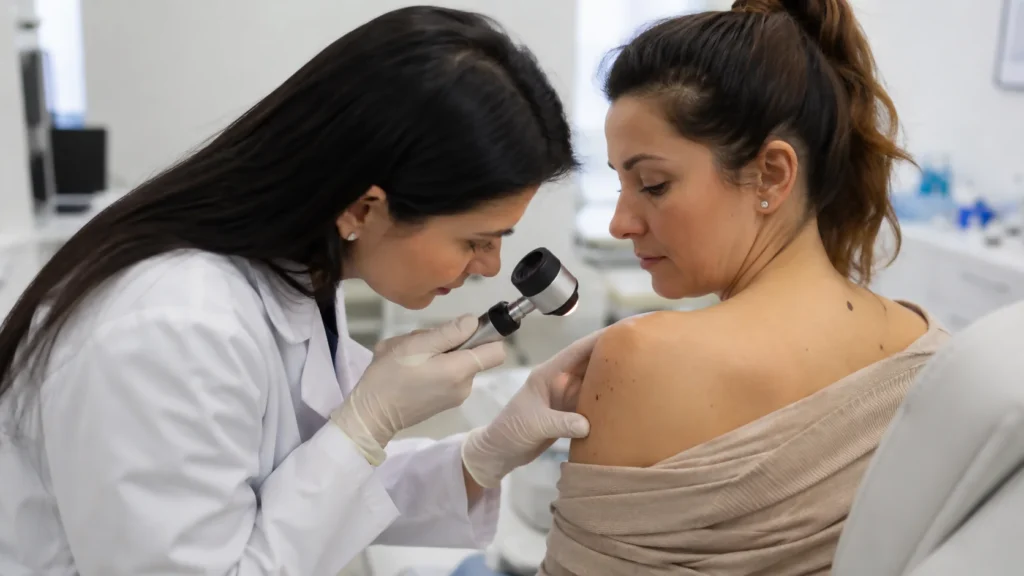
Dermatologists are medical doctors who diagnose and treat conditions affecting the skin, hair, and nails. Their work can include medical, diagnostic, surgical, and cosmetic care.
Typical responsibilities include:
- Examining the skin for disease or abnormal changes
- Diagnosing acne, eczema, psoriasis, infections, and other conditions
- Evaluating suspicious lesions
- Performing biopsies
- Treating skin cancer
- Conducting dermatologic surgery
- Managing chronic skin conditions
- Performing cosmetic procedures when relevant to the practice
The range of responsibilities helps explain compensation differences. Procedure volume, specialization, practice setting, patient demand, and ownership can all affect the economics of the role.
Is It Hard to Become a Dermatologist?
Becoming a dermatologist requires a long education and training pathway.
A typical route includes:
- Four years of undergraduate education
- Four years of medical school
- One prerequisite clinical year
- Three years of dermatology residency
- Optional fellowship training
That is approximately 12 years after high school before independent dermatology practice, assuming no gap years or additional training. The American Board of Dermatology requires four years of postgraduate training: one approved PGY-1 clinical year and three years of specialty-specific dermatology residency.
Dermatology residency competition
Dermatology residency positions filled at a very high rate in the 2026 Main Residency Match. NRMP reported that 156 programs offered 546 standard PGY-2 dermatology positions, and 545 filled—a 99.8% fill rate.
That figure shows strong demand for available positions, but it is not an individual applicant’s probability of matching. NRMP notes that applicant counts can include the same person across multiple specialty or program-type combinations. Applicant-specific competitiveness requires more detailed Match data than a fill rate alone.
Optional fellowships
Additional training may be available in areas such as:
- Micrographic surgery and dermatologic oncology
- Pediatric dermatology
- Dermatopathology
Extra training can expand a physician’s scope of practice, but it also postpones full attending earnings. Fellowship decisions should not be based only on a hoped-for salary increase.
Salary Reality Check: Training, Debt, and Delayed Earnings
Dermatology can lead to high compensation, but the financial path includes years of training before attending-level earnings begin.
AAMC reports that 70% of 2025 medical-school graduates had education debt. Among graduates with education debt, the median was $215,000. AAMC also reports median four-year attendance costs of $297,745 at public medical schools and $408,150 at private schools for the graduating class of 2026. Individual debt and costs vary substantially.
| Stage | Income position | Common financial pressure |
| College | No physician income | Tuition and living costs |
| Medical school | Usually no physician income | Tuition, fees, and possible borrowing |
| Residency | Stipend income | Debt, rent, exams, and licensing |
| Fellowship | Stipend income | Additional delay before attending earnings |
| Early attending career | Higher earnings begin | Loan payments and relocation |
| Established career | Greater earning potential | Taxes, retirement, and possible business risk |
The financial decision should include:
- Total education cost
- Amount borrowed
- Interest costs
- Residency income
- Time before full earnings
- Work schedule
- Geographic flexibility
- Career fit
A high eventual salary does not make the training period financially easy, and it cannot compensate indefinitely for work a person does not want to perform.
Dermatologist Job Outlook
BLS projects dermatologist employment to rise from approximately 10,900 positions in 2024 to 11,600 in 2034, an increase of about 6%. Physicians and surgeons as a broader group are projected to grow by 3% over the same period.
A national projection does not guarantee:
- Employment in a preferred city
- A specific salary
- A partnership opportunity
- A preferred schedule
- Residency admission
- Equal demand in every local market
Job opportunities and compensation will continue to vary by region, practice setting, and employer.
Who Dermatology May Suit and Who May Prefer Another Career
Salary should be part of the decision, not the entire decision.
| Dermatology may suit someone who… | Another path may suit someone who… |
| Has a genuine interest in skin disease and visual diagnosis | Is choosing the field mainly for its salary |
| Can accept a long education and training period | Wants to begin full professional earnings sooner |
| Enjoys outpatient care and procedures | Strongly prefers hospital-based acute care |
| Is prepared for a competitive residency pathway | Wants a less competitive training route |
| Can manage delayed earnings and possible education debt | Needs to minimize education costs |
| Is comfortable discussing visible or sensitive health concerns | Dislikes appearance-related or highly personal consultations |
| Can work through diagnostic uncertainty | Prefers work with faster, more definitive answers |
| Values a combination of medical and procedural care | Dislikes clinic-based workflows or high patient volume |
Dermatology may offer strong compensation and varied clinical work. It still requires sustained academic performance, patient-care skills, and a willingness to complete a demanding training path.
How to Evaluate a Dermatologist Job Offer
Compare the full contract rather than focusing only on the headline salary.
Review:
- Guaranteed base salary
- Length of the guarantee
- Productivity formula
- Bonus threshold
- Collections definition
- Patient-volume expectations
- Signing-bonus repayment terms
- Relocation assistance
- Call duties
- Paid leave
- Retirement and health benefits
- Malpractice coverage
- Tail insurance
- Partnership timeline
- Partnership buy-in
- Restrictive covenants
- Termination provisions
A high salary with an unrealistic productivity threshold, expensive partnership buy-in, or heavy call burden may provide less value than a lower offer with stronger guarantees and a sustainable schedule.
An actual physician employment contract should be reviewed by a qualified professional familiar with medical employment agreements.
Frequently Asked Questions
Do dermatologists make more in private practice?
They can, but “private practice” covers several arrangements. An employed dermatologist at a private group may receive a salary and bonus. A partner or owner may also receive business distributions but takes on operating expenses and financial risk. Ownership creates potential upside, not guaranteed higher income.
Can a dermatologist make $1 million a year?
The national sources used in this guide do not establish $1 million as a typical or dependable dermatologist income benchmark. BLS reports a $323,530 mean employee wage, while the cited physician surveys report averages between approximately $454,000 and $508,401.
Seven-figure anecdotes may involve unusual ownership arrangements, business profits, very high procedure volume, or income sources that are not comparable with an employee salary. They should not be used as a normal career-planning assumption without reliable financial evidence.
Do cosmetic dermatologists make more?
Cosmetic services may provide greater revenue potential because many treatments are paid for directly by patients. Actual personal compensation depends on procedure demand, pricing, patient volume, equipment, staffing, rent, marketing, and ownership. A cosmetic focus alone does not guarantee higher earnings.
How many years does it take to become a dermatologist?
The standard pathway commonly takes about 12 years after high school: four years of college, four years of medical school, one prerequisite clinical year, and three years of dermatology residency. Optional fellowship training can add another year or more.
Are dermatologists paid hourly?
BLS reports a mean hourly employee wage of $155.55. In practice, many dermatologists are compensated through salaries, productivity bonuses, collections formulas, partnership distributions, or owner income rather than a simple hourly paycheck.
What the Salary Numbers Mean for Career Planning
The clearest official employee-wage benchmark is $323,530 per year. Broader physician surveys place average dermatologist compensation between approximately $454,000 and $508,401. The gap exists partly because the sources measure different populations and forms of pay.
Three points matter most:
- Employee wages and total physician compensation are not identical.
- Practice ownership can increase both potential upside and financial risk.
- The career’s financial value depends on training time, debt, workload, location, and long-term fit—not only the final salary.
For a student considering dermatology, the best next step is not selecting the largest number in a salary survey. It is evaluating the complete path: education cost, residency income, Match competition, daily responsibilities, employment options, and post-training compensation structure.










Comments 2